Put two rookie traders in front of the screen, provide them with your best high-probability set-up, and for good measure, have each one take the opposite side of the trade. More than likely, both will wind up losing money. However, if you take two pros and have them trade in the opposite direction of each other, quite frequently both traders will wind up making money - despite the seeming contradiction of the premise. What's the difference? What is the most important factor separating the seasoned traders from the amateurs? The answer is money management.
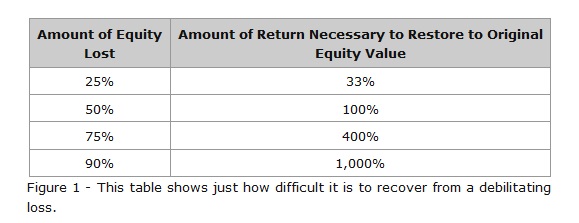
Like dieting and working out, money management is something that most traders pay lip service to, but few practice in real life. The reason is simple: just like eating healthy and staying fit, money management can seem like a burdensome, unpleasant activity. It forces traders to constantly monitor their positions and to take necessary losses, and few people like to do that. However, as Figure 1 proves, loss-taking is crucial to long-term trading success.
Amount of Equity LostAmount of Return Necessary to Restore to Original Equity Value 25% 33% 50% 100% 75% 400% 90% 1,000% Figure 1 - This table shows just how difficult it is to recover from a debilitating loss.
see Figure 1
Note that a trader would have to earn 100% on his or her capital - a feat accomplished by less than 1% of traders worldwide - just to break even on an account with a 50% loss. At 75% drawdown, the trader must quadruple his or her account just to bring it back to its original equity - truly a Herculean task!
The Big One Although most traders are familiar with the figures above, they are inevitably ignored. Trading books are littered with stories of traders losing one, two, even five years' worth of profits in a single trade gone terribly wrong. Typically, the runaway loss is a result of sloppy money management, with no hard stops and lots of average downs into the longs and average ups into the shorts. Above all, the runaway loss is due simply to a loss of discipline.
Most traders begin their trading career, whether consciously or subconsciously, visualizing "The Big One" - the one trade that will make them millions and allow them to retire young and live carefree for the rest of their lives. In forex, this fantasy is further reinforced by the folklore of the markets. Who can forget the time that George Soros "broke the Bank of England" by shorting the pound and walked away with a cool $1-billion profit in a single day? But the cold hard truth for most retail traders is that, instead of experiencing the "Big Win", most traders fall victim to just one "Big Loss" that can knock them out of the game forever.
Learning Tough Lessons Traders can avoid this fate by controlling their risks through stop losses. In Jack Schwager's famous book "Market Wizards" (1989), day trader and trend follower Larry Hite offers this practical advice: "Never risk more than 1% of total equity on any trade. By only risking 1%, I am indifferent to any individual trade." This is a very good approach. A trader can be wrong 20 times in a row and still have 80% of his or her equity left.
The reality is that very few traders have the discipline to practice this method consistently. Not unlike a child who learns not to touch a hot stove only after being burned once or twice, most traders can only absorb the lessons of risk discipline through the harsh experience of monetary loss. This is the most important reason why traders should use only their speculative capital when first entering the forex market. When novices ask how much money they should begin trading with, one seasoned trader says: "Choose a number that will not materially impact your life if you were to lose it completely. Now subdivide that number by five because your first few attempts at trading will most likely end up in blow out." This too is very sage advice, and it is well worth following for anyone considering trading forex.
Money Management Styles Generally speaking, there are two ways to practice successful money management. A trader can take many frequent small stops and try to harvest profits from the few large winning trades, or a trader can choose to go for many small squirrel-like gains and take infrequent but large stops in the hope the many small profits will outweigh the few large losses. The first method generates many minor instances of psychological pain, but it produces a few major moments of ecstasy. On the other hand, the second strategy offers many minor instances of joy, but at the expense of experiencing a few very nasty psychological hits. With this wide-stop approach, it is not unusual to lose a week or even a month's worth of profits in one or two trades. (For further reading, see Introduction To Types Of Trading: Swing Trades.)
To a large extent, the method you choose depends on your personality; it is part of the process of discovery for each trader. One of the great benefits of the forex market is that it can accommodate both styles equally, without any additional cost to the retail trader. Since forex is a spread-based market, the cost of each transaction is the same, regardless of the size of any given trader's position.
For example, in EUR/USD, most traders would encounter a 3 pip spread equal to the cost of 3/100th of 1% of the underlying position. This cost will be uniform, in percentage terms, whether the trader wants to deal in 100-unit lots or one million-unit lots of the currency. For example, if the trader wanted to use 10,000-unit lots, the spread would amount to $3, but for the same trade using only 100-unit lots, the spread would be a mere $0.03. Contrast that with the stock market where, for example, a commission on 100 shares or 1,000 shares of a $20 stock may be fixed at $40, making the effective cost of transaction 2% in the case of 100 shares, but only 0.2% in the case of 1,000 shares. This type of variability makes it very hard for smaller traders in the equity market to scale into positions, as commissions heavily skew costs against them. However, forex traders have the benefit of uniform pricing and can practice any style of money management they choose without concern about variable transaction costs.
Four Types of Stops Once you are ready to trade with a serious approach to money management and the proper amount of capital is allocated to your account, there are four types of stops you may consider.
1.Equity Stop - This is the simplest of all stops. The trader risks only a predetermined amount of his or her account on a single trade. A common metric is to risk 2% of the account on any given trade. On a hypothetical $10,000 trading account, a trader could risk $200, or about 200 points, on one mini lot (10,000 units) of EUR/USD, or only 20 points on a standard 100,000-unit lot. Aggressive traders may consider using 5% equity stops, but note that this amount is generally considered to be the upper limit of prudent money management because 10 consecutive wrong trades would draw down the account by 50%.
One strong criticism of the equity stop is that it places an arbitrary exit point on a trader's position. The trade is liquidated not as a result of a logical response to the price action of the marketplace, but rather to satisfy the trader's internal risk controls.
2.Chart Stop - Technical analysis can generate thousands of possible stops, driven by the price action of the charts or by various technical indicator signals. Technically oriented traders like to combine these exit points with standard equity stop rules to formulate charts stops. A classic example of a chart stop is the swing high/low point. In Figure 2 a trader with our hypothetical $10,000 account using the chart stop could sell one mini lot risking 150 points, or about 1.5% of the account.
http://i.investopedia.com/inv/articl...neyMgmt_1r.jpg
Figure 2
3.Volatility Stop - A more sophisticated version of the chart stop uses volatility instead of price action to set risk parameters. The idea is that in a high volatility environment, when prices traverse wide ranges, the trader needs to adapt to the present conditions and allow the position more room for risk to avoid being stopped out by intra-market noise. The opposite holds true for a low volatility environment, in which risk parameters would need to be compressed.
One easy way to measure volatility is through the use of Bollinger Bands, which employ standard deviation to measure variance in price. Figures 3 and 4 show a high volatility and a low volatility stop with Bollinger Bands. In Figure 3 the volatility stop also allows the trader to use a scale-in approach to achieve a better "blended" price and a faster break even point. Note that the total risk exposure of the position should not exceed 2% of the account; therefore, it is critical that the trader use smaller lots to properly size his or her cumulative risk in the trade.
4.Margin Stop - This is perhaps the most unorthodox of all money management strategies, but it can be an effective method in forex, if used judiciously. Unlike exchange-based markets, forex markets operate 24 hours a day. Therefore, forex dealers can liquidate their customer positions almost as soon as they trigger a margin call. For this reason, forex customers are rarely in danger of generating a negative balance in their account, since computers automatically close out all positions.
This money management strategy requires the trader to subdivide his or her capital into 10 equal parts. In our original $10,000 example, the trader would open the account with an forex dealer but only wire $1,000 instead of $10,000, leaving the other $9,000 in his or her bank account. Most forex dealers offer 100:1 leverage, so a $1,000 deposit would allow the trader to control one standard 100,000-unit lot. However, even a 1 point move against the trader would trigger a margin call (since $1,000 is the minimum that the dealer requires). So, depending on the trader's risk tolerance, he or she may choose to trade a 50,000-unit lot position, which allows him or her room for almost 100 points (on a 50,000 lot the dealer requires $500 margin, so $1,000 – 100-point loss* 50,000 lot = $500). Regardless of how much leverage the trader assumed, this controlled parsing of his or her speculative capital would prevent the trader from blowing up his or her account in just one trade and would allow him or her to take many swings at a potentially profitable set-up without the worry or care of setting manual stops. For those traders who like to practice the "have a bunch, bet a bunch" style, this approach may be quite interesting.
Conclusion As you can see, money management in forex is as flexible and as varied as the market itself. The only universal rule is that all traders in this market must practice some form of it in order to succeed.
"Hierbei sei es noch zu erwähnen, dass wir generell pro Trade maximal nur 1-3% unser Bankroll riskieren sollten! Bitte hier absolut konsequent bleiben, auch wenn es sehr schwer fällt, denkt an Eure langfristigen Gewinne!"
Leider lesen Sie solche Sätze in nahezu allen Forexbüchern. Das ist meines erachtens auch der Grund dafür, wieso 90% aller Trader verlieren.
Die meisten Forexstrategien sind geradezu nicht auf Marktverhältnisse mit 1-3% Risiko ausgerichtet!
We believe it is time to open a new Topic dedicated to Money Management.
Here we'll be posting trading systems and methods that help to control losses, evaluate and limit risks, improve win : loss ratio, in other words, everything related to money management in Forex.
We hope that this subject will create a new interest to money management in currency trading, and eventually help you improve a winning ratio of your favorite trading system.
Forex Trading Money Management – An EYE OPENING Article
http://cdn1.ltttmstatic.com/wp-conte...ads/index1.jpg
An Eye-Opening Article on Forex Trading Money Management
IMPORTANT NOTE: This article will create some disagreements and debates around the trading community. I would like to remind all of you that this article on money management is based on my own trading experiences. It was written to expose some truths and some myths surrounding the topic of managing capital. It is intended to share my perspective. If you want to disagree , be rude, or argue about this article by writing long comments and emails, I won’t be responding or entering a discussion. I repeat, this article is written from my own experiences and is how I trade and is how many pro’s trade, what you are taught about money management is usually ‘lies’ invented by the industry to help you lose your money “slower” so that brokers can make commission / spreads from you. Most information on money management is complete lies and will not work in the real world, trust me.. everything I talk about on this website is based on real world application, not theory.
I will warn you that what you are about to read is likely to be contradictory to what you may have read or heard about forex money management and risk control. I can only tell you that what am I about to divulge to you is the way I trade, it is the way many professional forex traders manage capital. So get ready, open your mind, and enjoy this article on how to effectively grow your trading account by effectively managing your money. If your using the 2% rule, this may put that method into question, which is the point… to make you think about it from all angles and perspectives.
Everyone knows that money management is a crucial aspect of successful forex trading. Yet most people don’t spend nearly enough time concentrating on developing or implementing a money management plan. The paradox of this is that until you develop your money management skills and consistently utilize them on every single trade you execute, you will never be a consistently profitable trader.
I want to give you a professional perspective on money management and dispel some common myths floating around the trading world regarding the concept of money management. We hear many different ideas about risk control and profit taking from various sources, much of this information is conflicting and so it is not surprising that many traders get confused and just give up on implementing an effective forex money management plan, which of course ultimately leads to their demise. I have been successfully trading the financial markets for nearly a decade and I have mastered the skill of risk reward and how to effectively utilize it to grow small sums of money into larger sums of money relatively quickly.
Money Management Myths: Myth 1: Traders should focus on pips.
You may have heard that you should concentrate on pips gained or lost instead of dollars gained or lost. The rationale behind this money management myth is that if you concentrate on pips instead of dollar you will somehow not become emotional about your trading because you will not be thinking about your trading account in monetary terms but rather as game of points. If this doesn’t sound ridiculous to you, it should. The whole point of trading and investing is to make money and you need to be consciously aware of how much money you have at risk on each and every trade so that the reality of the situation is effectively conveyed. Do you think business owners treat their quarterly profit and loss statements as a game of points that is somehow detached from the reality of making or losing real money? Of course not, when you think about it these terms it seems silly to treat your trading activities like a game. Trading should be treated as a business, because that’s what it is, if you want to be consistently profitable you need to treat each trade as a business transaction. Just as any business transaction has the possibility of risk and of reward, so does every trade you execute. The bottom line is that thinking about your trades in terms of pips and not dollars will effectively make trading seem less real and thus open the door for you treat it less seriously than you otherwise would.
From a Mathematical standpoint, thinking of trading in terms of “how many pips you lose or gain” is completely irrelevant. The problem is that each trader will trade a different position size, thus, we must define risk in terms of “Ddollars at risk or dollars gained”. Just because you risk a large amount of pips, does not mean you are risking a large amount of your capital, such is the case that if you have a tight stop this does not mean your risking a small amount of capital.
Myth 2: Risking 1% or 2% on every trade is a good way to grow your account This is one of the more common money management myths that you are likely to have heard. While it sounds good in theory, the reality is that the majority if retail forex traders are starting with a trading account that has $5,000 in it or less. So to believe that you will grow your account effectively and relatively quickly by risking 1% or 2% per trade is just silly. Say you lose 5 trades in a row, if you were risking 2% your account is now down to $4,519.60, now you are still risking 2% per trade, but that same 2% is now a smaller position size than it was when your account was at $5,000.
Thus, in the % risk model, as you lose trades you automatically reduce your position size. Which is not always the best course of action. There’s psychological evidence that suggests it’s human nature to become more risk averse after a series of losing trades and less risk averse after a series of winning trades, but that doesn’t mean the risk of any one trade becomes more or less simply because you lost or won on your previous trade. As we can see in my article on randomly distributed trading results, your previous trade’s results don’t mean anything for the outcome of your next trade.
What ends up happening when traders use the % risk model is that they start off good, they risk 1 or 2% on their first few trades, and maybe they even win them all. But once they begin to hit a string of losers, they realize that all of their gains have been wiped out and it is going to take them quite a long time just to make back the money they have lost. They then proceed to OVER-TRADE and take less than quality setups because they now realize how long it will take them just to get back to break even if they only risk 1% to 2% per trade.
So, while this method of money management will allow you to risk small amounts on each trade, and therefore theoretically limit your emotional trading mistakes, most people simply do not have the patience to risk 1 or 2% per trade on their relatively small trading accounts, it will eventually lead to over-trading which is about the worst thing you can do for your bottom line.It is also a difficult task to recover from a drawn down period. Remember, once you drawn down, using a 2 % per trade method, your risk each trade will be smaller, there fore, your rate of recovery on profits is slower and hinders the traders effort. The Most important fact is this.. if you start with $10,000 , and drawn down to $5,000, using a fixed % method, it will take you “much longer” to recover because you started out risking 2% per trade which was $200, but at the $5,000 draw-down level, your only risking $100 per trade, so even if you have a good winning streak, your capital is recovering at “half the rate” it would using “fixed $ per trade risk.
Myth 3: Wider stops risk more money than smaller stops
Many traders erroneously believe that if they put a wider stop loss on their trade they will necessarily increase their risk. Similarly, many traders believe that by using a smaller stop loss they will necessarily decrease the risk on the trade. Traders that are holding these false beliefs are doing so because they do not understand the concept of Forex position sizing.
Position sizing is the concept of adjusting your position size or the number of lots you are trading, to meet your desired stop loss placement and risk size. For example, say you risk $200 per trade, with a 100 pip stop loss you would trade 2 mini-lots: $2 per pip x 100 pips = $200.
Now let’s you want to trade a pin bar forex strategy but the tail is exceptionally long but you would still like to place your stop above the high of the tail even though it will mean you have a 200 pip stop loss. You can still risk the same $200 on this trade, you just need to adjust your position size down to meet this wider stop loss, and you would adjust the position down to 1 mini-lot rather than 2. This means you can risk the same amount on every trade simply by adjusting your position size up or down to meet your desired stop loss width.
Let’s now look at an example of what can happen if you don’t practice position sizing effectively by failing to decrease the number of lots you are trading while increasing stop loss distance.
Example: Two traders risk the same amount of lots on the same trade setup. Forex Trader A risks 5 lots and has a stop loss of 50 pips, Trader B also risks 5 lots but has a stop loss of 200 pips because he or she believes there is an almost 100% chance that the trade will not go against him or her by 200 pips. The fault with this logic is that typically if a trade begins to go against you with increasing momentum, there theoretically is no limit to when it may stop. And we all know how strong the trends can be in the forex market. Trader A has gotten stopped out with his or her pre-determined risk amount of 5 lots x 50 pips which is a loss of $250. Trader B also got stopped out but his or her loss was much larger because they erroneously hoped that the trade would turn around before moving 200 pips against them. Trader B thus losses 5 lots x 200 pips, but their loss is now a whopping $1,000 instead of the $250 it could have been.
We can see from this example why the belief that just widening your stop loss on a trade is not an effective way to increase your trading account value, in fact it is just the opposite; a good way to quickly decrease your trading account value. The fundamental problem that afflicts traders who harbor this believe is a lack of understanding of the power of risk to reward and position sizing.
The Power of Risk to Reward
Professional traders like me and many others concentrate on risk to reward ratios, and not so much on over analyzing the markets or having unrealistically wide profit targets. This is because professional traders understand that trading is a game of probabilities and capital management. It begins with having a definable market edge, or a trading method that is proven to be at least slightly better than random at determining market direction. This edge for me has been price action analysis. The price action trading strategies that I teach and use can have an accuracy rate of upwards of 70-80% if they are used wisely and at the appropriate times.
The power of risk to reward comes in with its ability to effectively and consistently build trading accounts. We all hear the old axioms like “let your profits run” and “cut your losses early”, while these are well and fine, they don’t really provide any useful information for new traders to implement. The bottom line is that if you are trading with anything less than about $25,000, you are going to have to take profits at pre-determined intervals if you want to keep your sanity and your trading account growing. Entering trades with open profit targets typically doesn’t work for smaller traders because they end up never taking the profits until the market comes swinging back against them dramatically. (I think this is very important, go back an re read that last sentence)
If you know your strike rate is between 40-50% than you can consistently make money in the market by implementing simple risk to reward ratios. By learning to use well-defined price action setups to enter your trades you should able to win a higher percentage of your trades, assuming you TAKE profits.
Let’s Compare 2 Examples – One Trader Using the 2 % Rule, and one Trader using Fixed $ Amount. Example 1 – -you have a risk to reward ratio of 1:3 on every trade you take. This means you will make 3 times your risk on every trade that hits your target, if you win on only 50% of your trades, you will still make money:
Let’s say your trading account value is $5,000 and you risk $200 per trade.
You lose your 1st trade = $5,000-$200 = $4,800,
You lose your 2nd trade = $4,800-$200 = $4,600,
You win your 3rd trade = $4,600+$600 = $5,200
You win your 4th trade = $5,200+$600 = $5,800
From this example we can see that even losing 2 out of every 4 trades you can still make very decent profits by effectively utilizing the power of risk to reward ratios. For comparison purposes, let’s look at this same example using the 2% per trade risk model:
Example 2 - Once again, your trading account value is $5,000 but you are now risking 4% per trade (so that both examples start out with a risk of $200 per trade) : Remember, you have a risk to reward ratio of 1:3 on every trade you take. This means you will make 3 times your risk on every trade that hits your target, if you win on only 50% of your trades, you will still make money:
You lose your 1st trade = $5,000 – $200 = $4800
You lose your 2nd trade = $4800 – $192 = $4608
You win your 3rd trade = $4608 + $552 = $5160
You win your 4th trade = $5160 + $619 = $5780
Now we can see why risking 4% (or 2% etc) of your account on each trade is not as efficient as the trader using the fixed $ amount. Important to note that after 4 trades, risking the same dollar amount per trade and effectively utilizing a risk to reward ratio of 1:3, using fixed $ risk per trade, the first traders account is now up by $800 versus $780 on the %4 risk account.
Now, If the trader using % risk rule had a draw down period and lost 50% of their account, they effectively have to make back 100% of their capital to be back at break even, now, this may also be so for the trader using the fixed $ risk method, but which trader do you think has the best chance of recovering? Seriously, it could take a very long time to recover from a drawn down using the % risk method. Sure, some will argue that you can drawn down heavier and its more risky to use the fixed $ method, but we are talking about real world trading here, I need to use a method that gives me a chance to recover from losses, not just protect me from losses. With a good trading method and experience, you can use the fixed $ method, which is why I wanted to open your eyes to it.
In Summary
The power of the money management techniques discussed in this article lies in their ability to consistently and efficiently grow your trading account. There are some underlying assumptions with these recommendations however, mainly that you are trading with money you have no other need for, meaning your life will not be directly impacted if you do lose it all. You also must keep in mind that the whole idea of risk to reward strategies revolves around having an effective edge in the market and knowing when that edge is present and how to use it, you can learn this from my price action forex trading course.
While I do not recommend traders use a set risk percentage per trade, I do recommend you risk an amount you are comfortable with; if your risk is keeping you up at night than it is probably too much. If you have $10,000 you may risk something like $200 or $300 per trade.. as a set amount, or whatever your are comfortable with, it may be a lot less, but it will be constant. Also remember, Professional traders have learned to judge their setups based on the quality of the setup, otherwise known as discretion. This comes through screen time and practice, as such; you should develop your skills on a demo account before switching to real money. The money management strategy discussed in this article provides a realistic way to effectively grow your account without evoking the feeling of needing to over-trade which so often happens to traders who practice the % risk method of forex money management. Learn to use my price action strategies with the power of risk to reward ratios and your trading results will begin to turn around.
Nial Fuller is considered a leading ‘Authority’ on Price Action Forex trading strategies. If you want to learn more about harnessing the power and simplicity of Price Action Trading Strategies please visit Nial Fuller’s Forex Trading Course & Traders Community Page Here. Nial’s Students get lifetime access to all of his advanced price action Forex Courses, video lessons, webinar tutorials, daily trade setups newsletter, live trade setups discussion forum, traders support line & free ongoing course updates. For more information visit the Forex Course page here.
This definitely falls in line with what I have been observing lately. After trading %based MM for a while, I recently decided to go with fixed amount (due to transition into futures trading) and find it a lot better. It also saves the hassle of having to recalculate every time!
Gaps are empty spaces between the close of one candle and the open of the next. In Forex gaps are not very common and they usually only occur at market open on Sundays. These gaps occur between a pairs close price on Friday and it’s open price on Sunday.
Forex Gap Strategy — is an interesting trading system that utilizes one of the most disturbing phenomena of the Forex market — a weekly gap between the last Friday's close price and the current Monday's open price. The gap itself takes its origin in the fact that the interbank currency market continues to react on the fundamental news during the weekend, opening on Monday at the level with the most liquidity. The offered strategy is based on the assumption that the gap is a result of speculations and the excess volatility, thus a position in the opposite direction should probably become profitable after a few days.
Features
Regular trading with clear rules.
No stop-loss hunting or premature hits.
Statistically proven profit.
You have to open position at the week's beginning and close it right before the end.
How to Trade?
Select a currency pair with a relatively high level of volatility. I recommend GBP/JPY as it showed the best results during my tests. But other JPY-based pairs should work too. By the way, it's a good strategy to use on all major currency pairs at the same time.
When a new week starts look if there is a gap. A gap should be at least 5 times the average spread for the pair. Otherwise it can't be considered a real signal.
If Monday's (or late Sunday's if you trade from North or South America) open is below the Friday's (or early Saturday if you trade from Oceania or Eastern Asia) close the gap is negative and you should open a Long position.
If Monday's open is above the Friday's close the gap is positive and you should open a Short position.
Don't set a stop-loss or a take-profit level (it's a rare occasion but stop-loss isn't recommended in this strategy).
Right before the end of the weekly trading session (e.g., 5 minutes before the end) you need to close the position.
You can see GBP/JPY pair's last 7 weeks (as of May 24, 2010) and all of them have gaps. 6 out of 7 gaps give correct signals that result in a lot of profit. The last gap gives a wrong signal and yields a medium loss. The average spread for GBP/JPY was 3 pips during the example period and all gaps were much wider than 15 pips, making them all qualifying signals. The net total profit was 1,612 pips in 7 weeks — not that bad.
Warning!
Use this strategy at your own risk. EarnForex.com can't be responsible for any losses associated with using any strategy presented on the site. It's not recommended to use this strategy on the real account without testing it on demo first.
Die Forex-GAP Strategie basiert auf dem Handel von Kurssprüngen zwischen dem Schlusskurs
von Freitag Abend und dem Eröffnungskurs am Montag Morgen. Die Ursache eines GAPs ist,
dass der Interbankenmarkt während dem Wochenende auf Nachrichten oder fundamentale
Daten reagiert und diese dann am Montag morgen mit großer Liquidität gehandelt werden.
Dabei basiert diese Strategie auf der Annahme, dass diese Gaps das Ergebnis von Spekulation
und der übermäßigen Volatilität im Markt sind und sich der Kurs in den kommenden Stunden
oder Tagen wieder in die entgegen dem GAP gesetzte Richtung entwickelt.
Vorteile dieser Strategie
- diese Strategie kann im regulären Handel angewendet werden
- die Regeln sind klar definiert
- statistisch gesehen bietet diese Strategie in nomalen Marktphasen (keine Krisen)
ein gutes Profitpotential
Nachteile dieser Strategie
- die Positionen müssen am Anfang der Woche eröffnet und am Ende der Woche
geschlossen werden
Anwendung der Strategie
1. Wählen Sie ein Währungspaar mit hoher Volatilität aus. Empfehlenswert ist hier beispielsweise
GBP/JPY, aber auch alle anderen JPY basierten Währungspaare
sind für den Handel mit dieser Strategie geeignet. Zudem ist die Forex-GAP Strategie auf alle
Haupt-Währungspaare gleichzeitig anwendbar.
2. Schauen Sie zum Anfang der neuen Woche nach GAPs. Dabei sollte das GAP mindestens
das 5-Fache des Spreads des Währungspaares betragen, damit es als echtes Signal
gewertet werden kann.
3. Wenn das GAP zur Eröffnung am Montag unter dem Schlusskurs von Freitag liegt, handelt es
sich um ein negatives GAP. Dies bedeutet, Sie sollten eine Long Position eröffnen.
4. Wenn das GAP zur Eröffnung am Montag über dem Schlusskurs von Freitag liegt, handelt es
sich um ein positives GAP. Dies bedeutet, Sie sollten eine Short Position eröffnen.
5. Setzen Sie keine Stop-Loss oder Take-Profit Order (Dies ist eine der wenigen Strategien,
bei denen das setzen von Stop-Loss Aufträgen nicht empfohlen wird).
6. Wenn die Handelswoche zu Ende geht (beispielsweise 5 Min. vor Handelsschluss),
schließen Sie die Position.
Im Beispiel sieht man den Kurs des GBP/JPY im Zeitraum von 7 Wochen. Jeden Montag enstanden
bei der Eröffnung GAPs. In diesem Beispiel gaben 6 von 7 Signalen korrekt,
welche bis Ende der Handelswoche teils weit im Profit hätten geschlossen werden können.
Das letzte GAP generierte ein falsches Signal, woraus ein mittelgroßer Verlust entstanden wäre.
Der durchschnittliche Spread im GBP/JPY betrug während dem Testzeitraum 5 Pips. Da alle GAPs
größer als 25 Pips waren (Spread x 5), konnten alle Signale als gültig gewertet werden.
Der Profit über den Testzeitraum von 7 Wochen, beträgt im Beispiel 1527 Pips, was sicherlich
nicht allzu schlecht ist.
Warnung:
Die Verwendung der Forex Strategien erfolgt auf eigene Gefahr. Broker-Bewertungen.de stellt seinen
Besuchern diese kostenlos zur Verfügung und ist nicht für eventuelle Verluste, die durch die Nutzung
der Forex Strategien entstehen verantwortlich. Bitte testen Sie alle Strategien vorher ausführlich auf
Demokonten, bevor Sie diese auf einem Echtgeld-Konto anwenden.
Gaps are areas on a chart where the price of a stock (or another financial instrument) moves sharply up or down, with little or no trading in between. As a result, the asset's chart shows a "gap" in the normal price pattern. The enterprising trader can interpret and exploit these gaps for profit. This article will help you understand how and why gaps occur, and how you can use them to make profitable trades.
Gap Basics Gaps occur because of underlying fundamental or technical factors. For example, if a company's earnings are much higher than expected, the company's stock may gap up the next day. This means that the stock price opened higher than it closed the day before, thereby leaving a gap. In the forex market, it is not uncommon for a report to generate so much buzz that it widens the bid and ask spread to a point where a significant gap can be seen. Similarly, a stock breaking a new high in the current session may open higher in the next session, thus gapping up for technical reasons.
Gaps can be classified into four groups:
Breakaway gapsare those that occur at the end of a price pattern and signal the beginning of a new trend.
Exhaustion gapsoccur near the end of a price pattern and signal a final attempt to hit new highs or lows.
Common gapsare those that cannot be placed in a price pattern - they simply represent an area where the price has "gapped."
Continuation gaps occur in the middle of a price pattern and signal a rush of buyers or sellers who share a common belief in the underlying stock's future direction.
To Fill or Not to Fill When someone says that a gap has been "filled," that means that the price has moved back to the original pre-gap level. These fills are quite common and occur because of the following:
Irrational Exuberance: The initial spike may have been overly optimistic or pessimistic, therefore inviting a correction.
Technical Resistance: When a price moves up or down sharply, it doesn't leave behind any support or resistance.
Price Pattern: Price patterns are used to classify gaps, and can tell you if a gap will be filled or not. Exhaustion gaps are typically the most likely to be filled because they signal the end of a price trend, while continuation and breakaway gaps are significantly less likely to be filled, since they are used to confirm the direction of the current trend.
When gaps are filled within the same trading day on which they occur, this is referred to as fading. For example, let's say a company announces great earnings per share for this quarter, and it gaps up at open (meaning it opened significantly higher than its previous close). Now let's say that, as the day progresses, people realize that the cash flow statement shows some weaknesses, so they start selling. Eventually, the price hits yesterday's close, and the gap is filled. Many day traders use this strategy during earnings season or at other times when irrational exuberance is at a high.
How to Play the Gaps There are many ways to take advantage of these gaps, with a few more popular strategies. Some traders will buy when fundamental or technical factors favor a gap on the next trading day. For example, they'll buy a stock after-hours when a positive earnings report is released, hoping for a gap up on the following trading day. Traders might also buy or sell into highly liquid or illiquid positions at the beginning of a price movement, hoping for a good fill and a continued trend. For example, they may buy a currency when it is gapping up very quickly on low liquidity and there is no significant resistance overhead.
Some traders will fade gaps in the opposite direction once a high or low point has been determined (often through other forms of technical analysis). For example, if a stock gaps up on some speculative report, experienced traders may fade the gap by shorting the stock. Lastly, traders might buy when the price level reaches the prior support after the gap has been filled. An example of this strategy is outlined below.
Here are the key things you will want to remember when trading gaps:
Once a stock has started to fill the gap, it will rarely stop, because there is often no immediate support or resistance.
Exhaustion gaps and continuation gaps predict the price moving in two different directions - be sure that you correctly classify the gap you are going to play.
Retail investors are the ones who usually exhibit irrational exuberance; however, institutional investors may play along to help their portfolios - so be careful when using this indicator, and make sure to wait for the price to start to break before taking a position.
Be sure to watch the volume. High volume should be present in breakaway gaps, while low volume should occur in exhaustion gaps.
Example To tie these ideas together, let's look at a basic gap trading system developed for the forex market. This system uses gaps in order to predict retracements to a prior price. Here are the rules:
1. The trade must always be in the overall direction of the price (check hourly charts).
2. The currency must gap significantly above or below a key resistance level on the 30-minute charts.
3. The price must retrace to the original resistance level. This will indicate that the gap has been filled, and the price has returned to prior resistance turned support.
4. There must be a candle signifying a continuation of the price in the direction of the gap. This will help ensure that the support will remain intact.
Note that because the forex market is a 24-hour market (it is open 24 hours a day from 5pm EST on Sunday until 4pm EST Friday), gaps in the forex market appear on a chart as large candles. These large candles often occur because of the release of a report that causes sharp price movements with little to no liquidity. In the forex market, the only visible gaps that occur on a chart happen when the market opens after the weekend.
Let's look at an example of this system in action:
Figure 1 - The large candlestick identified by the left arrow on this GBP/USD chart is an example of a gap found in the forex market. This does not look like a regular gap, but the lack of liquidity between the prices makes it so. Notice how these levels act as strong levels of support and resistance.
We can see in Figure 1 that the price gapped up above some consolidation resistance, retraced and filled the gap, and finally, resumed its way up before heading back down. We can see that there is little support below the gap, until the prior support (where we buy). A trader could also short the currency on the way down to this point, if he or she were able to identify a top.
The Bottom Line Those who study the underlying factors behind a gap and correctly identify its type, can often trade with a high probability of success. However, there is always a risk that a trade can go bad. You can avoid this, firstly, by watching the real-time electronic communication network (ECN) and volume. This will give you an idea of where different open trades stand. If you see high-volume resistance preventing a gap from being filled, then double check the premise of your trade and consider not trading it if you are not completely certain that it is correct.
Second, be sure that the rally is over. Irrational exuberance is not necessarily immediately corrected by the market. Sometimes stocks can rise for years at extremely high valuations and trade high on rumors, without a correction. Be sure to wait for declining and negative volume before taking a position.Lastly, always be sure to use a stop-loss when trading. It is best to place the stop-loss point below key support levels, or at a set percentage, such as -8%.
Remember, gaps are risky (due to low liquidity and high volatility), but if properly traded, they offer opportunities for quick profits.