



Hi TEB's
I've been studying your simple system with the 4H and trend lines combined with trading the 15/30/1H within those trends. Here's some data on GBPJPY you may find useful.
On a short,
I defined the start of the trend line where the 4H crossed the 80 down....if the down trend started before them I started the trend lines there. You'll find much of the time this is the start of the trend anyways. If price broke the trendline and the 4H stock was headed up above 20 I classified that as the trend ended.
I then started trading in the direction of the 4H on the 15M, 30M and 1H independently.
Trades were entered each time the stochastic crossed the 80 down, 61.8 down and 50 down.
There were 2x as many 30 min trades as hourly and 2x as many 15M trades as 30 mins. Funny how that worked out so nicely.
There is a noticeable breakdown prior to the trend reversing...more on this further below.
Here are the percentages I measured for combined TF trades:
from 80 to 20 94% success 6% failure 50% of trades
from 61.8 to 25 91% success 7% failure 86% of trades
from 50 to 25 92% success 8% failure 100% of trades
25 seemed to be the better level for trades starting from 61.8 and 50...about a 5% difference in increased failures moving the target to 20.
Failure only means the stochastic did not fall to the level on a trade, it does not mean pips lost. Successes does not always mean a pip gain. However, for the most part pips losses were small and would have little impact over net gain.
Now, noticing a price break in trend and the 4H stochastic above 20 moving up would help catch a trend break. More identifying were tags in the stoch movement of trade failures. These failures would see a trade from the 80 to 20 or 62 to 25 make little movement. For example most failures happen when the stoch moved from 62 to 50 and then reversed to initiate another down trade or simply went back to 80. A move from 80 to 20 seeing a reversal around 40 back to 80 was also a break signal.
In other words failures increased across the time frames as/prior to the trend breaking down. Otherwise, the successes were very high while the trend was in place with just very "close" failures (failures that almost reached target) appearing rarely. If you do some observations towards the end of trends you will see this quite easily.
To sum up all that.....
Enter the trade with the 4H trend on a short at 80, 61.8 and ride it to the stoch hits 25-20. When you start having failures, it is a warning sign to stop trading that trend. That will get you better than 90% success and a good net of pips.
Might call this one Pip Fishing! Throw out the net and take in the pips.
I've been studying your simple system with the 4H and trend lines combined with trading the 15/30/1H within those trends. Here's some data on GBPJPY you may find useful.
On a short,
I defined the start of the trend line where the 4H crossed the 80 down....if the down trend started before them I started the trend lines there. You'll find much of the time this is the start of the trend anyways. If price broke the trendline and the 4H stock was headed up above 20 I classified that as the trend ended.
I then started trading in the direction of the 4H on the 15M, 30M and 1H independently.
Trades were entered each time the stochastic crossed the 80 down, 61.8 down and 50 down.
There were 2x as many 30 min trades as hourly and 2x as many 15M trades as 30 mins. Funny how that worked out so nicely.
There is a noticeable breakdown prior to the trend reversing...more on this further below.
Here are the percentages I measured for combined TF trades:
from 80 to 20 94% success 6% failure 50% of trades
from 61.8 to 25 91% success 7% failure 86% of trades
from 50 to 25 92% success 8% failure 100% of trades
25 seemed to be the better level for trades starting from 61.8 and 50...about a 5% difference in increased failures moving the target to 20.
Failure only means the stochastic did not fall to the level on a trade, it does not mean pips lost. Successes does not always mean a pip gain. However, for the most part pips losses were small and would have little impact over net gain.
Now, noticing a price break in trend and the 4H stochastic above 20 moving up would help catch a trend break. More identifying were tags in the stoch movement of trade failures. These failures would see a trade from the 80 to 20 or 62 to 25 make little movement. For example most failures happen when the stoch moved from 62 to 50 and then reversed to initiate another down trade or simply went back to 80. A move from 80 to 20 seeing a reversal around 40 back to 80 was also a break signal.
In other words failures increased across the time frames as/prior to the trend breaking down. Otherwise, the successes were very high while the trend was in place with just very "close" failures (failures that almost reached target) appearing rarely. If you do some observations towards the end of trends you will see this quite easily.
To sum up all that.....
Enter the trade with the 4H trend on a short at 80, 61.8 and ride it to the stoch hits 25-20. When you start having failures, it is a warning sign to stop trading that trend. That will get you better than 90% success and a good net of pips.
Might call this one Pip Fishing! Throw out the net and take in the pips.

 ) and I seem not to know how you filtered this as a false signal.
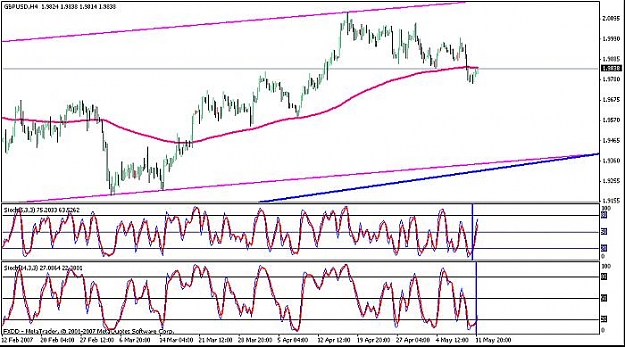


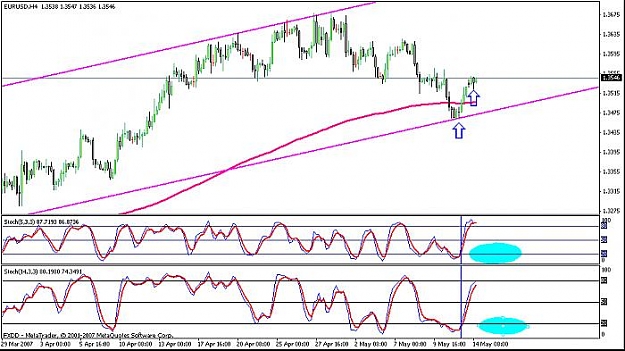

 What are you watching right now and could you give us a heads up when you see someting happening today ,perhaps with some explanation of why your doing what you are.