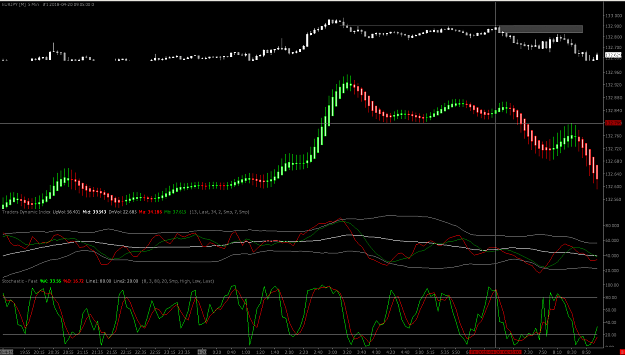


Hello everybody. I'm a long time lurker at this thread (5 years) . I'm not using the method my self so I'm not an expert. I see a lot of discussions about if the original OP's (RIP BigE) method if it is profitable or if newbies should start with this method. My impression is that it's profitable for a few (I only know Tekkies that use the original method). But others have to do modifications (for example mehdi: https://www.forexfactory.com/showthread.php?t=588548) to get profitable. I think the method works well when the price is trending and not so good when the price is ranging. So I will show how you can use the original method in an trending environment with an small modification (hope somebody have time to test it  ).
).
BigE used a set of rules for entry:
Your safest trades will always be when green crosses red and you enter on candle 1 or 2... odds are in your favor. Why? Because I'm expecting 3-8 candles... which is average...
With bounce trades the odds are lower for your success... but it still works.
When wanting to enter a TDI trade... take a moment first to observe basic 4x things... like:
How close am I to the previous high or lo
Am I in an uptrend or downtrend.. short & long term...
Am I in or close to a consolidation area
Are the previous candles small...
Look at the candles on the last reversal... big, little, what
How does the momentum look right now (12-2, 4-6)
..and rules for exit:
Looking at your TDI... if you see:
1. TDI go flat
2. TDI start to hook over
3. TDI do a check mark reversal
If we use the method only when price is trending we doesn't need to care about if the candle is small (small pause in the trend), entry at candle 1 or 2 rule, angle of the TDI crossing (momentum is not so important when we expect the price to continue the trend), and support&resistance (in an trend we expect the price to break it). We doesn't need to care about the exit rules by the TDI either. They are good for scalping when you need to get out fast but when the price is trending we accept pullbacks in the trend without exit the trade.
How do we know if the price is trading. I will describe two methods:
1. You have an uptrend if price have HH and HL, and you have a downtrend if the price have HL and LL.
2. Use a long term moving average. Uptrend if moving average goes up and downtrend if the moving average going down. Consolidation if moving average
is close to flat(no trading). I think moving average is best for newbie. You can for example use 50 MA simple type.
Exit: You can used a fixed R:R or you can exit when the trend is finish (f.eks. price crossing of the trend MA)
Money management:
1% risk at R:R = 1:1 is a good start. Be careful not have to short SL. The last swing point or the swing point before that is a good place for SL.
BigE eksempel for TDI entry from post 2:

The same example where we only take trade in the direction of the trend. We use 1. above to determine the trend:

Example where we use 50 MA simple type to determine the trend. The horizontal line is example on SL placement. The vertical red lines shows entry that is successful if you place a SL at some distance. The black vertical line show failed trade because the trend change direction.

Here is an example of consolidation when you should not trade

Hope this is useful for some newbies.
).BigE used a set of rules for entry:
Your safest trades will always be when green crosses red and you enter on candle 1 or 2... odds are in your favor. Why? Because I'm expecting 3-8 candles... which is average...
With bounce trades the odds are lower for your success... but it still works.
When wanting to enter a TDI trade... take a moment first to observe basic 4x things... like:
How close am I to the previous high or lo
Am I in an uptrend or downtrend.. short & long term...
Am I in or close to a consolidation area
Are the previous candles small...
Look at the candles on the last reversal... big, little, what
How does the momentum look right now (12-2, 4-6)
..and rules for exit:
Looking at your TDI... if you see:
1. TDI go flat
2. TDI start to hook over
3. TDI do a check mark reversal
If we use the method only when price is trending we doesn't need to care about if the candle is small (small pause in the trend), entry at candle 1 or 2 rule, angle of the TDI crossing (momentum is not so important when we expect the price to continue the trend), and support&resistance (in an trend we expect the price to break it). We doesn't need to care about the exit rules by the TDI either. They are good for scalping when you need to get out fast but when the price is trending we accept pullbacks in the trend without exit the trade.
How do we know if the price is trading. I will describe two methods:
1. You have an uptrend if price have HH and HL, and you have a downtrend if the price have HL and LL.
2. Use a long term moving average. Uptrend if moving average goes up and downtrend if the moving average going down. Consolidation if moving average
is close to flat(no trading). I think moving average is best for newbie. You can for example use 50 MA simple type.
Exit: You can used a fixed R:R or you can exit when the trend is finish (f.eks. price crossing of the trend MA)
Money management:
1% risk at R:R = 1:1 is a good start. Be careful not have to short SL. The last swing point or the swing point before that is a good place for SL.
BigE eksempel for TDI entry from post 2:
Attached Image (click to enlarge)
The same example where we only take trade in the direction of the trend. We use 1. above to determine the trend:
Attached Image (click to enlarge)
Example where we use 50 MA simple type to determine the trend. The horizontal line is example on SL placement. The vertical red lines shows entry that is successful if you place a SL at some distance. The black vertical line show failed trade because the trend change direction.
Attached Image (click to enlarge)
Here is an example of consolidation when you should not trade
Attached Image (click to enlarge)
Hope this is useful for some newbies.
1