

Highlights of the latest Market Research release on EUR.
Full research available here.

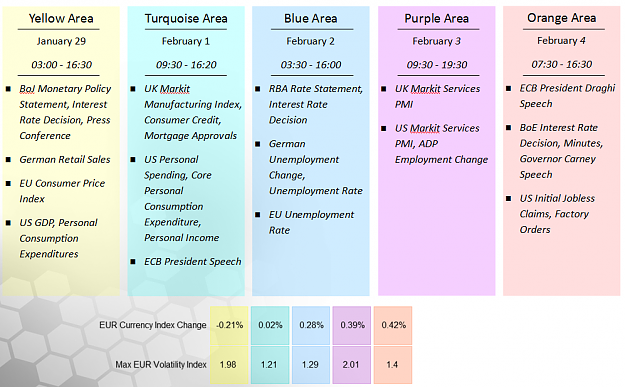
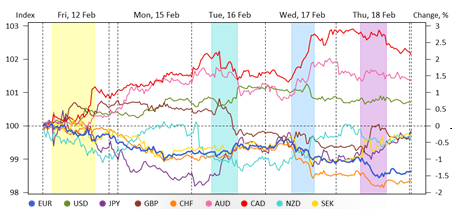
After a plunge amid more favorable data from the US and anticipation of further action by the European Central Bank on January 22 and some wobbly movements on the following Friday, the EUR Index rushed through the new week on an uptrend, ultimately becoming one of the best performer of the period. The single currency posted modest weekly loses against the pound, the Canadian dollar and the krona, whose indexes held in the appreciation area throughout the whole period, but managed outperform notably the Pacific currencies and the Swiss franc.

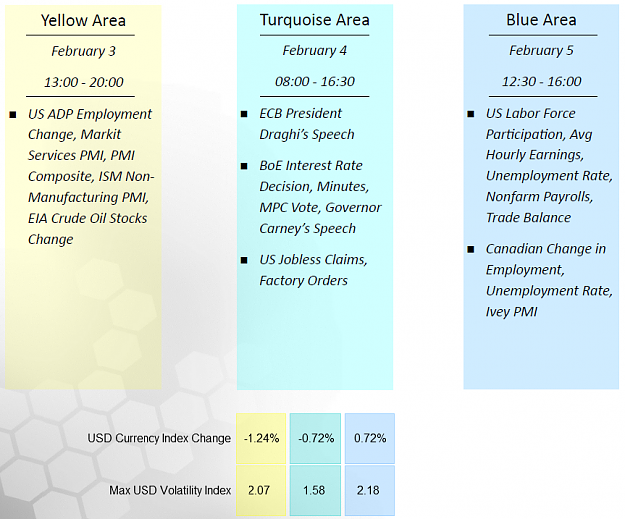
In spite of the fact that the period was rich with influential economic events, the market volatility during the period was mostly below the historical level and slightly exceeded it only in 15% of time. However, on Thursday, at the end of the observed period the Euro’s volatility skyrocketed significantly almost above the historical level. Such a strong reaction started after the Federal Reserve decided to keep interest rates unchanged between 0.25% and 0.50%, following the first rate hike from the record low in a decade.

The period was marked by an increase in the average values of all observed correlation pairs. The most noticeable strengthening was observed in the bonds between EUR/USD and the EUR/JPY as well as EUR/CHF. Changes of the average EUR/USD correlations with EUR/AUD, EUR/CAD and EUR/NZD, in turn, were minimal, even though the dynamics of the component was rather animate. It held at the level of 0.35, but during the weekend and at the Wednesday’s evening, sharp falls of the component were noted , bringing it as low as 0.20 and notably skewing the average.

Full research available here.
Attached Image (click to enlarge)
After a plunge amid more favorable data from the US and anticipation of further action by the European Central Bank on January 22 and some wobbly movements on the following Friday, the EUR Index rushed through the new week on an uptrend, ultimately becoming one of the best performer of the period. The single currency posted modest weekly loses against the pound, the Canadian dollar and the krona, whose indexes held in the appreciation area throughout the whole period, but managed outperform notably the Pacific currencies and the Swiss franc.
Attached Image
In spite of the fact that the period was rich with influential economic events, the market volatility during the period was mostly below the historical level and slightly exceeded it only in 15% of time. However, on Thursday, at the end of the observed period the Euro’s volatility skyrocketed significantly almost above the historical level. Such a strong reaction started after the Federal Reserve decided to keep interest rates unchanged between 0.25% and 0.50%, following the first rate hike from the record low in a decade.
Attached Image
The period was marked by an increase in the average values of all observed correlation pairs. The most noticeable strengthening was observed in the bonds between EUR/USD and the EUR/JPY as well as EUR/CHF. Changes of the average EUR/USD correlations with EUR/AUD, EUR/CAD and EUR/NZD, in turn, were minimal, even though the dynamics of the component was rather animate. It held at the level of 0.35, but during the weekend and at the Wednesday’s evening, sharp falls of the component were noted , bringing it as low as 0.20 and notably skewing the average.
Attached Image