

Highlights of the latest Market Research release on EUR.
Full research available here.

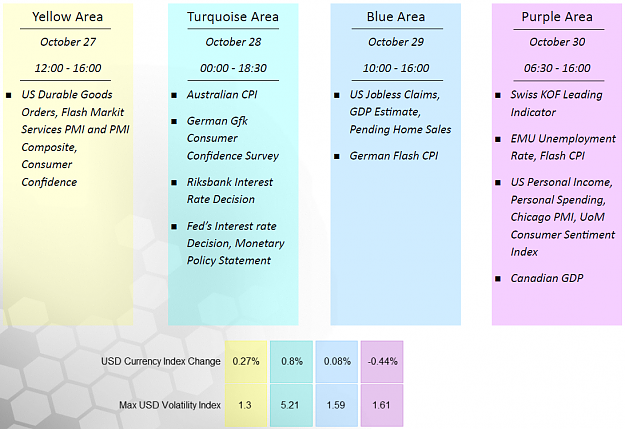
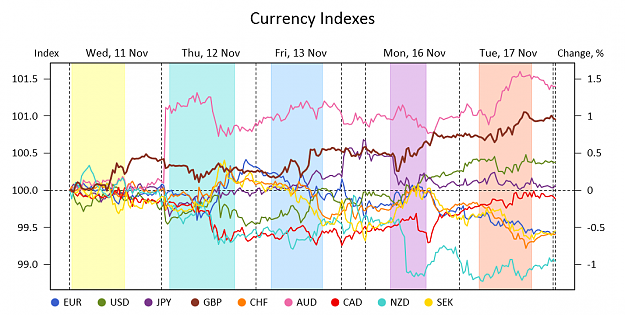
The past trading week was rich for the sharp moves of the indexes, but saw little directional evolution as the gauges barely broke out of the 99.0-101.0 points tunnel. The most dynamic day of the period was Wednesday, when all the observed currencies displayed strong reactions to economic events. The day started with the release of weaker-than-expected CPI in Australia fueling expectations for another rate cut, and the AUD Index tumbled 0.8 points, losing its place in the appreciation area. Next up was the Riksbank, and as the regulator announced an increase of its QE program and its readiness to cut rates and intervene into the market, the krona rallied, nearly breaching the 101.0 mark. The main market-moving event of the day and the period, however, was the release of the Fed’s statement. As the market saw the regulator hinting to a December rate hike, the dollar surged, sending its index above the 101.0 level and sending its peers into different directions.

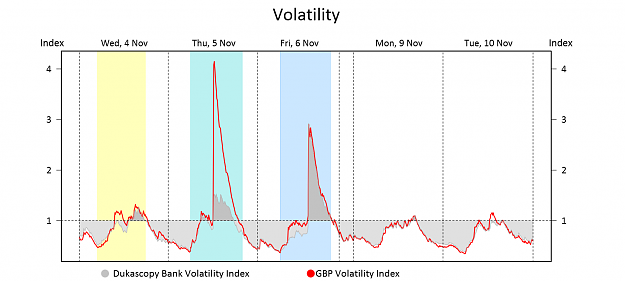
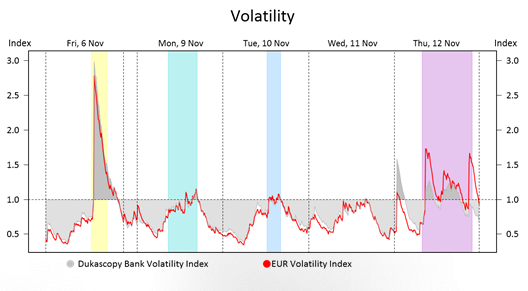
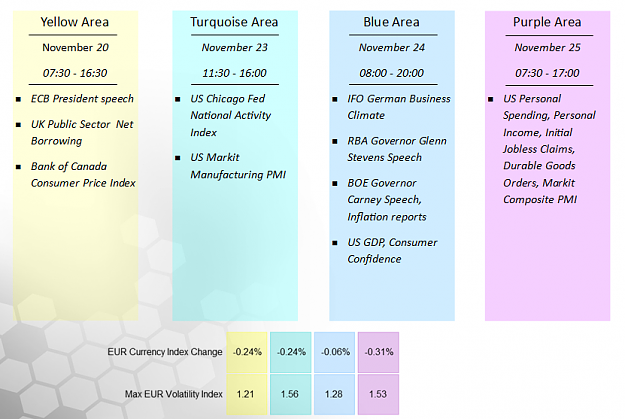
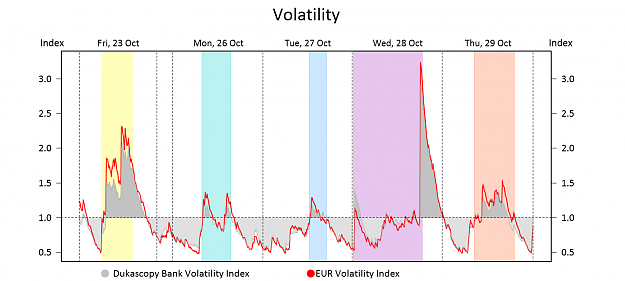
After a relatively calm previous week, the Euro’s elevated volatility portion shifted up from 18% to 32% in the past five trading days. Moreover, the measure of all observed currencies ranged from 26% to 32%. The only exception was the Swedish krona, which spent more than 40% above the historical level. The Riksbank’s monetary policy announcement and the increase of the Swedish retail sales forced the krona’s turbulence gauge to jump to 1.79 and 1.38 points, respectively. However, the most notable surge of the krona’s index, as well as the ones of the most of its peers, happened after the release of Fed’s statement.
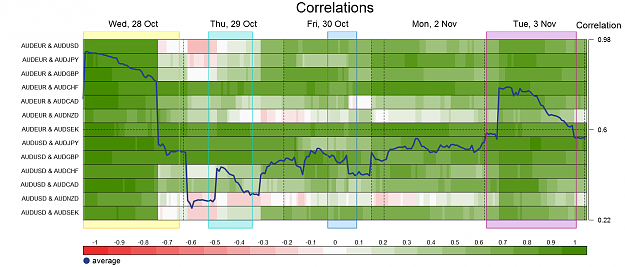
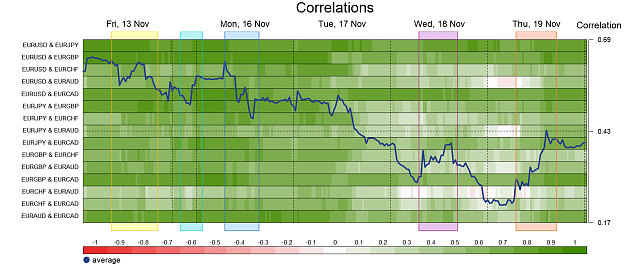
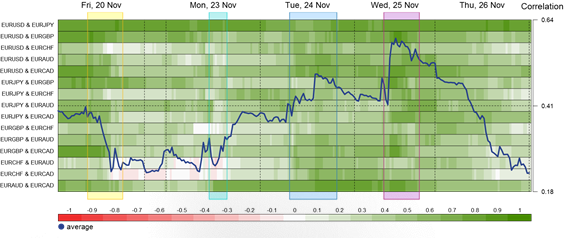
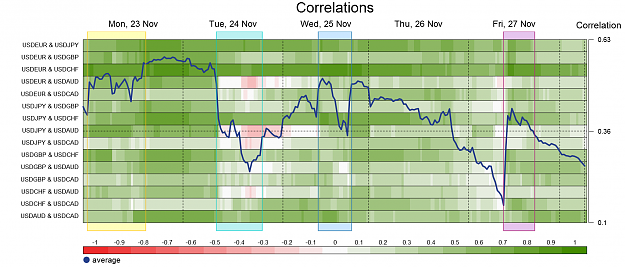
With the head start from Mario Draghi’s press conference on October 22, the Euro’s correlation composite spent most of the period above its monthly average, shifting its distribution to the higher levels. Among the EUR/USD components, the strengthening was observed in the pair’s bonds with EUR/CHF and EUR/NZD, with the former raising its average to 0.46 from 0.15 in the previous period. Meanwhile, the Kiwi’s gauge signaled the strongest correlations, its composite posting an average of 0.64. The Aussie’s and the krona’s measures were close behind with the means of 0.59 and 0.53, respectively.

Full research available here.
Attached Image (click to enlarge)
The past trading week was rich for the sharp moves of the indexes, but saw little directional evolution as the gauges barely broke out of the 99.0-101.0 points tunnel. The most dynamic day of the period was Wednesday, when all the observed currencies displayed strong reactions to economic events. The day started with the release of weaker-than-expected CPI in Australia fueling expectations for another rate cut, and the AUD Index tumbled 0.8 points, losing its place in the appreciation area. Next up was the Riksbank, and as the regulator announced an increase of its QE program and its readiness to cut rates and intervene into the market, the krona rallied, nearly breaching the 101.0 mark. The main market-moving event of the day and the period, however, was the release of the Fed’s statement. As the market saw the regulator hinting to a December rate hike, the dollar surged, sending its index above the 101.0 level and sending its peers into different directions.
Attached Image (click to enlarge)
After a relatively calm previous week, the Euro’s elevated volatility portion shifted up from 18% to 32% in the past five trading days. Moreover, the measure of all observed currencies ranged from 26% to 32%. The only exception was the Swedish krona, which spent more than 40% above the historical level. The Riksbank’s monetary policy announcement and the increase of the Swedish retail sales forced the krona’s turbulence gauge to jump to 1.79 and 1.38 points, respectively. However, the most notable surge of the krona’s index, as well as the ones of the most of its peers, happened after the release of Fed’s statement.
Attached Image (click to enlarge)
With the head start from Mario Draghi’s press conference on October 22, the Euro’s correlation composite spent most of the period above its monthly average, shifting its distribution to the higher levels. Among the EUR/USD components, the strengthening was observed in the pair’s bonds with EUR/CHF and EUR/NZD, with the former raising its average to 0.46 from 0.15 in the previous period. Meanwhile, the Kiwi’s gauge signaled the strongest correlations, its composite posting an average of 0.64. The Aussie’s and the krona’s measures were close behind with the means of 0.59 and 0.53, respectively.
Attached Image (click to enlarge)