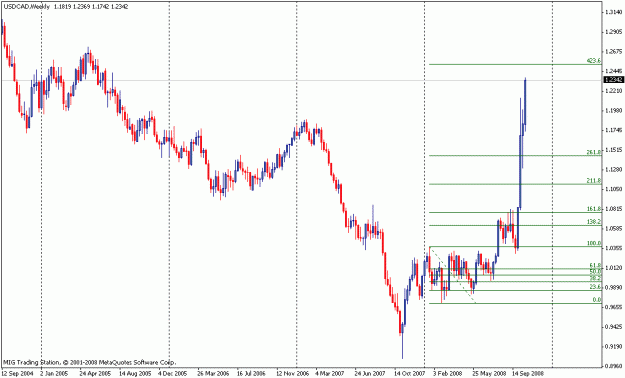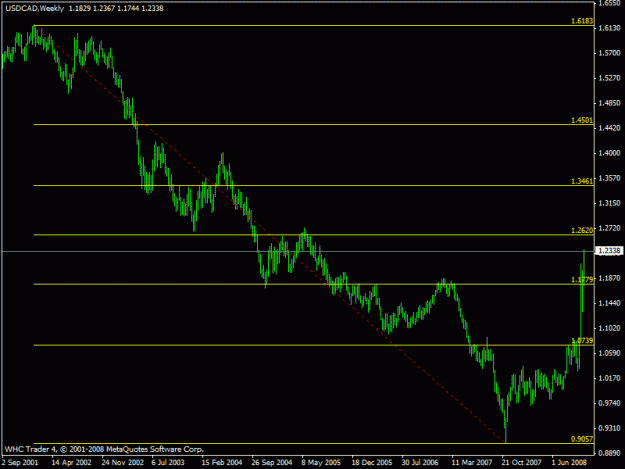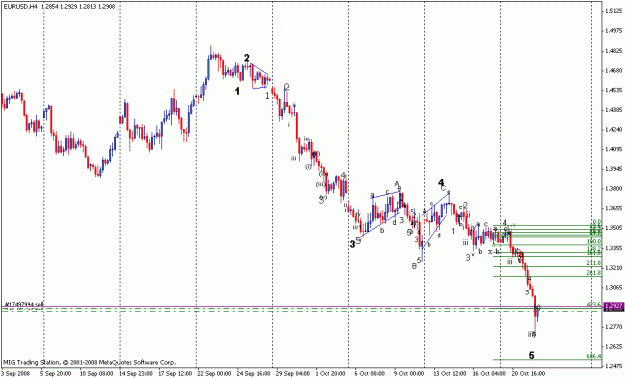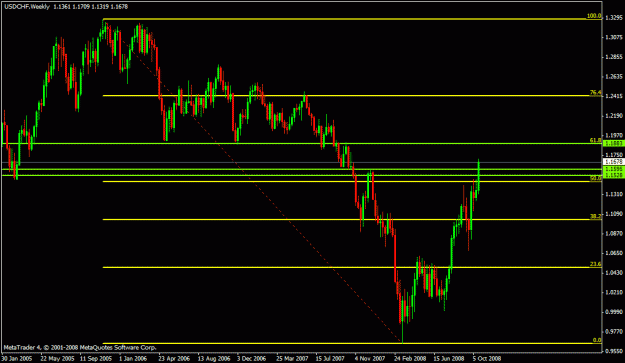
Also a fib resistance level...
R
R
DislikedPrice on Loonie approaching resistance @ around 1.2685 that is the high of 2005Ignored
No brainer fundamental trades 55 replies
This time... I'm Keeping MY MONEY (BRV - No Brainer Trades) 3 replies
The Koala System (No brainer) 127 replies
EUR/GBP SHORT for No Brainer 67 replies
Selling USD and YEN is a no brainer. 12 replies
DislikedPrice on Loonie approaching resistance @ around 1.2685 that is the high of 2005Ignored
DislikedYes indeed. What do you think about short position from that resistance level, keeping in mind the buck beying so bullish lately?Ignored
Disliked4X4EVER
You are 100% right. We all go through these phases. Some give up and some stay on and become wise. You are among the wise and it was good of you sharing it with all of us. It would be helpful for all of us if you can briefly describe how Houdini, BRV and Ironman influenced you.Ignored
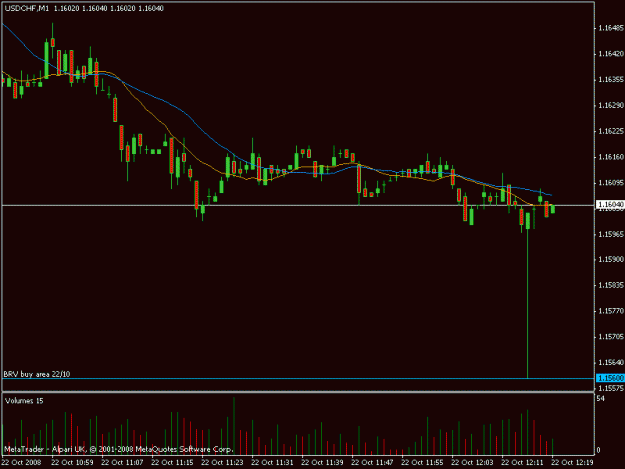
DislikedCan anyone think what happened when the BRV level got spiked? [edit] ... I mean, What might have caused it?Ignored
DislikedDear BRV , i've just went long on USDJPY at 98.69 after notice the FX option USDJPY99.50 99.80 100.00 expires today at 10am eastern time...
Your comments ??Ignored
DislikedI am trying to work out how he managed that as well..... and apart from it being a 'roundish number' I cannot work out how he nailed that one !
BRV .... \"The Master\" does it again !
Ignored
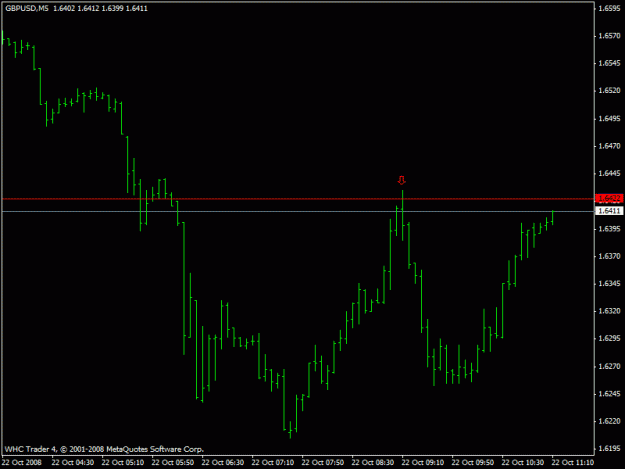
DislikedGM BRV and the crew. Hope yall caught this precise bounce on the GBP/JPY a few minutes ago. I was looking @ GBP/USD as it has made a slightly bigger pullback and thought that price might reverse, so i missed this lovely short entry on the Geppy...damn, could have been a nice present in the cold morning... Lesson learned once again - trade your chart. The chart is your bible. Dont trade what you think just read the chart. Period.
Posting a clean chart for youIgnored
DislikedThe main influence Houdini had on me is realizing that risk is something that should be viewed before any reward. Of course I learned much in the way of technical analysis and understanding price action but it's the discipline he has that has had such an effect on me and others. In forex, we are taught to focus primarily on what you can gain. Of course, risk is talked about, but not really focused on by most in my opinion. How many times have you heard of someone saying that there risk management is important to them and yet they risk 5, 10 and I have even heard 20% in any one trade. Of course, I am not saying that there are some out there who cannot grow and account aggressively by risking more because there are always exceptions to the rule, but knowing that we have the odds stacked against us in this market with 95% failure rate, why not try to at least try to even them up a little by risking very little per trade so we can live to trade another day both with physical and MENTAL capital? I did not believe this for a long time. I thought that you should risk enough to make a difference in the reward (feel good about the win which is emotional trading IMO), but when this market opened up and started blowing through major levels of S/R, I realized that if I am going to trade in these conditions, I should take very little risk. I think if we all took that approach in all market conditions, we might see more success in this business. Think about it, if you were to lose 3 trades in a row at 5% risk each, then you are 15% down in your account. How does that make you feel when it comes to placing your next trade? Confident? Well, maybe you can say yes, but I can certainly say I start to question my ability in that situation because now I am thinking about losing and then I am 20% down ( I am now trading with an emotional handicap). But you contrast that with risking let's say 1-2% and now you are only 3-6% down. You may likely be more selective on your trade but your confidence will not have taken as big of a hit. Even worse, what if you lose 5, 6 or 7 trades in a row. Losing is part of this business and we all get \"cocky\" from time to time and the market has to humble us. I would rather be humbled at much less expense. As far a BRV and Ironman, I think by reading what they have posted here and at their blogs, it re-enforces to me that S/R is universal to this market and WHEN you can learn to find the TSR (true support resistance)areas, you can now begin to select the \"cream of the crop\" trades. The basics they teach are so often overlooked in this market of \"system\" pushers I guess because it's simple. I overlooked it for a very long time and only wish I would have had threads like this to build my foundation the right way early on. Brv is trying to teach traders the right approach to acheiving consistant results in this market and I think he would agree that even when you understand the technical aspects, you have to constantly stay on top of your game mentally. This is where the battle is won. So give yourself an edge. I think of it this way, when your trading becomes boring, then you are probably risking the right amount. Too many of us seek the thrill of the win, and therefore we must have a significant amount to fill that need. I really believe the most effective way to do that is risk much less and trading becomes ho-hum. Ho-hum can make you wealthy.Ignored
DislikedI keep on hearing things left and right that got me thinking down a different path tonight. Its basically my own personal take on why so many traders lose money trading, and some simplified \"training\" solutions. Big concept, I know, but I tried to boil it down to some pretty simple things. At any rate, here's what I came up with; I hope it helps:
-------------------
We all know the statistic, and it’s not a pretty one. According to CRB, “Ninety-two percent of day traders trying to scalp lose money. Only eight percent are successful. Out of the eight percent, only two percent of the day trading public makes money on a consistent basis.” Why then, when these numbers are so widely publicized, would so many newer traders come into the market each and every day and try to earn a killing? It’s simple: economics. The majority of the human population is economically driven, and there’s no justice to go into the reasons as to why. It’s why lottery games where individuals have a 1 in 47 million chance of winning keep getting millions upon millions of people trying twice a week to hit the jackpot. People want money, and they want it now.
I get a lot of emails from people aching over losses, and they keep on coming. “I lost 50 thousand”, “ I lost 20 thousand”, “I lost 60 thousand”, and they all end in the same way: “I need to make it back, fast”. Within the context of all of these emails, I get clues as to why so much has been lost and in such a short amount of time, and they can be boiled down into two basic concepts:
1.Overtrading
2.Overleverage
A lot can be said about these two things, and they can be broken down into many separate categories, and we’ll do so later. But for now, these two fundamental factors, and these two alone, are the killers of all killers.
But what causes these two factors to happen in the first place? Why do people naturally gravitate to these suicidal tendencies? It has to do with two things:
1.Factual information / guidance of which we learn
2.Trading Habits
Now here’s the major problem, and it has to do with number 2 on the list above. When we begin our trading careers, we are factually deficient. We lack number one here. In other words, we are poorly informed, have not read enough information, or the right information, in regards to trading, and we have a basic knowledge of what we are doing. We will learn a few particular strategies, open our trading stations, and start to trade it, without barely any other knowledge of the instruments we are trading, what really moves them, or how to handle these trades once we are in them. We have a poor knowledge of the market, and how to trade in general, whether we realize it or not. We are inexperienced.
At this time in the early stages of our trading careers, we are developing, though we don’t realize it, habits. We are incorporating our poor knowledge base into our actions, and subsequently, developing poor trading habits.
Here’s something important to realize:
We can choose to omit factual information from our brains quite easily (trading systems, knowledge of specific currencies, price movement, fundamental facts, etc.) if proven false.
We CANNOT choose to rid ourselves of habits easily at all. Habits are typically a result of subconscious activity, and execution of our habits comes quite easily.
Ask anyone with a bad habit outside of the realm of trading. Many smokers do not wish that they smoked, but they do, because they have developed the habit of doing so. As anyone knows, getting a smoker to quit is like pulling a bad tooth from an angry pitbull. It’s tough.
So what does this mean? Despite all of the information we pick up throughout our trading careers, whether it be on trading technique, fundamentals, technical analysis, etc., we are still subconsciously tied to poor trading habits. So despite our exhausting attempts to learn a better trading technique, learn more about instrument valuation, macroeconomics, etc, they can all be done in vain unless we change our execution habits.
I know a lot of very “smart” analysts who are horrible traders. These guys could talk me around in depth explanations of macroeconomic environments and make me look like a complete idiot while doing so, and I’ll admit that till the day I die. I used to work with many of them, so I know them very well. But when it comes down to actual trading, I’ll beat them tenfold, because I developed a skill which they find extremely difficult to do, or are too “smart” to realize otherwise, so goes the argument.
Let’s be clear: factual information and trading habits are two completely different things, and they need to be distinguished as such. Factual information is extremely important to have, whether it be in regards to technique, market psychology, fundamentals, etc., and this is learned over time, and evolves over time. Constant learning and acting as an information sponge is crucial to our success, and we need to keep doing it. But more importantly, we need to develop successful trading habits in order to prosper. It’s not an option, it’s a requirement.
The combination of these two things (the right factual information and good trading habits) can evolve someone from a straight loser to a dead on winner, but you need them both. If you ask me what I designate as the “right” information, it has to do with market fads and what ultimately moves price (human intervention and mass buying/selling, i.e. how people will react in various environments).
So how do we change our bad trading habits? Well the first step, like anything else, is to realize that you have it. The next step is to exercise various options that will dig you out of this seemingly endless cycle of losing all the time, and this is where our other two concepts, overtrading, and overleverage, come into play.
Overtrading is a function of haste and poorly planned trades. Overtrading will occur if a trader is on a winning streak and wants to keep on winning, or if a trader is on a losing streak and needs to turn things around. In haste, a trader will just keep on adding poorly planned trades to his mix of positions in hopes of turning an above-average profit, which usually lends him or her into disaster.
Overleverage, as you can imagine, is done in a similar manner. Any rules the trader has learned in terms of risk or money management goes right out the window and he or she will double or triple down on positions in order to make a killing, or just come out of a loser at breakeven. In the process, accounts get drained, and things get ugly. And it’s no wonder why.
If you’re reading this and can relate, I’m not surprised. One look at the statistic mentioned at the beginning of this article and a general summation of all the complaints I read are usually a function of these two things. They, as you can imagine, are poor trading habits, and ones that take all of the hard-earned money from your account and push it into the account of the person on the other side of your trade.
Poor trading habits display a lack of reality, or ignorance thereof. For instance, if you do have good money management habits and exercise proper risk guidelines, but you keep on losing, it’s because you are using a trade entry system which doesn’t work, or holding too much conviction on obvious losers. But for some reason, you stay with it, because you believe that “sticking to a plan” is good. Well you would be right about that, but tossing out a losing trading strategy is just as equally important as exercising good risk. Either way, you’re using a bad system, and it needs to go. You need to change the habit of using this system.
Most traders have a hard time “letting go”, and this is what usually ends them down the path of disaster. Smart traders stick to what works, and do so over the long run. This means letting profits run and cutting losses in a systematic pattern which mathematically works out over time. If the math doesn’t work out, it’s simply not worth doing. You are in the business of trading with the expectation to turn a profit, and if the numbers aren’t realizing this, then something is wrong.
So how do we get out of this destructive cycle? Realizing these pitfalls and correcting them is one of the hardest jobs we have as traders. Experience teaches us otherwise, but there are rarely any shortcuts. I am recommending the three steps below which should be used as a learning process, or better yet, development of good trading habits:
Our first job is to find consistently profitable trading systems and master them. There are literally thousands of them out there with plenty of data to support success under all forms of various market conditions. Find them and stick with them. This is the easy part.
Next, when executing trades, plan them out vigorously. Delve into any relevant information you need in order to make an informed decision, and take only the trades which fit into the framework of your profitable trading strategy. Lack of proper planning or learning to take trades based on weak or fundamentally incorrect information, or worse yet, “hunches”, is a quick path to failure. A lot of independent money gets lost due to a lack of proper planning.
Finally, and most importantly, cut down your intraday trading leverage substantially. And when I say substantially, I mean almost to nothing. Until we learn and develop a solid, consistently profitable trading habit, we want to use very, very small leverage and open almost insignificant position sizes. This allows us benefit from two different angles:
1.We have winners and we let them run. Because the money we are trading is “relatively insignificant”, we have no emotional attachment to money gained, as the most it could buy us is a cup of coffee
2.Losers don’t affect us emotionally, either. If we take a loss, it’s about as bad as paying a parking meter for one hour
How is this going to help us? When we have developed a good habit of letting winners run and cutting losers off, we see that over time, we are able to turn a profit, in terms of %, that we are more than happy with. When it comes time to putting on “real” money (bigger positions), you are exercising a good trading habit that has proven to be consistently profitable. Again, we are building a profitable trading habit, nothing more. And don’t use “demo account” money or simulated trading. Nothing hurts more than the loss of real cash, even if it is only one dollar here or there.
Everyone talks about how hard trading is mentally and it’s easy to see why many hedge funds have on-call psychologists in order to come in and talk to traders. Breaking any destructive cycle is difficult, yet by starting from scratch and “relearning” trading from the beginning we can head towards the most important factor that can lead to success: having good habits. Profits are what we ultimately seek, and the process of doing so has to start somewhere. Erase the board and start from the beginning.Ignored
DislikedVery true - I would like to see one ad, just one, for one of these crappy trading systems out there say \"Your chances of doing this successfully are 1 in 100....Buy Now!!!\".
Maybe then we can get some honesty back in this business!
Basics hold true.....people forget to do the math though and focus too much on how to enter the trades....thats almost always where most of the focus goes in this business....you could even say that about parts of this thread....its just natural. Risk is the name of the game though; you either learn to deal with it and manage it properly or you lose. Plain and simple.Ignored
DislikedIt's been good for another bounce down. 1st half pipped in, 2nd is at 70 PIPs and counting...Ignored
DislikedThe reason before double zeros is due to option protection. Many times people will move to create option barriers to avoid these 00 areas from getting hit before expiration.....just been my experience.Ignored