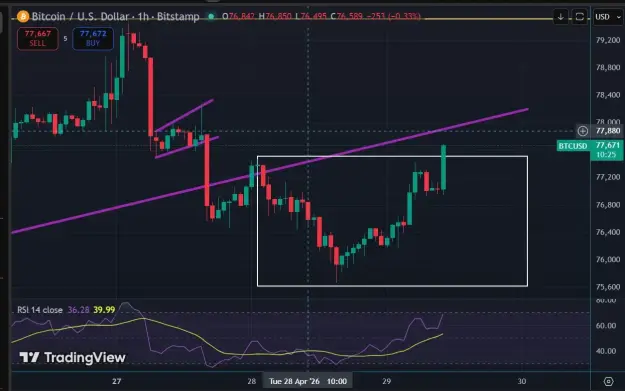


Bear market behaviour is often fundamentally different from bull market conditions. In many cases, our psychological bias is not naturally designed to trade the short side effectively. This is also evident when applying a strategy such as RSI 30/60—where shorts are taken when RSI is above 60 and positions are covered when RSI reaches 30. On lower timeframes like M15, market noise can significantly distort signals, leading to inconsistent execution.
A practical adjustment is to shift the timeframe higher, from M15 to H1. This helps filter out market noise and produces clearer, more structured signals. In many cases, the win probability remains comparable and can even improve, not because the indicator itself changes, but because the strategy is effectively aligned with selling into rallies within a clearer trend-biased environment. Without a proper trend bias, and without a structured scaling or execution framework, RSI-based entries can easily degrade into near-random signals rather than a systematic trading edge.
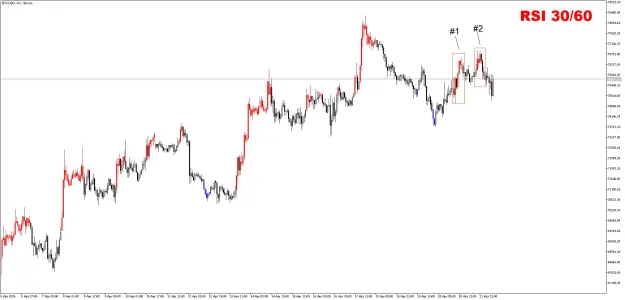
The current Bitcoin chart highlights two potential zones for initiating short positions (#1 and #2). By applying a scale-in approach, these entries can be averaged effectively, resulting in a more favourable overall entry price and improved position structure. At the same time, it is essential to stay disciplined and respect MIDD (Maximum Intraday Drawdown) constraints to ensure capital protection against sudden or extended adverse moves.
A practical adjustment is to shift the timeframe higher, from M15 to H1. This helps filter out market noise and produces clearer, more structured signals. In many cases, the win probability remains comparable and can even improve, not because the indicator itself changes, but because the strategy is effectively aligned with selling into rallies within a clearer trend-biased environment. Without a proper trend bias, and without a structured scaling or execution framework, RSI-based entries can easily degrade into near-random signals rather than a systematic trading edge.
Attached Image (click to enlarge)
The current Bitcoin chart highlights two potential zones for initiating short positions (#1 and #2). By applying a scale-in approach, these entries can be averaged effectively, resulting in a more favourable overall entry price and improved position structure. At the same time, it is essential to stay disciplined and respect MIDD (Maximum Intraday Drawdown) constraints to ensure capital protection against sudden or extended adverse moves.