



 This project is being replicated based on content from TradingView, following the latest World AlgoTrading Championship.
 The development team included 6 coding specialists in Pine Script and 3 financial experts, whose names, qualifications, and institutions where they studied, graduated, and were awarded in their careers are published in this week's official TradingView article.
 Every year, TradingView launches a challenge to find the best-performing algorithm developed by its users. As an open platform, anyone — even a complete beginner — can submit their strategy and code to participate.
 This year, over 1.2 million users participated by submitting their strategies and promising codes for initial review. After the first phase, around 480,000 users were granted demo accounts to run their algorithms.
 The algorithms could be executed in two ways:
 Via API using external personal platforms (acting like a regular user placing trades on the TradingView chart).
 Using the Eithcap broker, where participants could choose any supported trading platform.
 Our team chose to use MetaTrader 4 (MT4) due to its advanced tools and flexibility, allowing us to create custom adaptations — even for functions incompatible with TradingView — by masking variables with code blocks that are accepted. This method allowed us to extract capabilities that TradingView itself doesn’t offer. Of course, this required a highly skilled team that fully understood the task.
 The theoretical objective was simple:
To extract non-standard, dynamic information from the market so the algorithm could decide what to do in real time, placing pending orders in certain areas and cancelling them if the scenario changed.
 While implementing this in standard MQL4 wasn’t difficult, the real challenge was teaching the algorithm how to avoid certain scenarios and how to reassess when conditions change — essentially a digital brain, similar to AI, but focused on short-term pattern recognition.
However, for that, it needed to store data externally, which required the creation of APIs to consult outside the MT4 environment.
 Until a brilliant idea emerged: we could take a snapshot of the analyzed region, convert it into binary data (0s and 1s), and store it in a .txt file inside the platform’s Files folder. This way, the algorithm could access the data without relying on external servers.
 This innovation eliminated delays caused by data fetching from external servers, which could cost valuable seconds — even a single second can be the difference between executing or avoiding an order. Everything had to be precise, and every step was a new challenge that demanded a solution never created before.
 Fortunately, our coding experts don’t see these challenges as problems — but as opportunities to overcome. Passionate about their craft, they contributed voluntarily, driven by the desire to create something the world has never seen.
 Two weeks later, the first prototype was ready in MQL4 — around 14,000 lines of code. The team nervously awaited whether MetaTrader 4 would accept the massive file or crash.
 After countless compilation errors and 9 straight hours fixing just 8 errors, the code was finally running — a true milestone, and ready for tournament submission.
 Then came the intellectual phase of the project:
The financial experts fine-tuned the code for secure risk management and sustainable balance growth.
After 48 hours of deep analysis, they requested specific adjustments, which the coders quickly delivered after 16 hours of intense work. The strategy was finally refined and optimized.
 The goal wasn't profit maximization, but rather:
 The lowest possible drawdown
 The highest number of consecutive wins
While most competitors chased high profits (risking their entire equity), our algorithm aimed to grow gradually, with near-zero risk, steadily climbing toward success with unmatched performance.
 After 23 consecutive trading days (excluding weekends), the competition provided each participant with a $500 demo account, allowing trading in the following assets for performance monitoring:
 XAU/USD
 NASDAQ
 EUR/USD
Many accounts skyrocketed from $500 to over $10,000 within the first 10 days — impressive gains. However, in the days that followed, they not only lost all their profits but also blew the entire account.
 Meanwhile, our algorithm advanced steadily and quietly, without drawing much attention.
During the entire competition period, it maintained a 100% win rate, completely eliminated risk, and consistently progressed.
 As a result, it won the award for:
- Best Performance
 Top Security
 Highest Risk-to-Reward Ratio
 I’ll continue updating this article whenever possible, but for those truly interested, the file is already available for acquisition.

 The profit amount itself should not be the focus, as the configuration used was specifically set to demonstrate only the capital growth curve and the drawdown behavior during this period.
 The goal was to create the most difficult test environment possible, exposing our algorithm to intense market stress scenarios, ensuring that even in worst-case conditions, it continues to perform with safety and efficiency.
 Take note of the number of winning buy orders and winning sell orders executed over the 6-month period — a strong indicator of balanced strategy efficiency across both directions of the market.
 Now let’s take a look at the behavior of XAU/USD over the past 6 months.
 Refer to the image above.
 Gold (XAU) is known for being one of the most volatile assets in the financial markets.
 Our algorithm already performs exceptionally well on XAU. However, some users — especially those with more ambitious goals and shorter return windows — have requested a variation of the EA for more dynamic accounts with varying capital.
 Many of these users operate under specific conditions: they manage money from third parties and offer monthly interest based on trading performance. This calls for a faster, more aggressive EA variation tailored for high-efficiency scenarios.
 As we've explained in previous updates, we're always working on new solutions and versions to meet the evolving needs of our users. Despite being a champion EA, fully verified on TradingView, we know there's always room for improvement and adaptation — especially for specialized account types.
 If you're looking to trade XAU and you're comfortable with a medium risk exposure of 13% to 20% of your broker balance, this variation might be an excellent option.
 To support the high order flow, this variation includes an order balancing system:
 A simple panel has also been added: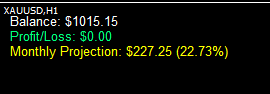

 Profit projection over the next 30 days — updated in real-time as trades occur
 Notice how in this version, even with 12% of losing trades, the overall profitability increased when the entire trading period was analyzed.
 Minimal data distortion
 That means the results you're seeing now are a true reflection of real market behavior — not simulations or projections.
 Got a suggestion or want to get in touch with me directly?
 WhatsApp: +55 27 99686-8314
 Telegram:
  Or simply send me a message right here on Forex Factory — I'll get back to you as soon as I read it.
 .
. Multi-Timeframe Optimization
 Execution Details
 using real tick data with 99% modeling quality
 .
. The timeframe remained M5 (5 minutes)
  , the EA shows its ability to adapt and reshape its operations in the safest way possible
  New Test: RSI 14 with Higher Target and Expanded Order Limit
 The previous limit of 5 simultaneous orders was removed, allowing up to 25 concurrent positions if the strategy conditions are met
  Controlled Aggression with Strategic Balance
 — proving once again its resilience in both conservative and high-pressure environments.
 .
.

 High-Risk Simulation with $100 Starting Balance
 XAU/USD Trading
  You can find more details about this EA in the full article available at the link below:
 The Super EA (Banned from MQL5)
