8 pip spread............wowza, brokers still offer such poor spreads nowadays? Anyways a trader must consider account balance, risk% and SL!!! If you, dont your never gonna make any money!!! Trade 1; Account Balance - 10000$ Base currency USD Risk % - 2 SL - 10 pips Lots size - 1.5 Lets use GBPUSD today you: Buy: 1.2040 TP TP: 1.208 (40 pips) Costs - 7$ per 100k ( I use paybackfx get 1.5$ rebates per 100k on my commission) SL: 1.203 Risk (150+(7-1.5)) 600$ - (10.5$ commission + 2.25) 589.5+2.25$ Profit = 591.75$ Trade 2: Account Balance - 10000$...
{quote} My point is that most people will not take a trade where their risk:reward is skewed i.e. risking 40,30 or even 20 pips as in the example you gave to make 10, yet when they enter a trade risking 10 pips to make 40 and the trade goes well and price climbs, there will be a point where the R:R flips around and you are now risking a more pips to make few, which is no different to taking trade 2.
Ignored
If Trade 1 and Trade 2 are part of what we're assuming has been analysed to be the "same" trade/setup (that did go to target) surely there's no end of arguments that could be made for entries/stratagems?
maybe Im ,Can you please explain how ? In this example you gave and how I trade, you only have to be right 17% of the time to break even.
Ignored
I am basically highlighting that your R:R is constantly changing throughout the lifecycle of a trade, whether you like it or not you are constantly risking more pips to gain less pips or less pips to gain more pips, depending on how the trade is performing.
I am also highlighting that there is no profit advantage over either R:R strategies in the examples i gave.
{quote} If Trade 1 and Trade 2 are part of what we're assuming has been analysed to be the "same" trade/setup (that did go to target) surely there's no end of arguments that could be made for entries/stratagems?
the answer is very simple..............If you can answer the question"Is the price random?"............then you will have clear answer to your question
{quote} I am basically highlighting that your R:R is constantly changing throughout the lifecycle of a trade, whether you like it or not you are constantly risking more pips to gain less pips or less pips to gain more pips, depending on how the trade is performing. I am also highlighting that there is no profit advantage over either R:R strategies in the examples i gave.
Ignored
I see what your saying and thats why I brought up your account balance playing a factor into your position sizing because then it does.
Trade 1:
Risk 155.75$
To make 591.75$
You only have to be right 21% of the time to breakeven
Trade 2:
Risk 116$
To make 35.9$ You then have to be right 76.3% of the time.
You tell me from a probabilities stand point, what your better chances of making money are ?
Learn, a forex trader must, unlearn and relearn he will.
It's possible to look at any piece of historic PA that moved between point A and B, and make cases both statistical and otherwise for any number of ways to trade it.
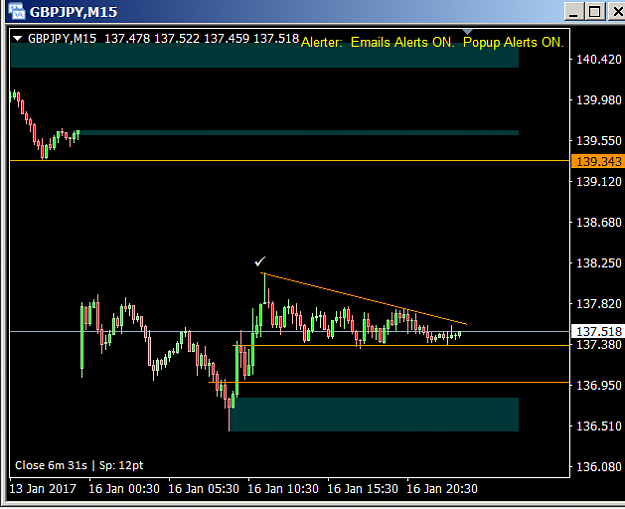
I'm trying to work out how you'd apply this to live trading: GBPJPY M15 for instance:
It's fair to say that based on current PA it's going to try and close the gap. Once price started rising today are you saying that there's no real advantage to waiting for a pullback? In other words it was valid to buy that high around the white arrow for example?
{quote} I see what your saying and thats why I brought up your account balance playing a factor into your position sizing because then it does. Trade 1: Risk 155.75$ To make 591.75$ You only have to be right 21% of the time to breakeven Trade 2: Risk 116$ To make 35.9$ You then have to be right 76.3% of the time. You tell me from a probabilities stand point, what your better chances of making money are ?
Ignored
When you take a trade that is closer to your tp and further from your stop loss, your probability of hitting tp is higher than a trade that is taken further from your tp and closer to the stop loss. Using a profitable strategy, when you take a later trade, i.e. price is closer too the tp and further from the sl, you are essentially filtering out all the trades that will hit sl if you were to take the trade from the earlier (but valid) entry point closer to sl and further away from target.
However this does not mean that one is better than the other. Just because one is more probable of hitting target than the other doesn't make a difference to profit over x trades because the profit is smaller on the more probable trades with a smaller profit target and bigger stop, and the profit is larger on the less probable trdes with a larger profit target and smaller stop.
This also means entry point has no factor is whether your strategy is profitable or not, its the exit that defines profitabilty.
{quote} It's possible to look at any piece of historic PA that moved between point A and B, and make cases both statistical and otherwise for any number of ways to trade it. I'm trying to work out how you'd apply this to live trading: GBPJPY M15 for instance: It's fair to say that based on current PA it's going to try and close the gap. Once price started rising today are you saying that there's no real advantage to waiting for a pullback? In other words it was valid to buy that high around the white arrow for example? Screenshot_1.png;2142446 {image}...
Ignored
Let's say that you have a trade signal to go long at where the price is now at the pullback, and the sl will go under the very low of that chart and your tp is the gap close giving roughly 1 risk to 2 reward. And you know that this setup is profitable over a large amount of trades. Now, if you were't at the computer when you would normally enter, and price moves up by 1R, then you decide to enter later risking 2 to 1 reward, that setup will be just as profitable in the long run as entering earlier where you would enter normally. Meaning R:R makes no difference, meaning entry point is not important either.
I think you are coming the conclusion is that risk-reward is not a static e.g. the R:R evolves over the course of the trade.
There 3 cases I consider:
Not touching your stop.
The "break even" trade e.g. once you pass some arbitrary positive value of R, some PA barrier etc you move to BE.
Trailing your stop.
Not touching the stop: If the trader doesn't touch there stop during the course of the trade then the size of R (risk) changes with respect to the original unit of risk. For example if a trade with a 4R target goes up +3R before coming back and taking out the stop then at the point the trade was up +3R the unit risk was actually 4R. So not moving the stop is a fools errand especially if when chasing low reward trades.
Break even: Same scenario as above but this time the trader moved to break-even (the so-called free money trade). Adjust the above numbera the peak the unit risk is now 3R (or 3 times the original risk) at the peak of the trade.
Trailing your stop: This is an art that mainly will depended largely on the system in use. The goal of trailing the stop is to NOT get into a situation where we are not risking 3 or 4 untis of risk (as outlined in the break even and not-moving your stop scenarios) in the hope we get the +1R and get to say we made it to our traget..
So in short: risk is not a fixed variable in any given trade. If you don't adjust your stop loss (assuming you use one ... ceratinly not saying you have to) your trade will evolve from the "trade1" example into a "trade2" example. You need a very high win rate for not moving your stop to make consisent money. Same for the break even scenario - the only difference is the BE case is subject to less fees/comission drawdown.
{quote} Well the more price is going in 1 direction, the more probability it will carry on going in that direction, just like newtons 1st law.
Ignored
I wish folks would stop equating a physical law with Human behavior... the path of a ball moving in a smooth single plane without friction is predictable.. human behavior is not predictable... a trend is a trend until its not whereas the path of the ball in the example above will continue to move in a straight line...
{quote} I wish folks would stop equating a physical law with Human behavior... the path of a ball moving in a smooth single plane without friction is predictable.. human behavior is not predictable... a trend is a trend until its not...the path of the ball in the example above will continue to move in a straight line...
Ignored
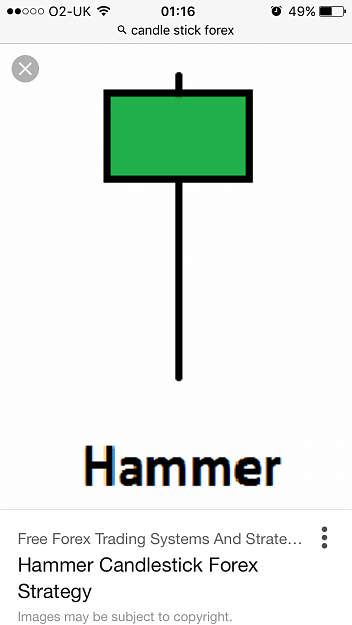
Look at the candle below, price has moved down but is. now moving up to make this hammer type candle - which is most likely to happen next, price makes new high or price makes new low?