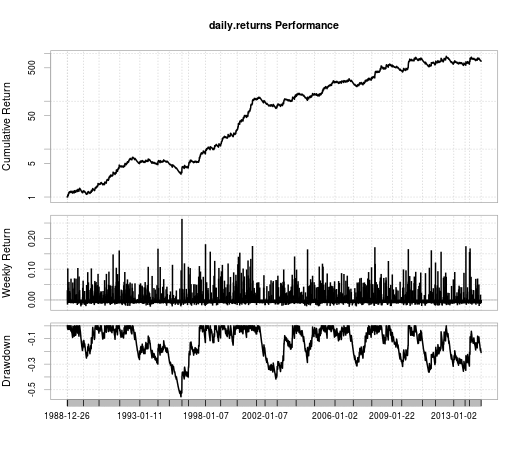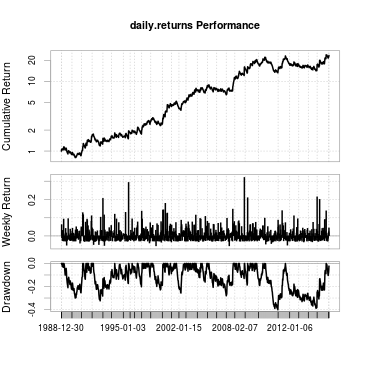


I'm gonna show you a simple initial approach to the "pattern detection" idea. I will use the open of the last 7 bars to define a "pattern" which will be the relationships between these values. I then look into the past to see if there are enough examples to train my machine learning algo. This is a function to perform this task, it returns 1 if there are enough examples in the historical data, 0 if there are not enough:
If there are enough examples I then build the input/output array using the matching patterns I have located in the past. In this case the inputs are a past number of returns and the outputs are the outcomes of long and short trades managed with a simple trailing stop where the SL is moved to the starting SL value distance from the current open if this stop is more favorable than the present stop:
With these two functions I can build the machine learning functions. This time I decided to use a neural network as the machine learning algo:
In this case the algorithm is retrained and relaunched on every hourly bar where there are enough examples. I then performed an optimization to see if I could find anything worth it on the EUR/USD 1H and found some interesting stuff. Here is a linear system example I found:
starting SL = 150% ATR20
B = 75 (number of examples used per training)
C = 8 (number of input returns used per example)
D = 185 (frontier for the trade output)
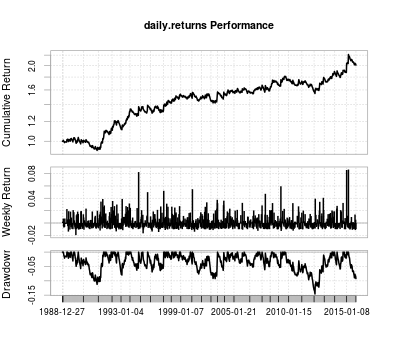
This algo does not use any hourly filters on the 1H chart, for this reason it's very different from everything I have shared so far on the 1H. Thoughts, always appreciated...
Inserted Code
int is_viable_examplesByStructure(int examplesNeeded, int frontier){
    int tl = frontier;
    double open1, open2, open3, open4, open5, open6, open7;

    open1 = iOpen(0,1);
    open2 = iOpen(0,2);
    open3 = iOpen(0,3);
    open4 = iOpen(0,4);
    open5 = iOpen(0,5);
    open6 = iOpen(0,6);
    open7 = iOpen(0,7);
   int i = 0, j = 0, n=0, m = 0;
   while(m<examplesNeeded && i+tl+500<iBars(0)){

      if (
           ((iOpen(0,i+tl+1) > iOpen(0,i+tl+2)) == (open1 > open2)) &&
           ((iOpen(0,i+tl+1) > iOpen(0,i+tl+3)) == (open1 > open3)) &&
           ((iOpen(0,i+tl+1) > iOpen(0,i+tl+4)) == (open1 > open4)) &&
           ((iOpen(0,i+tl+1) > iOpen(0,i+tl+5)) == (open1 > open5)) &&
           ((iOpen(0,i+tl+1) > iOpen(0,i+tl+6)) == (open1 > open6)) &&
           ((iOpen(0,i+tl+1) > iOpen(0,i+tl+7)) == (open1 > open7)) &&
           ((iOpen(0,i+tl+2) > iOpen(0,i+tl+3)) == (open2 > open3)) &&
           ((iOpen(0,i+tl+2) > iOpen(0,i+tl+4)) == (open2 > open4)) &&
           ((iOpen(0,i+tl+2) > iOpen(0,i+tl+5)) == (open2 > open5)) &&
           ((iOpen(0,i+tl+2) > iOpen(0,i+tl+6)) == (open2 > open6)) &&
           ((iOpen(0,i+tl+2) > iOpen(0,i+tl+7)) == (open2 > open7)) &&
           ((iOpen(0,i+tl+3) > iOpen(0,i+tl+4)) == (open3 > open4)) &&
           ((iOpen(0,i+tl+3) > iOpen(0,i+tl+5)) == (open3 > open5)) &&
           ((iOpen(0,i+tl+3) > iOpen(0,i+tl+6)) == (open3 > open6)) &&
           ((iOpen(0,i+tl+3) > iOpen(0,i+tl+7)) == (open3 > open7)) &&
           ((iOpen(0,i+tl+4) > iOpen(0,i+tl+5)) == (open4 > open5)) &&
           ((iOpen(0,i+tl+4) > iOpen(0,i+tl+6)) == (open4 > open6)) &&
           ((iOpen(0,i+tl+4) > iOpen(0,i+tl+7)) == (open4 > open7)) &&
           ((iOpen(0,i+tl+5) > iOpen(0,i+tl+6)) == (open5 > open6)) &&
           ((iOpen(0,i+tl+5) > iOpen(0,i+tl+7)) == (open5 > open7)) &&
           ((iOpen(0,i+tl+6) > iOpen(0,i+tl+7)) == (open6 > open7))
           )
           {
       m++;
      }
      i++;
   }

   if (m<examplesNeeded){ return(0) ;} else { return(1); }
}
If there are enough examples I then build the input/output array using the matching patterns I have located in the past. In this case the inputs are a past number of returns and the outputs are the outcomes of long and short trades managed with a simple trailing stop where the SL is moved to the starting SL value distance from the current open if this stop is more favorable than the present stop:
Inserted Code
RegressionDataset regression_i_simpleReturn_o_tradeOutcome_examplesByStructure(int period, int barsUsed, double initial_SL, int frontier, double minStop){
   Data<RealVector> inputs(period,RealVector(barsUsed));
   Data<RealVector> labels(period,RealVector(2));
    double openPrice;
    double SL_long, SL_short, new_SL;
    double atr;
    int tl = frontier;
    double open1, open2, open3, open4, open5, open6, open7;

    open1 = iOpen(0,1);
    open2 = iOpen(0,2);
    open3 = iOpen(0,3);
    open4 = iOpen(0,4);
    open5 = iOpen(0,5);
    open6 = iOpen(0,6);
    open7 = iOpen(0,7);

   int i = 0, j = 0, n=0, m = 0;
   while(m<period){

      if (
           ((iOpen(0,i+tl+1) > iOpen(0,i+tl+2)) == (open1 > open2)) &&
           ((iOpen(0,i+tl+1) > iOpen(0,i+tl+3)) == (open1 > open3)) &&
           ((iOpen(0,i+tl+1) > iOpen(0,i+tl+4)) == (open1 > open4)) &&
           ((iOpen(0,i+tl+1) > iOpen(0,i+tl+5)) == (open1 > open5)) &&
           ((iOpen(0,i+tl+1) > iOpen(0,i+tl+6)) == (open1 > open6)) &&
           ((iOpen(0,i+tl+1) > iOpen(0,i+tl+7)) == (open1 > open7)) &&
           ((iOpen(0,i+tl+2) > iOpen(0,i+tl+3)) == (open2 > open3)) &&
           ((iOpen(0,i+tl+2) > iOpen(0,i+tl+4)) == (open2 > open4)) &&
           ((iOpen(0,i+tl+2) > iOpen(0,i+tl+5)) == (open2 > open5)) &&
           ((iOpen(0,i+tl+2) > iOpen(0,i+tl+6)) == (open2 > open6)) &&
           ((iOpen(0,i+tl+2) > iOpen(0,i+tl+7)) == (open2 > open7)) &&
           ((iOpen(0,i+tl+3) > iOpen(0,i+tl+4)) == (open3 > open4)) &&
           ((iOpen(0,i+tl+3) > iOpen(0,i+tl+5)) == (open3 > open5)) &&
           ((iOpen(0,i+tl+3) > iOpen(0,i+tl+6)) == (open3 > open6)) &&
           ((iOpen(0,i+tl+3) > iOpen(0,i+tl+7)) == (open3 > open7)) &&
           ((iOpen(0,i+tl+4) > iOpen(0,i+tl+5)) == (open4 > open5)) &&
           ((iOpen(0,i+tl+4) > iOpen(0,i+tl+6)) == (open4 > open6)) &&
           ((iOpen(0,i+tl+4) > iOpen(0,i+tl+7)) == (open4 > open7)) &&
           ((iOpen(0,i+tl+5) > iOpen(0,i+tl+6)) == (open5 > open6)) &&
           ((iOpen(0,i+tl+5) > iOpen(0,i+tl+7)) == (open5 > open7)) &&
           ((iOpen(0,i+tl+6) > iOpen(0,i+tl+7)) == (open6 > open7))
           ){

        atr = iAtrWholeDaysSimpleShift(PRIMARY_RATES, 20, i+tl+1);
        openPrice = cOpen(i+tl);
        SL_long = openPrice+spread()-atr*initial_SL;
        SL_short = openPrice+atr*initial_SL;

        n = 0;

        while ((SL_long < low(i+tl-n)) && (n<tl)){
            n += 1;
            atr = iAtrWholeDaysSimpleShift(PRIMARY_RATES, 20, i+tl-n+1);

            new_SL  = cOpen(i+tl-n)+spread() - (initial_SL*atr);
            if(new_SL <= SL_long){
                new_SL = cOpen(i+tl-n);
            }

          if (cOpen(i+tl-n)-new_SL > minStop){
              SL_long = new_SL;
            }
        }

        labels.element(m)[0] = SL_long-(openPrice+spread());

        n = 0;

        while ((SL_short > high(i+tl-n)+spread()) && (n<tl)){
            n += 1;
            atr = iAtrWholeDaysSimpleShift(PRIMARY_RATES, 20, i+tl-n+1);
            new_SL  = cOpen(i+tl-n) + (initial_SL*atr);
            if(new_SL >= SL_short){
                new_SL = cOpen(i+tl-n);
            }
          if (new_SL-cOpen(i+tl-n) > minStop){
              SL_short = new_SL;
            }
        }

        labels.element(m)[1] = openPrice-SL_short;

       for(j=0;j<barsUsed;j++){
       inputs.element(m)[j] = (iOpen(0,tl+j+i)-iOpen(0,1+tl+j+i))/iOpen(0,1+tl+j+i);
        }
       m++;
      }
      i++;
   }

   RegressionDataset dataset(inputs,labels);
   return dataset;
}
With these two functions I can build the machine learning functions. This time I decided to use a neural network as the machine learning algo:
Inserted Code
double NN_Prediction_i_simpleReturn_o_tradeOutcome_examplesByStructure(int learningPeriod, int barsUsed, double initial_SL, int frontier, double minStop, int trainingEpochs)
{

    int is_viable = is_viable_examplesByStructure(learningPeriod, frontier);

    if (is_viable == 0) return(0);

    RegressionDataset dataset = regression_i_simpleReturn_o_tradeOutcome_examplesByStructure(learningPeriod, barsUsed, initial_SL, frontier, minStop);

    FFNet<FastSigmoidNeuron,FastSigmoidNeuron> network;
    unsigned numInput=barsUsed;
    unsigned numHidden=(int)((barsUsed+2)/2);
    unsigned numOutput=2;
    unsigned numberOfSteps=trainingEpochs;
    unsigned step;
    network.setStructure(numInput, numHidden, numOutput);
    initRandomUniform(network,-0.5,0.5);
    SquaredLoss<> loss;
    ErrorFunction error(dataset, &network,&loss);
    RpropMinus optimizer;
    optimizer.init(error);
    for(step = 0; step < numberOfSteps; ++step){
      optimizer.step(error);
    }
    network.setParameterVector(optimizer.solution().point); // set weights to weights found by learning
    Data<RealVector> testOutput;
    RegressionDataset datasetInput = p_regression_i_simpleReturn(barsUsed);
    testOutput = network(datasetInput.inputs());
    if (testOutput.element(0)[0] > 0 && testOutput.element(0)[1] < 0) return(1);
    if (testOutput.element(0)[1] > 0 && testOutput.element(0)[0] < 0) return(-1);
    return(0);
}
In this case the algorithm is retrained and relaunched on every hourly bar where there are enough examples. I then performed an optimization to see if I could find anything worth it on the EUR/USD 1H and found some interesting stuff. Here is a linear system example I found:
starting SL = 150% ATR20
B = 75 (number of examples used per training)
C = 8 (number of input returns used per example)
D = 185 (frontier for the trade output)
Attached Image
This algo does not use any hourly filters on the 1H chart, for this reason it's very different from everything I have shared so far on the 1H. Thoughts, always appreciated...

 Much appreciated.