



 We need to talk about this super EA.
 We have been testing it for some time now as a new variation of another great EA we developed.
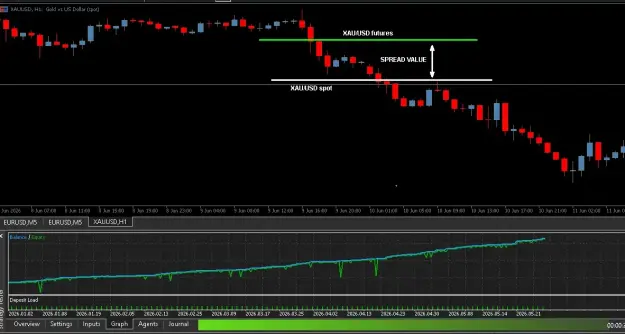
 However, this one performs arbitrage between XAU/USD Futures and XAU/USD Spot.
 It uses 3 RSIs: one deployed in the futures market, another in the spot market, and a third one looking for the spread between both markets, searching for gaps and price dislocations. When they drift apart to a certain spread distance—either due to high volatility or high-impact news—the order triangulation is triggered, and a trade is opened within that spread difference.
 The spread tends to revert to normal, and that is how the profit is captured.
 This means that whether the market swings up or down, it won't make the slightest difference because our order is triangulated within the spread gap.
 If the spread narrows, the balance goes positive regardless of where the market goes.
 Capturing small positions will keep filling your pockets with a few dollars, stacking resources so that when the spread truly creates a considerable vacuum, it uses all those captured resources to inject into the ultimate trade, ensuring a steady and very safe growth of your balance.
 Something similar that inspired us was an EA being sold on the MQL5 website for 7,000 dollars.
 However, we managed to replicate this feat, and you can acquire it for a fraction of that price.
 Are you interested in this EA or want to know more? Contact me via Telegram: @code88br
 Attached Image(s) (click to enlarge)


 This creates a sort of bid and ask that move along with the price. Our orders always oscillate within this margin.
 I have never seen anything like this before. Something similar exists on the MQL5 website in one of their most expensive EAs, but with these improvements in measuring the distance using RSI, I have never seen its equal. The RSI becomes dynamic, and when configured specifically, it can tell us exactly when volatility and the spread increase.
 This is a very safe way to trade and a highly intelligent way to manage funds.

 Contact me via TELEGRAM