

# USDJPY 5-Minute Morning Routine Report
**Date & Time of Analysis:** June 9, 2026, 21:00 UTC (Updated)
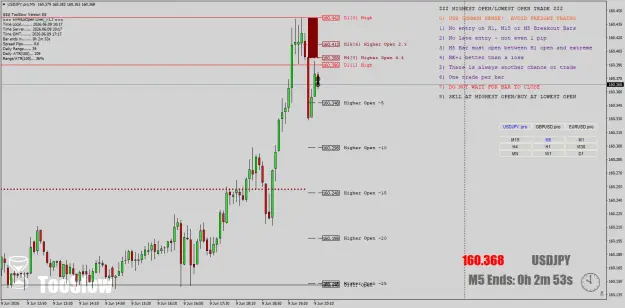
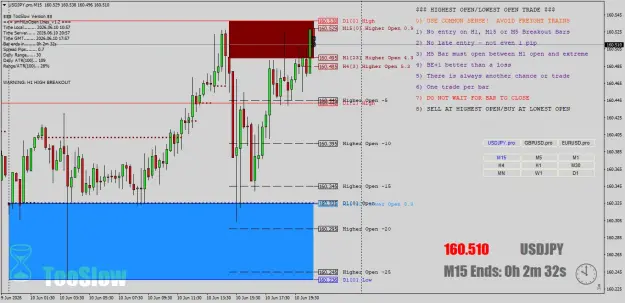
**Current USDJPY Price:** ~160.15 (Consolidating just above the 160.00 psychological handle) [citation:1][citation:3][citation:4]
## 1. Risk Appetite Analysis (Step 1)
- **Current Bias:** **Neutral-to-RISK-ON** (Geopolitical Relief).
- **The Context:** The market is currently digesting a geopolitical shift. The US Dollar is retreating slightly from a two-month high due to easing Middle East tensions [citation:3][citation:9].
- **The Signal:** Reports indicate Israel and Iran have halted direct attacks following an appeal from President Trump. This *reduces* demand for traditional safe havens like the USD and puts a slight bid into risk assets [citation:4][citation:5].
- **Implication for USDJPY:** While a "Risk-On" environment typically hurts the USD, the JPY is *also* a safe haven. Currently, the JPY is actually the **strongest** of the majors today because of local factors (see Step 3), creating a "tug of war" [citation:4][citation:6].
## 2. Economic Calendar Analysis (Step 2)
- **Immediate Threat:** **MODERATE** (Watch the clock).
- **Today's Data (June 9):**
- *10:00 AM ET:* US Wholesale Inventories & Existing Home Sales. Low expectation for volatility [citation:8].
- **The "Big Picture" Warning:**
- **TOMORROW (June 10):** US CPI (Consumer Price Index) report.
- **THURSDAY (June 11):** US PPI (Producer Price Index) report [citation:3][citation:4].
- **Professional Strategy:** The market is currently in a "holding pattern." Traders are reluctant to make large moves ahead of tomorrow's inflation data. However, the window *before* those reports (i.e., *right now*) often sees thin liquidity, allowing for technical moves.
## 3. Headline & Sentiment Analysis (Step 3)
- **The Dominant Story:** **The "Katayama Threshold" (Intervention Zone).**
- **The Threat:** Japan's Finance Minister Satsuki Katayama stated today that authorities remain ready to take "decisive action" against yen depreciation [citation:2][citation:3].
- **The Reality:** USDJPY is trading at ~160.15. This is the exact "danger zone" that prompted Japan to spend ~$73 Billion on intervention just one month ago [citation:2].
- **The Paradox:** Normally, easing Middle East tensions would *weaken* the Yen (less need for safety). However, the *threat* of Japan selling Dollars to defend 160 is acting as a floor under the Yen, preventing it from crashing [citation:4][citation:10].
## Professional Framework: The 3-Signal Overlay
Here is how the environment dictates the strategy for the next trading session:
| Signal Layer | Current Status | Impact on USDJPY |
| :--- | :--- | :--- |
| **Risk Appetite** | **Risk-On** (Stocks up, Oil down, Ceasefire news) | Bearish for USD/JPY (Money leaves USD safety). |
| **Economic Calendar** | **Pre-CPI Lull** (Major report due tomorrow) | Neutral/Bullish (Low volume could cause random spikes). |
| **Headlines** | **Intervention Warnings** (Japan threatening to sell USD) | **Bearish** (Strongest signal currently). |
## The Verdict & Trading Plan
**The Environment:** Hostile to chasing longs.
You have a perfect storm for a short-term USDJPY pullback:
1. The Dollar is generally weaker due to geopolitics.
2. Japan is actively *threatening* to force the price down.
**The Strategy:**
- **Avoid:** Buying USDJPY at current levels (160.10 - 160.30). This is considered "late entry" and dangerous given the intervention risk [citation:5][citation:10].
- **Watch for:** A breakdown below **159.90**. If the price breaks below 160, stop-losses may trigger, accelerating a move toward 159.50.
- **The "Professional" Trade:** If you are risk-averse, **stand aside**. The fundamentals say "Risk-On," but the technicals show the pair stuck at a major intervention level. Wait for the CPI report tomorrow to provide the energy to break this deadlock.
**Price Action Rule:** Respect the **160.00** line. If price stays above, it is stubbornly bullish. If price closes below **159.80** on the hourly, the intervention fears are winning and shorts become favorable.
**Date & Time of Analysis:** June 9, 2026, 21:00 UTC (Updated)
**Current USDJPY Price:** ~160.15 (Consolidating just above the 160.00 psychological handle) [citation:1][citation:3][citation:4]
## 1. Risk Appetite Analysis (Step 1)
- **Current Bias:** **Neutral-to-RISK-ON** (Geopolitical Relief).
- **The Context:** The market is currently digesting a geopolitical shift. The US Dollar is retreating slightly from a two-month high due to easing Middle East tensions [citation:3][citation:9].
- **The Signal:** Reports indicate Israel and Iran have halted direct attacks following an appeal from President Trump. This *reduces* demand for traditional safe havens like the USD and puts a slight bid into risk assets [citation:4][citation:5].
- **Implication for USDJPY:** While a "Risk-On" environment typically hurts the USD, the JPY is *also* a safe haven. Currently, the JPY is actually the **strongest** of the majors today because of local factors (see Step 3), creating a "tug of war" [citation:4][citation:6].
## 2. Economic Calendar Analysis (Step 2)
- **Immediate Threat:** **MODERATE** (Watch the clock).
- **Today's Data (June 9):**
- *10:00 AM ET:* US Wholesale Inventories & Existing Home Sales. Low expectation for volatility [citation:8].
- **The "Big Picture" Warning:**
- **TOMORROW (June 10):** US CPI (Consumer Price Index) report.
- **THURSDAY (June 11):** US PPI (Producer Price Index) report [citation:3][citation:4].
- **Professional Strategy:** The market is currently in a "holding pattern." Traders are reluctant to make large moves ahead of tomorrow's inflation data. However, the window *before* those reports (i.e., *right now*) often sees thin liquidity, allowing for technical moves.
## 3. Headline & Sentiment Analysis (Step 3)
- **The Dominant Story:** **The "Katayama Threshold" (Intervention Zone).**
- **The Threat:** Japan's Finance Minister Satsuki Katayama stated today that authorities remain ready to take "decisive action" against yen depreciation [citation:2][citation:3].
- **The Reality:** USDJPY is trading at ~160.15. This is the exact "danger zone" that prompted Japan to spend ~$73 Billion on intervention just one month ago [citation:2].
- **The Paradox:** Normally, easing Middle East tensions would *weaken* the Yen (less need for safety). However, the *threat* of Japan selling Dollars to defend 160 is acting as a floor under the Yen, preventing it from crashing [citation:4][citation:10].
## Professional Framework: The 3-Signal Overlay
Here is how the environment dictates the strategy for the next trading session:
| Signal Layer | Current Status | Impact on USDJPY |
| :--- | :--- | :--- |
| **Risk Appetite** | **Risk-On** (Stocks up, Oil down, Ceasefire news) | Bearish for USD/JPY (Money leaves USD safety). |
| **Economic Calendar** | **Pre-CPI Lull** (Major report due tomorrow) | Neutral/Bullish (Low volume could cause random spikes). |
| **Headlines** | **Intervention Warnings** (Japan threatening to sell USD) | **Bearish** (Strongest signal currently). |
## The Verdict & Trading Plan
**The Environment:** Hostile to chasing longs.
You have a perfect storm for a short-term USDJPY pullback:
1. The Dollar is generally weaker due to geopolitics.
2. Japan is actively *threatening* to force the price down.
**The Strategy:**
- **Avoid:** Buying USDJPY at current levels (160.10 - 160.30). This is considered "late entry" and dangerous given the intervention risk [citation:5][citation:10].
- **Watch for:** A breakdown below **159.90**. If the price breaks below 160, stop-losses may trigger, accelerating a move toward 159.50.
- **The "Professional" Trade:** If you are risk-averse, **stand aside**. The fundamentals say "Risk-On," but the technicals show the pair stuck at a major intervention level. Wait for the CPI report tomorrow to provide the energy to break this deadlock.
**Price Action Rule:** Respect the **160.00** line. If price stays above, it is stubbornly bullish. If price closes below **159.80** on the hourly, the intervention fears are winning and shorts become favorable.
My Threads: Trading is as simple as 1-2-3, Highest Open / Lowest Open Trade