

Some of you might have seen previous iterations of this project. I ditched it after I realised it needed a hell of a lot more work than I thought to be useful outside of me and my trading. What is it?
A way of selecting the best pair, best kind of trade, backed by rigorous statistical modelling. Effectively, live probabilities of price moves according to time of day, events coming up, pair, recent shocks. It answers specifically questions for FX intraday traders:
- What style of trade (trend, reversion, scalp, breakout) is most effective right now on which pairs
- What size stop over the next hour should I use (tight/medium/loose)
- What's the current condition of the market, together with markers that tell you when it's likely to change (aka regime)
- What's the likely move of the day? And the next hour?
- When should I NOT trade
All of this is done using a combination of mathematical models used across institutions worldwide - market makers, hedge funds, pension funds et al. It amazed me no-one has done this before for retail, and then when I started it I realised why. It's phenomenally complex. So complex, several times I nearly threw in the towel but eventually persisted to this, an MVP.
What it's not is a strategy. Or a buy here sell here mystical black box. Or AI anything (those who've tried, already know - AI is not yet good at structured data). And any old doughnut can wap together a bunch of labels that says BREAKOUT NOW! but that's not what this is about. It's about monitoring volatility - both realised and forecast, establishing differentials to tease out changing regimes which are invisible to the naked eye. I defy anyone to figure out the vol is 40% below normal on a chart. Everyone thinks they can, because they confuse direction with vol.
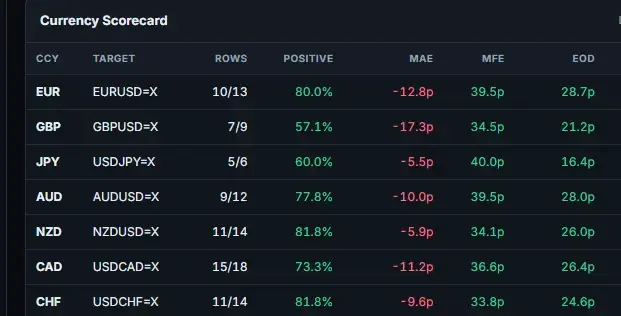
And finally, I hate dashboards - although this is one. Really hate them. Noone's ever made money from a dashboard. But it was necessary to expose the stats to ensure they're robust. And I've made the outputs - what you see on a chart - crushingly simple. Because when we're trading - me at least - I don't want to think hard about what does x/y/z indicate, I need to trade. So that's my focus and I hope it'll resonate.
I will be calling for beta testers in the coming weeks but going to use it myself first to tweak it until I know it's ready for real world use. Thus this as a journal for now. Also I realise that heavier quant stuff of coverage, qlike score and z tests is about as appealing as watching paint dry for most; basically, it's nerdy but it's necessary to get things as accurate as possible.
And for now, if you're confused as to what this really is - it all boils down to a chart and a decision matrix. On the chart, the gold box is the forecast range, the boxes are the hourly moves including what was historically forecast. Blue boxes are the future ranges - NOT where price will land. It could go up, it could go down. Imperfect but a damn sight better than finger in the air.
I trade daily so my benchmark of when this is ready for others is me being 100% sure it makes money. To do that, it needs real world testing first - ie live trades. Coming up next.
A way of selecting the best pair, best kind of trade, backed by rigorous statistical modelling. Effectively, live probabilities of price moves according to time of day, events coming up, pair, recent shocks. It answers specifically questions for FX intraday traders:
- What style of trade (trend, reversion, scalp, breakout) is most effective right now on which pairs
- What size stop over the next hour should I use (tight/medium/loose)
- What's the current condition of the market, together with markers that tell you when it's likely to change (aka regime)
- What's the likely move of the day? And the next hour?
- When should I NOT trade
All of this is done using a combination of mathematical models used across institutions worldwide - market makers, hedge funds, pension funds et al. It amazed me no-one has done this before for retail, and then when I started it I realised why. It's phenomenally complex. So complex, several times I nearly threw in the towel but eventually persisted to this, an MVP.
What it's not is a strategy. Or a buy here sell here mystical black box. Or AI anything (those who've tried, already know - AI is not yet good at structured data). And any old doughnut can wap together a bunch of labels that says BREAKOUT NOW! but that's not what this is about. It's about monitoring volatility - both realised and forecast, establishing differentials to tease out changing regimes which are invisible to the naked eye. I defy anyone to figure out the vol is 40% below normal on a chart. Everyone thinks they can, because they confuse direction with vol.
And finally, I hate dashboards - although this is one. Really hate them. Noone's ever made money from a dashboard. But it was necessary to expose the stats to ensure they're robust. And I've made the outputs - what you see on a chart - crushingly simple. Because when we're trading - me at least - I don't want to think hard about what does x/y/z indicate, I need to trade. So that's my focus and I hope it'll resonate.
I will be calling for beta testers in the coming weeks but going to use it myself first to tweak it until I know it's ready for real world use. Thus this as a journal for now. Also I realise that heavier quant stuff of coverage, qlike score and z tests is about as appealing as watching paint dry for most; basically, it's nerdy but it's necessary to get things as accurate as possible.
And for now, if you're confused as to what this really is - it all boils down to a chart and a decision matrix. On the chart, the gold box is the forecast range, the boxes are the hourly moves including what was historically forecast. Blue boxes are the future ranges - NOT where price will land. It could go up, it could go down. Imperfect but a damn sight better than finger in the air.
I trade daily so my benchmark of when this is ready for others is me being 100% sure it makes money. To do that, it needs real world testing first - ie live trades. Coming up next.
Attached Image(s) (click to enlarge)