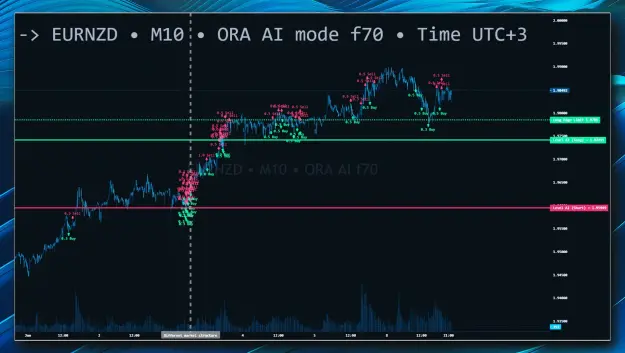


A quick reminder for anyone who has not followed the entire thread 
Most of the discussion here is about what we call the "difficult" trades. The successful ones rarely attract much research interest — and they are actually the majority (just look at the win rate on any account).
But if a system operates around 95%, there will always be the remaining 5%. Those are the trades we study.
Should we close them early and hand money to the broker? Or should we observe them carefully and understand how they behave? That is the purpose of this ongoing experiment.
Our approach is to observe. And what makes these cases especially interesting is that they have often produced even more profit when traded in line with the AI's logic rather than ignored. Typically, the AI has only one or two positions involved. The additional manual positions are ours — sometimes quite a few of them
Now consider a simple analogy.
Imagine you can forecast the weather with 90–95% accuracy. Suddenly, a storm appears during what was expected to be a sunny day. Does that single storm automatically invalidate the larger weather pattern? Does it suddenly transform the entire day into something fundamentally different?
Probably not.
Weather forecasting is actually a surprisingly good analogy here. It is complex, probabilistic, and deals with the future — just like markets.
Our view, supported by previous trade history, is that temporary disturbances do not necessarily invalidate the larger structure, provided one thing: your measured win rate is real, measured carefully, verified honestly, and not imagined.
That part, fortunately, is easy.
You can fool yourself. But it is much harder to fool publicly verified statistics
So once again, we watch and verify.
Let's see whether this case follows the same path
Most of the discussion here is about what we call the "difficult" trades. The successful ones rarely attract much research interest — and they are actually the majority (just look at the win rate on any account).
But if a system operates around 95%, there will always be the remaining 5%. Those are the trades we study.
Should we close them early and hand money to the broker? Or should we observe them carefully and understand how they behave? That is the purpose of this ongoing experiment.
Our approach is to observe. And what makes these cases especially interesting is that they have often produced even more profit when traded in line with the AI's logic rather than ignored. Typically, the AI has only one or two positions involved. The additional manual positions are ours — sometimes quite a few of them
Now consider a simple analogy.
Imagine you can forecast the weather with 90–95% accuracy. Suddenly, a storm appears during what was expected to be a sunny day. Does that single storm automatically invalidate the larger weather pattern? Does it suddenly transform the entire day into something fundamentally different?
Probably not.
Weather forecasting is actually a surprisingly good analogy here. It is complex, probabilistic, and deals with the future — just like markets.
Our view, supported by previous trade history, is that temporary disturbances do not necessarily invalidate the larger structure, provided one thing: your measured win rate is real, measured carefully, verified honestly, and not imagined.
That part, fortunately, is easy.
You can fool yourself. But it is much harder to fool publicly verified statistics
So once again, we watch and verify.
Let's see whether this case follows the same path
The future is determined solely by the present. More: ORASignal.com
 Expected BELOW 1.95949


 215.312.