

Historically, AUD has maintained a strong relationship with commodities, especially metals, liquidity cycles and global risk appetite. That is one of the reasons why institutional flows around Gold and AUD can sometimes reveal very interesting structural information when analyzed together.
And this is where things become interesting right now.
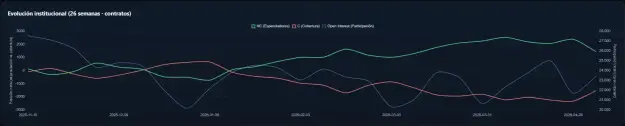
At first glance, Gold still looks institutionally active. Positioning remains large and participation is still present. But when I compare the current institutional structure of Gold against AUD, the picture underneath the surface becomes very different.
Gold currently shows a much more neutral and balanced institutional environment:
- participation is no longer expanding aggressively,
- continuation pressure has weakened,
- and transition pressure has started appearing beneath the surface.
Meanwhile AUD is showing something very different:
- cleaner institutional continuity,
- stronger positioning stability,
- rising conviction,
- and healthier participation relative to its own historical structure.
This is important because institutional analysis is not only about asking:
“Is Gold bullish or bearish?”
The deeper question is:
“Where is institutional conviction cleaner and stronger right now?”
And sometimes the answer is not the asset retail traders are emotionally focused on.
From my perspective, this is where institutional positioning becomes extremely valuable. It allows us to detect not only direction, but also relative quality of participation, conviction and structural health behind different markets.
Most retail traders only analyze candles.
But institutional money constantly rotates between assets searching for better structural conditions, cleaner continuation environments and stronger macro alignment.
That rotation process is often invisible if we only focus on price charts alone.


 Opening trades stopped feeling stressful
 I stopped sabotaging my own take profits and stops
 The need to constantly trade almost disappeared
 I stopped trying to constantly call tops and bottoms
 Pullbacks stopped feeling like panic situations



 what institutions are doing.