
December 8, 2025 – December 12, 2025
Waiting for Powell: The Art of Doing Nothing at High Altitude
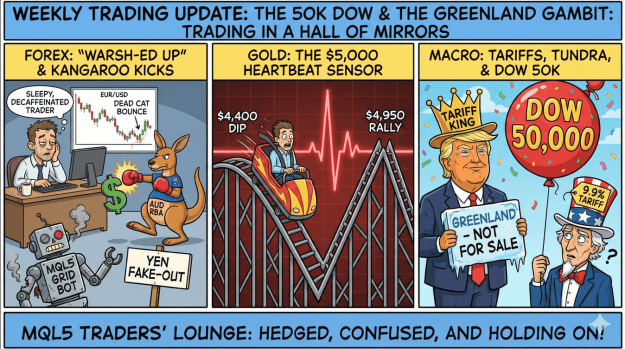
The Forex Stare-Down If you enjoyed watching paint dry this week, you probably loved the EUR/USD chart. The pair spent most of the week "consolidating" between 1.1550 and 1.1641, which is trader-speak for "we are terrified to move until Daddy Powell speaks." The entire market was paralyzed by the FOMC meeting, with a 90% probability of a rate cut priced in—because apparently, the other 10% of the market lives in a cave without Wi-Fi. We saw the usual pre-news jitters where the algorithm boys hunted stops on both sides, ensuring that retail traders trying to guess the "drift" got chopped up nicely before the actual news even hit. If your EA made money on this flatline, it’s either a genius or a ticking time bomb of a grid system.
Gold: The $4,200 "Boring" Zone Gold is trading comfortably above $4,200, and the audacity of the market is that we are calling this "range-bound." Remember when $2,000 was considered a psychological barrier? Now we are flirting with $4,300 targets, and analysts are yawning. The metal spent the week teasing a breakout, testing resistance near $4,240 but largely just sitting there collecting swap fees from anyone foolish enough to hold a position too long. It seems the only thing keeping Gold from rocketing to the moon or crashing back to reality is the collective breath-holding for the Fed’s 2026 outlook. It’s a "bullish consolidation," they say—which translates to "buy the dip, but please don't look at the RSI."
Macro Reality vs. Market Fantasy The S&P 500 slipped from its record highs because, heaven forbid, investors take profit before a major central bank decision. Inflation data came in "tame," which is a hilarious word to use for prices that are permanently stuck at "expensive." Meanwhile, the macro narrative has shifted from "recession fear" to "how many cuts can we bully the Fed into giving us?" The consensus seems to be that bad news is good news, good news is bad news, and no news is an excuse to sell. As we wrap up the week, the smart money has likely hedged everything, while the retail crowd is left wondering why their "guaranteed" news-trading setup hit stop-loss in both directions.

Waiting for Powell: The Art of Doing Nothing at High Altitude
The Forex Stare-Down If you enjoyed watching paint dry this week, you probably loved the EUR/USD chart. The pair spent most of the week "consolidating" between 1.1550 and 1.1641, which is trader-speak for "we are terrified to move until Daddy Powell speaks." The entire market was paralyzed by the FOMC meeting, with a 90% probability of a rate cut priced in—because apparently, the other 10% of the market lives in a cave without Wi-Fi. We saw the usual pre-news jitters where the algorithm boys hunted stops on both sides, ensuring that retail traders trying to guess the "drift" got chopped up nicely before the actual news even hit. If your EA made money on this flatline, it’s either a genius or a ticking time bomb of a grid system.
Gold: The $4,200 "Boring" Zone Gold is trading comfortably above $4,200, and the audacity of the market is that we are calling this "range-bound." Remember when $2,000 was considered a psychological barrier? Now we are flirting with $4,300 targets, and analysts are yawning. The metal spent the week teasing a breakout, testing resistance near $4,240 but largely just sitting there collecting swap fees from anyone foolish enough to hold a position too long. It seems the only thing keeping Gold from rocketing to the moon or crashing back to reality is the collective breath-holding for the Fed’s 2026 outlook. It’s a "bullish consolidation," they say—which translates to "buy the dip, but please don't look at the RSI."
Macro Reality vs. Market Fantasy The S&P 500 slipped from its record highs because, heaven forbid, investors take profit before a major central bank decision. Inflation data came in "tame," which is a hilarious word to use for prices that are permanently stuck at "expensive." Meanwhile, the macro narrative has shifted from "recession fear" to "how many cuts can we bully the Fed into giving us?" The consensus seems to be that bad news is good news, good news is bad news, and no news is an excuse to sell. As we wrap up the week, the smart money has likely hedged everything, while the retail crowd is left wondering why their "guaranteed" news-trading setup hit stop-loss in both directions.
Attached Image (click to enlarge)