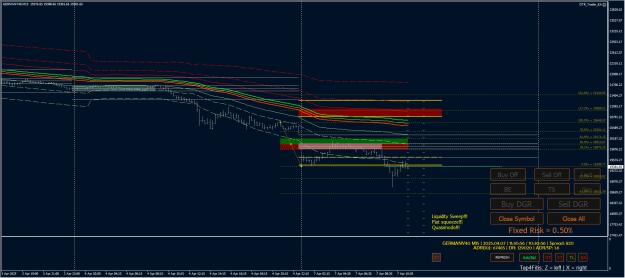


MT4 Trading Strategy Based on Trend Average and Pivot Points
The MT4 Trading Strategy Based on Trend Average and Pivot Points is a technical trading method designed for use on the MetaTrader 4 (MT4) platform. It combines trend-following principles with pivot point analysis to identify trade opportunities and manage risk. The strategy leverages a 100-period moving average (MA) and pivot point levels to determine the prevailing market trend on a higher timeframe, while executing trades on a designated base trading timeframe. This approach aims to capture directional movements by confirming trend bias and identifying key support and resistance levels.
Overview

This strategy employs a two-tier timeframe analysis. The higher timeframe is used for trend identification through the application of a 100-period moving average and pivot points, while the base trading timeframe is utilized to pinpoint precise entry and exit levels. Pivot points, calculated from timeframes that are higher than the base chart, serve as both trend confirmation tools and potential target levels. The method is adaptable, allowing traders to select base timeframes according to their trading style and the specific characteristics of the instrument being traded, such as intraday indices, commodities like gold, or longer-term assets.
Key Components
Trend Identification
- Higher Timeframe Analysis:
The strategy requires the use of a trend identification timeframe (e.g., H4 for base timeframes up to H1, or daily for higher base timeframes). - Moving Average (100-Period):
A 100-period moving average is applied to the higher timeframe to smooth out price action and help determine the overall trend. - Trend Bias Determination:
The market is considered to be in an uptrend if the price closes above both the pivot point (PP) and the 100-period MA, and in a downtrend if it closes below these levels.
Pivot Points
- Calculation Across Timeframes:
Pivot points are derived from a timeframe that is higher than the base trading timeframe. For instance, daily pivots might be used for a 15-minute chart, weekly pivots for a 1-hour chart, and monthly pivots for a 4-hour chart. - Support and Resistance Levels:
In addition to aiding in trend confirmation, pivot points (including levels such as PP, S1, S2, R1, R2) serve as reference levels for setting entry targets and stop losses.
Base Trading Timeframe
- Execution Chart:
The base trading timeframe is the chart where actual trades are placed. It can vary from M15 for short-term trading to H1 or H4 for longer-term strategies. - Alignment with Trend Bias:
Trades on the base chart are executed in the direction of the trend identified on the higher timeframe.
Strategy Implementation
Step-by-Step Process
- Define Your Base Trading Timeframe:
Select a chart that matches your trading style. For example, use M15 for intraday trading, H1 for commodities like gold, or H4 for longer-term trades. - Set the Pivot Timeframe:
Calculate pivot points from a higher timeframe than the base chart. Configure the MT4 pivot point indicator to display levels appropriate to the instrument and trading style (daily, weekly, or monthly). - Set the Trend Identification Timeframe:
Open a higher timeframe chart (e.g., H4 or daily) to determine the overall trend using the 100-period MA and pivot points. - Apply the Trend Average:
Add a 100-period moving average to the trend identification chart to filter the market noise and confirm the trend direction. - Determine Trend Bias:
- Uptrend: Price is above both the pivot point and the moving average.
- Downtrend: Price is below both the pivot point and the moving average.
- Establish Trading Rules:
- Long Trades: Initiated when the trend is up, and the price on the base chart shows signs of reversal at support levels (e.g., PP or S1).
- Short Trades: Initiated when the trend is down, and the price on the base chart indicates potential resistance (e.g., PP or R1).
Additional indicators such as RSI or MACD may be used for further entry confirmation.
- Setting Targets and Stops:
- Targets: Utilize pivot levels (e.g., R1 and R2 for long trades, S1 and S2 for short trades) as potential profit targets.
- Stop Losses: Define stop levels based on recent swing lows or highs, or near key pivot levels to manage risk effectively.
- Risk Management:
Employ proper risk management by limiting the risk per trade (typically 1-2% of the trading account) and maintaining a risk-reward ratio of at least 1:2. This ensures that losses are controlled relative to potential gains.
Example Scenario: Trading GOLD on H1
- Base Timeframe: H1 chart.
- Pivot Timeframe: Weekly pivots.
- Trend Identification: H4 chart is used with a 100-period moving average.
- Execution:
If the H4 chart indicates an uptrend (price closes above the weekly pivot point and 100-MA), the trader would look for long opportunities on the H1 chart. A typical entry might involve a pullback to the weekly pivot point accompanied by a bullish reversal candlestick pattern, with a target set at R1 and a stop placed below the pivot point or a recent swing low.
MT4 Implementation and Automation
- Indicators and Tools:
- Pivot point indicators that support various higher timeframe settings are essential.
- The 100-period moving average is readily available within MT4’s built-in tools.
- Chart Configuration:
Traders should maintain two charts: one for the base trading timeframe and another for the trend identification timeframe. - Expert Advisor (EA):
Automation can be achieved by programming an EA in MQL4 to detect trend bias, generate trade signals, and manage orders based on the defined criteria.
Final Summary

The MT4 Trading Strategy Based on Trend Average and Pivot Points integrates multiple technical analysis tools to establish a coherent trading approach. By combining the long-term trend identification capabilities of a higher timeframe moving average and pivot points with precise entry and exit signals on a base trading timeframe, traders can systematically approach market trends and optimize their risk management practices. While the strategy is adaptable to various instruments and trading styles, traders are encouraged to test and adjust parameters to align with specific market conditions.
Disclaimer: This article is for informational purposes only and does not constitute financial advice. Traders should conduct their own research and consider consulting with a financial professional before implementing any trading strategy.
---
Credit: @BestTraderEv
---
Disliked{quote} {file} I use: Trend Average Periods: 100 Pivot Timeframe: will be dependent on the instrument, spread, and your base trading Tf. Examples: For Intraday Indices Trading (High volatility, small relative Spread) I use Daily for M15 as my base trading Tf. For GOLD I use Weekly for H1 as my base trading Tf. If I wanted to use H4 as my base trading Tf, I would use Monthly Pivot Timeframe. So, the basis is the base trading Tf. Timeframe for Trend Identification: I use 4 Hours for base trading Tfs up to H1. Higher base trading Tfs will require higher...Ignored