



I never said risk wasn't a factor, only that it doesn't come close to taking precedence over the ability to have a process oriented approach to trading.
Al Brooks very clearly and explicitly states that too tight a stop loss, not too tight relative to the reward. I'd post the link but the copy I have of the interview was shared with me by someone else and I don't have permission to post it. However, the interview from which the clip was taken is on youtube. I don't remember who the interviewer was, but he had an accent, maybe British, maybe Australian, I'm not sure. I believe the interview was pre-covid, maybe sometime between 2015 and 2019.
The problem with the chart you posted is that it fools those who've not experienced the roulette epiphany into making (more likely, maintaining) false assumptions about the risk/reward equation because it mentions "win rate" without making clear that "win rate" is just laymen's speak for "probability," and that as reward to risk increases in favorability, probability, i.e. "win rate? shrinks. A 5:1 win rate requires only a 20% win rate. But the win rate of 5:1 trades is likely to be less than that. I posted a video about this a few pages back in the thread. A trader was advised when he was new to go for larger rewards relative to his risk. As he increased his profit target he started to lose more often. That is the fact that such charts as you posted hide. I feel bad for the newer traders following along who come across that chart now and think "oh, that makes sense." Once they do that, they're trapped. Failure is assured.
If you want to keep your focus on risk reward and chasing 2:1 and 3:1 R/R's and using phrases like "asymmetrical risk:reward" do so. However, sports bettors, poker players, blackjack players, and futures traders who manage to earn an income they can rely on are not receiving more than $1 back for every $1 bet. In most cases, at the end of a series of bets, they are receiving maybe 50 to 60 cents in profits for every $1 bet over time. I'm not suggesting there ar no trading approaches that might give the 10:1 reward to risk. However, if it does, it will be like Gonzalo's roulette bets: Lose most, but when you win, it flips the ledger green.
Billy Walters has amassed a huge fortune, betting $110 to win $100. He wins about 57% of his bets by his own account. That, to me, is what most of us should be looking for here: Bet $110 to $100 and win as close to 60% as you can. Do that, and you can make a lot of money. However, keep chasing the multi-baggers and that win rate will become vanishingly small and your account will likely be blown because in all likelihood, you don't really have the edge you need to deliver a 20% win rate on 5:1 trades.
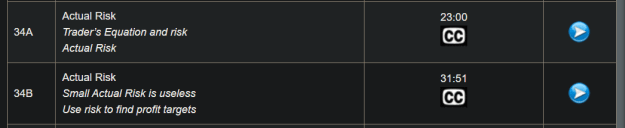
Finally, there is aa distinction to be made between "initial risk" and "actual risk." Initial risk is where Brooks would suggest you place your natural price action stop. As price moves favorably, the market will eventually reveal the "actual risk" of the trade. This is where one will generate multiple R's, not by designing a system to seek multiple R's, but by taking sound price action entries where the likelihood is about 60% in your favor that price will move in your favor, and on those trades that are profitable, your R:R will be higher than the initial risk appeared. But you have to be willing to risk that initial risk in order to trade from a care free state of mind.
For those who have access to Brooks's trading course, review these two videos:
I used to believe all this bull$hit but I've made too much $$$ the past five months since shedding ti to believe it ever again. I'm no millionaire trader and I don't want to sound like my life is suddenly Lambo's and bimbos. But getting rid of those false beliefs has made a world of difference for my own profitability.
Some of these trading beliefs are held by people almost as a matter of religion. I'm not here to slat anyone's god. And therefore, you should hold on to whatever beliefs you wish.
Al Brooks very clearly and explicitly states that too tight a stop loss, not too tight relative to the reward. I'd post the link but the copy I have of the interview was shared with me by someone else and I don't have permission to post it. However, the interview from which the clip was taken is on youtube. I don't remember who the interviewer was, but he had an accent, maybe British, maybe Australian, I'm not sure. I believe the interview was pre-covid, maybe sometime between 2015 and 2019.
The problem with the chart you posted is that it fools those who've not experienced the roulette epiphany into making (more likely, maintaining) false assumptions about the risk/reward equation because it mentions "win rate" without making clear that "win rate" is just laymen's speak for "probability," and that as reward to risk increases in favorability, probability, i.e. "win rate? shrinks. A 5:1 win rate requires only a 20% win rate. But the win rate of 5:1 trades is likely to be less than that. I posted a video about this a few pages back in the thread. A trader was advised when he was new to go for larger rewards relative to his risk. As he increased his profit target he started to lose more often. That is the fact that such charts as you posted hide. I feel bad for the newer traders following along who come across that chart now and think "oh, that makes sense." Once they do that, they're trapped. Failure is assured.
If you want to keep your focus on risk reward and chasing 2:1 and 3:1 R/R's and using phrases like "asymmetrical risk:reward" do so. However, sports bettors, poker players, blackjack players, and futures traders who manage to earn an income they can rely on are not receiving more than $1 back for every $1 bet. In most cases, at the end of a series of bets, they are receiving maybe 50 to 60 cents in profits for every $1 bet over time. I'm not suggesting there ar no trading approaches that might give the 10:1 reward to risk. However, if it does, it will be like Gonzalo's roulette bets: Lose most, but when you win, it flips the ledger green.
Billy Walters has amassed a huge fortune, betting $110 to win $100. He wins about 57% of his bets by his own account. That, to me, is what most of us should be looking for here: Bet $110 to $100 and win as close to 60% as you can. Do that, and you can make a lot of money. However, keep chasing the multi-baggers and that win rate will become vanishingly small and your account will likely be blown because in all likelihood, you don't really have the edge you need to deliver a 20% win rate on 5:1 trades.
Finally, there is aa distinction to be made between "initial risk" and "actual risk." Initial risk is where Brooks would suggest you place your natural price action stop. As price moves favorably, the market will eventually reveal the "actual risk" of the trade. This is where one will generate multiple R's, not by designing a system to seek multiple R's, but by taking sound price action entries where the likelihood is about 60% in your favor that price will move in your favor, and on those trades that are profitable, your R:R will be higher than the initial risk appeared. But you have to be willing to risk that initial risk in order to trade from a care free state of mind.
For those who have access to Brooks's trading course, review these two videos:
Attached Image (click to enlarge)
I used to believe all this bull$hit but I've made too much $$$ the past five months since shedding ti to believe it ever again. I'm no millionaire trader and I don't want to sound like my life is suddenly Lambo's and bimbos. But getting rid of those false beliefs has made a world of difference for my own profitability.
Some of these trading beliefs are held by people almost as a matter of religion. I'm not here to slat anyone's god. And therefore, you should hold on to whatever beliefs you wish.
Life itself is a privilege, but to live life to the fullest is a choice
8


 Love the template VidVad ...


