Similar Threads
Whats your best money management method? 52 replies
How to flow with the order flow? 26 replies
Money Management / Risk Management 24 replies
Money management model for multiple strategy trading method 16 replies
Most popular money management method. 7 replies
- #14,382
- Jan 16, 2025 6:38am Jan 16, 2025 6:38am
- | Commercial User | Joined Dec 2014 | 14,164 Posts
- BenjaminIs
- | Commercial Member | Joined Dec 2014 | 12,231 Posts | Online Now
Attached Image (click to enlarge)
https://www.forexfactory.com/attachm...l?d=1721753447
WWW.AVIELFOREXLEARNINGEDGE.COM
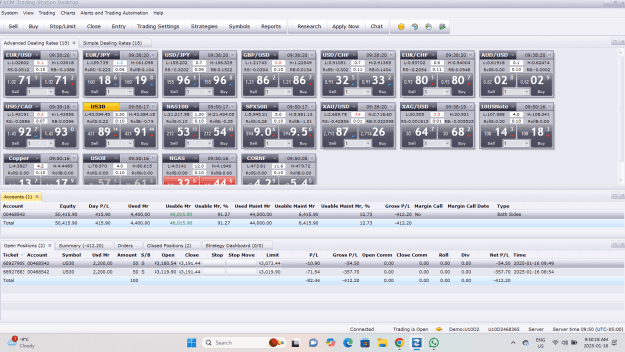
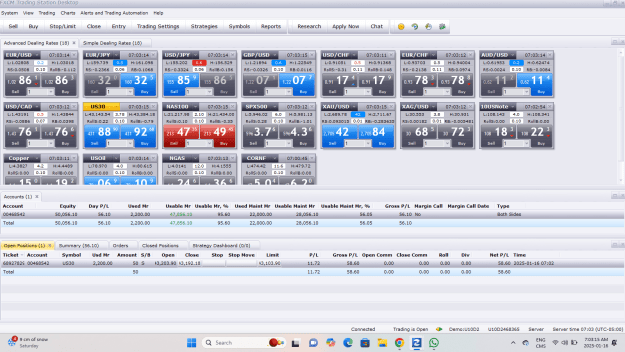
All SCREEN SHOTS show ALL Forex trades BEFORE and AFTER the FOREX Traes !!!
NOTE from BWM: This $50,000 US dollars FXCM UK Demo account was opened on January 15, 2025.
In the last 20 years, TOP FOREX traders rarely earn over 5% a month or 60% a year and NEVER more than 3 years in a row. There are reasons for this.
My students are expected to earn 5% a month under my guidance for 90 days, the length of my hands-on teaching.
Forex trading presents vast opportunities for profit through its high liquidity and leverage options. However, it also carries inherent risks, demanding a thorough understanding of market mechanics, disciplined trading strategies, and effective risk management. As a dynamic and complex financial market, Forex offers global challenges and rewards to participants.
WWW.AVIELFOREXLEARNINGEDGE.COM
News from around the world. Please CLICK on the link below.
https://finviz.com/news.ashx?v=2
5-Minute Chart of Dow 30 - Our X-Ray Photo - Please CLICK on the LINK below.
https://finviz.com/futures_charts.ashx?p=i5&t=YM
Please sign up for our 90-day Forex Trading and Information course by sending E Transfer of 125.00 Canadian dollars to Tobyruth11@yahoo.com
"Trader", does not mean that the sole objective is to make money. The moment you come with money-making as the sole and only objective, you are out of the game anyway and part of the larger crowd which is unsuccessful
Do things that can identify you as a professional trader - learn the process, understand and follow risk management and position sizing. Be disciplined and understand that trading is a long haul.
Each day around 8:30 AM to 9:30 AM Eastern Standard Time, I determine whether we have RISK ON or OFF.
No indicator can do this just as no technical indicator can effectively predict what will happen moment to moment as one MAJOR fundamental fact whether GEOPOLITICAL or FINANCIAL or now SUPPLY CHAIN or some New Covid 19 variant can cause the markets to go down or up 500 points as the Dow 30 has been doing recently and will continue to do. This happens sometimes in one day so normal charting cannot work.
That is why my Unique Method of Forex trading developed in 2003 when I started trading Forex and later in 2012 when I added to my business model and started teaching my unique 100% proven method of Money Flow trading.
It is no longer possible to trade without a STOP LOSS.
A STOP LOSS of fewer than 100 PIPS is not a good strategy. That leads me to explain why most of the 95% of all Retail Forex Traders lose. They trade with small amounts of money and SCALP, making it almost impossible to make profits over one year because of the VIOLENT NATURE of the swings in the Asset Classes caused by world-changing events.
Each Forex Trade that you do should not risk more than 2% of your trading Capital and that is based on trading Capital of $50,000 US Dollars, INITIALLY learning on a $50,000 US Funds Demo account just as I did for three years before I made my first Real Funds Trade on March 9, 2006, 18 years ago.
PLEASE GO WITH THE MONEY FLOW
Let us review what we teach and why it works if YOU WORK.
Without your WORK, you are wasting your time and probably your money.
There is no such thing as Political Correctness here because we are here to teach and share our knowledge.
SO.... going back to our winning FORMULA for FOREX SUCCESS.
20% of the SUCCESS is yourself the Forex Trader.
20% of the SUCCESS is your EDGE, which we teach you, Money Flow Trading.
20% of the SUCCESS is control of your RISK (Your hard-earned money) Our UNIQUE RISK MANAGEMENT allows you to trade without worry, fear, and greed. Of course, we want to make sure that you have the right qualities to be a winning Forex Trader so our course is for three months, so we can teach you the right trading methods we can see your results and make adjustments without your FEAR OF LOSS of Real Money.
20% of the SUCCESS is using and understanding the USE of Technical Indicators which include not only the common ones. It consists of understanding supply and demand. Support and Resistance and the use of Pivot Points which you can see daily on our daily charts that cover ALL our Trade Plans which we also help you develop and explain WHY. We review These Winning Trade Plans every three months or earlier if market circumstances require that.
20% of the SUCCESS is the FUNDAMENTALS, which are much more than Data released daily worldwide. It includes reports and articles extremely well researched as you can see from this article that explains why the TREND in the Equity Markets especially in North America is DOWN. By understanding the difference between PERCEPTIONS (MARKETS) and REALITY, you have a good handle on REALITY before the MASSES do and are not surprised when events eventually unfold.
When successful traders aren't trading, they are researching, developing, and innovating. When unsuccessful traders aren't Forex trading, they stare at screens and force trades. There is nothing better for trading psychology than being at the cutting edge of a growing business.
Quoting perfectionis
What are the key principles of risk management in forex trading, especially considering the influence of central banks and market sentiment? How do you determine risk-on or risk-off conditions, and how does it affect currency flows? Considering both fundamental factors and technical indicators, what impact could the Britain election have on forex markets? The election took place on Thursday, July 4, 2024.
The answers to your excellent questions will happen by you registering to post on Forex Factory so you can then post your questions or comments on my thread.
THE RETAIL SALES NUMBER FOR DECEMBER 2024 WILL BE RELEASED at 8:30 AM.
If the number is low the PERCEPTION, not the REALITY which they cannot do practically because it will lead to more inflation. Most commercial and retail Forex traders have no idea what QE (Quantative Easing) and QT (Quantative Tightning) do to CAUSE INFLATION.
If you want to call me and discuss it further I offer direct contact by calling me at 1 819 275 7780. Please sign up for my service by sending a Bank E Transfer in Canadian funds to Tobyruth11@yahoo.com
The fee is 125.00 dollars in Canadian funds from your bank account by E-Transfer.
We believe in a hands-on approach at a more than reasonable cost for a comprehensive service.
We can all see by looking at the link below, the 5 Minute Chart of Dow 30, the patterns keep repeating and you all have a chance if you want to learn to become very wealthy over the next year by signing up. You have zero risk as the information that you will have access to is invaluable.
Here is the link.
https://finviz.com/futures_charts.ashx?p=i5&t=YM
LOOK AT THE PATTERN OF TODAY and Every Forex trading day from Sunday at 2:00 AM Eastern Standard Time in Europe to 10:00 AM Eastern Standard Time when North American Equity Markets start trading at 9:30 AM Eastern Standard Time on Monday.
This X-RAY and PATTERN repeats between Sunday and Friday at 5:00 PM Eastern Standard Time when All Forex Trading stops until 3:00 PM Eastern Standard Time when New Zealand opens for trading followed by Asia at 8:00 PM, Europe at 2:00 AM and North America at 9:30 AM.
ABSOLUTE FORTUNES ARE POSSIBLE ONCE YOU UNDERSTAND !!! And you show that you have the DISCIPLINE by your results to CONTROL your FEAR, GREED and EGO !!! The markets are always right until they are not.
https://finviz.com/futures_charts.ashx?p=i5&t=YM
If you want to call me and discuss it further I offer direct contact by calling me at 1 819 275 7780. I will spend a minimum of 30 minutes with you on the telephone to answer any of your questions at NO COST TO YOU. Please sign up for my service by sending a Bank E Transfer of Canadian funds to Tobyr[email protected]
5-Minute Chart of Dow 30 - Our X-Ray Photo - Please CLICK on the LINK below.
https://finviz.com/futures_charts.ashx?p=i5&t=YM
NOTE: PLEASE REGISTER TO POST ON THIS THREAD. WE CAN THEN HELP YOU BECOME SKILLED WITH 24/7 Guidance. It costs nothing to register and takes less than 5 minutes.
CLICK ON THE LINK ABOVE AND LOOK AT THE REPEATING X-RAY Each Forex Trading Day.
You Need To Act So I Can Help You DISCOVER if you have the SKILLS to become a winning Forex trader using LEVERAGE of 100 to 1.
Our Forex Trade Plan from January 1, 2025, until March 31, 2025, is SHORT 50 UNITS of DOW 30, SHORT 50 UNITS of SP500, Go LONG 100 ounces of Gold and 5000 Ounces of Silver. I usually choose one of the MAJOR Currency Pairs to SHORT or GO LONG ON.
WWW.AVIELFOREXLEARNINGEDGE.COM
CLICK ON THIS LINK - IT IS THE 5-Minute Chart Of Dow 30. See how the KNOWN PATTERNS REPEAT -
https://finviz.com/futures_charts.ashx?p=i5&t=YM
The Dow Jones 30 (DJIA) went UP OVER 700 points YESTERDAY when the actual trading started and 4:00 PM when the markets closed.
I was travelling between Montreal and my home in Riviere Rouge, Quebec and I did no Forex trades HOWEVER, I opened a NEW DEMO account and have already put on my FIRST FOREX TRADE for today with a PROFIT TARGET of $500.00.
Attached Image (click to enlarge)
https://www.forexfactory.com/attachm...l?d=1722691331
THE WRONG PERCEPTION WORLDWIDE CONTINUED IN THE STOCK MARKETS.
WHY? Most Traders and EXPERTS do not understand ECONOMICS. READ THE JANUARY 2025 JOHN HUSSMAN NEWSLETTER.
HE CALLED IT PERFECTLY. RATE CUTS CANNOT STOP A RECESSION AND OTHER SERIOUS PROBLEMS IN THE MANIPULATED STOCK MARKETS.
https://finviz.com/futures_charts.ashx?p=i5&t=YM
LOOK AT THE PATTERN OF the last 24 hours as it repeats every day which is why my results are so spectacular and PROFITABLE.
CLICK ON THE LINK ABOVE AND SIGN UP OR CALL ME FOR A ONE-ON-ONE 30-minute discussion. Thanks - BWM
- #14,384
- Jan 16, 2025 6:42am Jan 16, 2025 6:42am
- | Commercial User | Joined Dec 2014 | 14,164 Posts
https://www.hussmanfunds.com/comment/mc250107/
Pressing for Yet More
https://www.hussmanfunds.com/wp-cont...utton60x60.jpg
https://www.hussmanfunds.com/wp-cont..._thumbnail.jpg
John P. Hussman, Ph.D.
President, Hussman Investment Trust
January 2025
That the free-enterprise economy is given to recurrent episodes of speculation will be agreed upon. There is protection only in a clear perception of the characteristics common to these flights… There are, however, few matters on which such a warning is less welcomed. Those involved with the speculation are experiencing an increase in wealth – getting rich or being further enriched. No one wishes to believe that this is fortuitous or undeserved; all wish to think that it is the result of their superior insight or intuition. Speculation buys up, in a very practical way, the intelligence of those involved. As long as they are in, they have a strong pecuniary commitment to belief in the unique personal intelligence that tells them that there will be yet more.”
– John Kenneth Galbraith, A Short History of Financial Euphoria
On December 6, the S&P 500 set the most extreme level of valuations on record, exceeding both the 1929 and 2000 market peaks on measures that we find best correlated with actual, subsequent 10-12-year S&P 500 total returns across a century of market cycles.
Reliable valuation measures are enormously informative about both long-term investment returns and the potential depth of market losses over the completion of any given market cycle. At the same time, valuations are of strikingly little use in projecting market outcomes over shorter segments of the market cycle. Investor psychology – the desire to speculate, or the aversion to risk – has a much stronger impact, which is why we also have to attend to factors including market internals, sentiment, short-term overextension/compression, and monetary policy (while unfavourable market internals dominate monetary easing, favourable internals amplify it).
Amid the untethered enthusiasm about artificial intelligence, and prospects for deregulation and lower corporate taxes, it’s worth repeating that despite all the society-changing innovations of the past 20-30 years, both GDP and S&P 500 Index revenues (which include the impact of stock buybacks) have grown at an average rate of only about 4.5% annually. That’s slower, not faster than the growth rate during the preceding half-century.
Yes, the largest companies are very profitable, but that’s nearly always true at speculative extremes. That cohort of mega-cap companies is constantly changing, and except on their approach to extremes like 1929, 1972, 2000, and today, the companies with the largest market capitalizations have historically gone on to lag the S&P 500 over time.
Investors regularly forget that the central feature of free enterprise is the continual emergence of innovation-driven “new eras” in which both profit margins and growth rates are trajectories rather than durable numbers. As I reviewed in last month’s comment, Ring Out Wild Bells, the primary driver of rising profit margins since 1990 has not been rapid productivity growth or higher EBIT margins (earnings before interest and taxes). The simple reality is that most of the expansion in profit margins since 1990 is explained by falling interest expense, thanks to persistently declining interest rates that companies temporarily locked in at the 2020-2021 lows.
https://www.hussmanfunds.com/wp-cont.../mc250107a.png
Meanwhile, most of the historical impact of corporate tax reductions was reflected in profit margins by the early 1980’s. Even if corporate taxes were reduced by one-third from here, and assuming those tax cuts were sustained permanently, the value of that tax reduction would amount to just 4% of market capitalization, and after-tax profit margins would increase by less than 1%.
https://www.hussmanfunds.com/wp-cont.../mc250107b.png
Having priced the stock market at elevated multiples of record earnings, investors now require profit margins to sustain record highs permanently – simply for growth in earnings and payouts to match the 4.5% revenue growth rate of recent decades, and they require the S&P 500 price/revenue ratio to remain at a permanently high plateau, three times its historical norm.
Given our 4-year baseline expectation for real GDP growth of just 1.5% (see The Turtle and the Pendulum), even 4.5% nominal growth would require either a 3% inflation rate in the coming years, or a 2% inflation rate coupled with a jump in productivity that fully restores the 1948-2000 average.
One might hope for higher inflation, imagining that it might produce higher nominal growth and accompanying market returns, but that would require valuations to remain at record extremes. Unfortunately, valuations are the first casualty of persistent inflation. In fact, except when valuations have been at least 25% below historical norms, the S&P 500 has lagged Treasury bills, on average, when consumer price inflation has been anything over 4%.
There’s no question that investors are eager to justify record valuation multiples by appealing to the growing share of technology companies in the S&P 500. Yet the technology sector itself is trading at the highest multiple to revenues on record. Meanwhile, the growth rate of overall S&P 500 revenues, which include the technology sector, is below historical norms while the S&P 500 price/revenue multiple is three times its historical norm, easily eclipsing the 1929 and 2000 peaks.
Still, for the moment, neither valuations nor arithmetic matter to investors. As Galbraith observed, “As long as they are in, they have a strong pecuniary commitment to belief in the unique personal intelligence that tells them that there will be yet more.”
Hence the sort of magazine cover Barron’s ran only a week after the S&P 500 set its recent record high – “Embrace the bubble.”
https://www.hussmanfunds.com/wp-cont.../mc250107c.png
What defines a bubble is that investors drive valuations higher without simultaneously adjusting expectations for returns lower. That is, investors extrapolate past returns based on price behaviour, even though those expectations are inconsistent with the returns that would equate price with discounted cash flows. The defining feature of a bubble is an inconsistency between expected returns based on price behaviour and expected returns based on valuations.
John P. Hussman, Ph.D., How to Spot a Bubble, March 2021
A review and update of market conditions
Our most reliable gauges of market valuation continue to trace out what I view as the extended peak of the third great speculative bubble in U.S. history – implying the most negative prospects for expected S&P 500 total returns on record. Still, valuations are not a timing tool. Given the continued unfavourable (and deteriorating) status of our key gauge of market internals, along with a continued preponderance of overextended warning syndromes, our investment outlook remains negative.
Although there are many points in history when the S&P 500 advanced despite a combination of elevated valuations and unfavourable internals, including the approaches to the 1972, 2000 and 2007 market peaks, there’s no question that an additional speculative tailwind was added in 2024 by Wall Street’s exuberance about AI and its eagerness for profit-centric policy shifts. As I noted in September Asking a Better Question, given the internal divergences we observe (which have worsened considerably in recent weeks), my impression is that our gauge of internals remains unfavourable precisely because of the internal divergences it is designed to measure. It’s the wrong question to ask how we might cleverly dart between a defensive outlook and a bullish one amid historically ominous market conditions. The better question was how to vary the intensity of a valid defensive outlook, in a way that can be expected to benefit even in a further advance, provided only that the market fluctuates along the way.
At present, based on the hedging adaptation we implemented in late September, we aren’t inclined to tighten our put option hedges further in the event of a continued market advance. Our outlook is bearish here, but it’s not one I expect to amplify at the moment. As I detailed in Subsets and Sensibility, one of the features of this hedging adaptation is that it reduces our risk of “fighting” market advances even in market conditions that are quite hostile from a historical perspective.
Concerning prevailing conditions, the chart below reviews our most reliable gauge of market valuations in data since 1928: the ratio of nonfinancial market capitalization to gross value-added (MarketCap/GVA). Gross value-added is the sum of corporate revenues generated incrementally at each stage of production, so MarketCap/GVA might reasonably be viewed as an economy-wide, apples-to-apples price/revenue multiple for U.S. nonfinancial corporations.
https://www.hussmanfunds.com/wp-cont.../mc250107d.png
The chart below shows our Margin-Adjusted P/E, which considers cyclical variations in profit margins and their impact on the price/earnings ratio, along with the ratio of the S&P 500 to the present value of actual subsequent S&P 500 dividends at every point in time since 1900, discounted at a constant rate of 10% annually (see chart text for additional details). The ratio therefore estimates the extent to which long-term S&P 500 total returns are likely to depart from a 10% average return. The higher the valuation, the larger the expected shortfall from historically run-of-the-mill expected returns of 10%.
https://www.hussmanfunds.com/wp-cont.../mc250107e.png
The chart below shows how our S&P 500 dividend discount model above is related to actual subsequent S&P 500 total returns in data since 1871. The relationship isn’t perfect. As with every good valuation measure, the “errors” typically reflect extreme valuations at the endpoint of a given investment horizon. For example, actual 10-year market returns (red) were substantially higher than expected returns (blue) in the 10 years beginning in 1919. The reason is that the endpoint of that 10-year horizon was the 1929 bubble peak. Likewise, actual 10-year market returns were substantially lower than expected returns in the 10 years beginning in 1922, because the endpoint of those 10 years was the 1932 market low.
https://www.hussmanfunds.com/wp-cont.../mc250107f.png
You’ll see that same feature of “errors” across history. Actual 10-year market returns were substantially lower than expected returns in the 10 years beginning in 1964 because the endpoint of that 10-year horizon was the 1974 secular valuation low. Actual 10-year market returns were substantially higher than expected returns in the 10 years beginning in 1990 because the endpoint of that 10-year horizon was the 2000 bubble peak.
Put simply, these so-called “errors” contain information. It’s enormously tempting to imagine, at bubble highs, that glorious backward-looking returns, far greater than those previously implied by valuations, demonstrate that historical standards of value are outdated. In their 1934 classic, Security Analysis, Benjamin Graham and David Dodd described the mood surrounding the 1929 market peak, observing that investors had abandoned their attention to valuations because “the records of the past were proving an undependable guide to investment.”
In truth, there was an enormous warning in the “error” between the returns investors were enjoying and the returns suggested by valuations. Presently, that same kind of “error” offers the same warning as those that misled investors to ignore valuations in 1929 and 2000.
It’s enormously tempting to imagine, at bubble highs, that glorious backward-looking returns, far greater than those previously implied by valuations, demonstrate that historical standards of value are outdated. In 1934, Benjamin Graham and David Dodd described the mood surrounding the 1929 market peak, observing that investors had abandoned their attention to valuations because ‘the records of the past were proving an undependable guide to investment.’ For the moment, neither valuations nor arithmetic matters to investors either. As Galbraith observed, ‘As long as they are in, they have a strong pecuniary commitment to belief in the unique personal intelligence that tells them that there will be yet more.’
In the bond market, the most notable development in recent weeks is that, after a long period of yields that we’ve viewed as “inadequate,” 10-year Treasury yields have finally pushed to levels that we believe provide reasonable prospects of outperforming Treasury bill returns. The chart below shows the 10-year Treasury bond yield compared to the simplest of the benchmarks we consider.
https://www.hussmanfunds.com/wp-cont.../mc250107g.png
The chart below shows the total return of 10-year Treasury bonds, over and above Treasury bill returns, based on whether the prevailing 10-year yield has been adequate or inadequate based on these benchmarks.
https://www.hussmanfunds.com/wp-cont.../mc250107h.png
The main update on precious metals shares here is that while we consider valuations to be reasonable, and weaker economic conditions (for example, an ISM Purchasing Managers Index below 50) tend to be better for gold stocks than strong economic conditions, we do consider the recently rising trend of interest rates to be a headwind. More favourable conditions for precious metals shares are likely to emerge when reasonable valuations and relatively weak economic conditions are joined by falling interest rates, even 10-year Treasury yields below, say, their level 6 months earlier.
The difference between our estimates of likely 10-year S&P 500 total returns and 10-year Treasury returns – the “equity risk premium” – is currently the widest and most negative in U.S. history. I find it fascinating that so many analysts trot out risk-premium estimates without offering evidence – ideally a century of it – on how those estimates have been related to actual, subsequent outcomes. Investors looking for unsubstantiated verbal bullish reassurance can find this sort of thing easily enough.
As for historical evidence – with the emphatic reminder that these estimates say almost nothing about near-term return prospects – the chart below shows the present situation. The reason the estimated gap between expected equity and bond returns is so extreme is that stock market valuations are at record highs while 10-year bond yields are at what we view as historically adequate levels.
Again, as always, you’ll see “errors” in this chart, in this case reflecting valuation extremes at the endpoint of certain 12-year horizons. If we assume and rely on market valuations remaining at record extremes 12 years from today, we can also assume that actual equity returns in the coming 12 years, relative to bonds, maybe better than our estimate below. Still, even the largest “error” in history would not push the resulting 12-year risk premium above zero.
https://www.hussmanfunds.com/wp-cont.../mc250107j.png
I realize that a shortfall of -11.0% versus bonds seems preposterous and implausible, though I haven’t been a stranger to seemingly preposterous and implausible estimates at the extremes of previous market cycles over the past 40 years. If one wishes to make the implications more tolerable, one can narrow the gap by several percent with heroic but not altogether impossible assumptions about profit margins and growth rates. Unfortunately, my impression is that one has to dispense with history altogether to garner more comfort than that.
The chart below shows the same data as a scatterplot.
https://www.hussmanfunds.com/wp-cont.../mc250107k.png
In short, prevailing conditions imply among the most negative prospective returns and deepest potential losses in history. If you look carefully at the bubble, you can already see the collapse within it. Yet turn the TV to the business channel, and at nearly every moment, you’ll find another person with the “unique personal intelligence that tells them that there will be yet more.”
Still, as I’ve often noted, if rich valuations were enough to drive the market lower, it would have been impossible to reach extremes like 1929, 2000, and today. The ascent of valuations would have been stopped at lower levels. The only way to get here, at the outer reaches of history, was to advance, undaunted, through every lesser extreme. My impression is that it will end badly, not just because current valuations assume favourable developments, but because they require outcomes that are at odds with history, economics, and financial arithmetic. For more on that point, see the section on “New eras” in Ring Out Wild Bells.
It’s unclear how the psychology of investors will unfold in the coming weeks. Our current outlook is bearish, but as I noted earlier, we’re not presently inclined to amplify that should the market advance further. In any event, given that we align our investment positions with measurable, observable conditions as they change over time, no forecasts are required.
The Farmer
I have one life and one chance to make it count for something. My faith demands that I do whatever I can, wherever I am, whenever I can, for as long as I can, with whatever I have, to try to make a difference… God gives us the capacity for choice. We can choose to alleviate suffering. We can choose to work together for peace. We can make these changes – and we must.”
– Jimmy Carter
Those of you who know me well know I’ve had three great mentors in my life, all peacemakers. Two that I’ve been inconceivably blessed to call friends – Jimmy Carter, and Thich Nhat Hanh (a Vietnamese Buddhist monk, “Thay” for “teacher”) – and one, Rev. Dr. Martin Luther King, who was taken from this world when I was only 6, but who over the years became and remained one of the voices in my head and heart. Dr. King was friends with Thay and nominated him for the Nobel Peace Prize in 1967. Thay’s continuation was three years ago. On December 29, at the age of 100, Jimmy went home.
At the center of everything Jimmy Carter did was his love of God, his commitment to human rights, and his unshakable belief in the dignity and value of every human being – regardless of race, country, religion, or wealth.
If you look in the mirror, you’ll see a reflection of yourself; a manifestation of yourself. That reflection isn’t you, but you can’t say it’s anything other than you. I think for Jimmy Carter, every human being was like that – a reflection of God; a manifestation of God. Jimmy Carter had no enemies. He might not admire everyone, but he harboured hatred toward no one.
Among the things I’ll remember most about Jimmy Carter were his solidity, wisdom, compassion, and principle – his ability to listen, understand, look at other human beings as equals, love others, and wage peace.
Thich Nhat Hanh often said “There is no way to peace. Peace is the way” – those without peace in themselves can do nothing to create peace in the world. What peace requires is for each side to have the capacity to see the suffering of the other, whether that suffering is born of injustice, fear, poverty, hatred, pride, or even misperception. If one has enough solidity in oneself to look deeply at the suffering of the other person, one sees better what to do, and what not to do, to promote peace. That doesn’t mean rolling over defenceless, compromising one’s security, setting aside justice, or making dishonourable concessions. It does ask us to try on different shoes and pause to understand. To do otherwise is to allow suffering to transform not into peace and reconciliation, but into endless cycles of violence and hatred.
Jimmy Carter’s capacity to see the human suffering on both sides of a conflict often made him an object of criticism by those unable to see beyond their suffering, and whose concern for humanity extends to only one side. Because his eyes weren’t narrowed to the team colours of us and them, black and white, he didn’t shy away from criticizing policies that undermine or erode human rights. He didn’t hesitate to remind and urge enduring allies, and our policymakers, toward their better selves. Nor did he tag those we might call “enemy” as anything less than human – looking instead at the causes and conditions of suffering on each side, and ways to achieve peace. I think Jimmy Carter saw those on the other “side” the same way Rev. Dr. Martin Luther King described, “No matter what he does, you see God’s image there. There is an element of goodness that he can never slough off.”
All those at war
Pray to obtain
God’s blessing,
It’s with those in pain
– Jimmy Carter, A Battle Prayer
A great deal has been written about Jimmy Carter’s achievements, particularly the Camp David Accords, and his decades of philanthropic work after leaving office. Beyond those achievements, and my remembrance of him, the aspects I feel compelled to add about President Carter are those that address the misperceptions about his presidency. There’s an undeserved parenthesis in the way that many people talk about Jimmy Carter. In my view, every aspect of his memory is an admirable one.
I think of Jimmy Carter’s term as President of the United States as the diligent work of a tenant farmer, on land owned by the people, harvesting seeds that – in many cases – he did not plant, and planting seeds that he could not stay long enough to harvest himself. Those who are incapable of recognizing what he inherited, and what he sowed, might criticize his work as a farmer. To me, despite the difficulties he often faced, our nation owes him a debt of admiration and gratitude – not only for what he has done since leaving office but for so much of what he accomplished as President.
President Carter prepared the ground and planted the seeds that helped to end the Cold War and reestablish U.S. leadership – and at least until recently – an expansion of democracy in the world. As Daniel Fried, the former U.S. Ambassador to Poland observed, “Introducing human rights into US bilateral relations meant that the default Cold War policy that a reliably anticommunist government could be embraced and its authoritarian nature tolerated was no longer automatic… it meant fewer free rides for dictatorships. By elevating human rights in the mix of US-Soviet and US-Soviet Bloc relations, Carter put the United States on offence in the Cold War and on the side of the people of the region.” That shift helped to embolden democratic movements, beginning with the Solidarity movement in Poland and spreading to other Eastern Bloc countries in the decade that followed.
President Carter often expressed pride that not a single bomb was dropped, nor was a single bullet fired by the U.S. during his Administration. In the most fitting cover of the year in Time magazine, Jonathan Alter wrote of President Carter, “his leadership helped prevent at least five wars—in Panama, Israel, and Iran when he was president, and in Haiti and North Korea after he left office. After waging four wars in the first 25 years of Israel’s existence, the Egyptian army—the only force capable of destroying Israel—hasn’t fired on the state once in all the years since.”
Yet even as he elevated human rights in U.S. foreign policy, Carter also initiated investments to modernize and enhance our military preparedness, including funding and development of stealth technology, the M1 Abrams tank, and precision-guided munitions that were critical later during the Gulf War. In his words, “Our policy is based on a historical vision of America’s role. Our policy is derived from a larger view of global change. Our policy is rooted in our moral values, which never change. Our policy is reinforced by our material wealth and by our military power. Our policy is designed to serve mankind.”
Before the Carter Administration, the U.S. had a sparse presence in the Middle East, mainly through offshore naval positions. Nixon had relied heavily on Iran, then an ally under the Shah, to serve as the regional policeman. After the Shah was toppled in the Iranian Revolution, the U.S. allowed him entry for medical treatment, which provoked the Iran hostage crisis, led by students loyal to Khomeini. Though Carter had previously sought and received assurances from the Iranian Prime Minister that the embassy would be protected, Khomeini had consolidated power by the time of the seizure. As Carter wrote in his diary at the time, “Without the protection provided by the host government, it’s almost impossible to do anything if one’s people are taken.”
Carter immediately froze billions of Iranian assets. Thirteen hostages were released in November 1979, and Khomeini suggested that the others might be put on trial. Carter informed Khomeini that the “trial” of any remaining hostage would result in an immediate blockade of Iranian commerce and that the death or injury of any hostage would result in direct U.S. military action. Khomeini never made threats about the hostages again.
During the crisis, Carter authorized a rescue attempt by U.S. helicopters from carriers in the Arabian Sea. However, those helicopters had limited experience in long-range operations in desert environments and encountered mechanical issues amid brownout conditions and sand kicked up by the rotors. Three helicopters became inoperable, and eight U.S. service members were lost in a collision during withdrawal. Among the only things people remember about the crisis is this failure to secure an early release or rescue, yet it was still Carter who directed the negotiation of the Algiers Accords through Warren Christopher, which led to the safe release of all of the hostages. That agreement was finalized just before he left office. It was also Carter who created the Rapid Deployment Joint Task Force (the precursor to U.S. Central Command) to respond to crises in the Middle East and Southwest Asia.
During the late-1960’s and early 1970’s, government deficits expanded as a result of the Vietnam War and Great Society programs, which destabilized confidence in the U.S. dollar. In 1971, Nixon abandoned the gold standard, suspending the convertibility of U.S. dollars for gold. By 1973, the Bretton Woods system of pegged exchange rates collapsed, as other nations objected to the “inordinate privilege” of the U.S., which was funding its growing deficits by issuing debt and (now unconvertible) currency, which foreign countries were forced to accumulate to prop up a fixed exchange rate with the dollar.
Nixon amplified the loss of confidence in the stability of the U.S. dollar with his appointment of Arthur Burns as Chairman of the Federal Reserve, who was widely criticized for yielding to Nixon’s pressure to maintain easy monetary policies for political purposes. The energy crisis that followed the 1973 OPEC oil embargo amplified the cycle of wage-price inflation that Carter inherited when he entered office.
When Burns’ term ended in 1978, Carter replaced him with G. William Miller for a brief period and appointed Paul Volcker as Fed Chair in 1979, who broke the back of inflation essentially by restoring public confidence that the Federal Reserve would not passively accommodate deficits, nor tolerate persistent inflation. Carter also established the Department of Energy to address the energy crisis and bolster energy independence. He gradually phased out existing price controls on oil and gas that had been established during the Nixon Administration, encouraging domestic oil production. He also placed solar panels on the White House, to symbolize an “all of the above” approach to energy production. Some remain on display at the Smithsonian.
In contrast to the widening government deficit burden he inherited, Carter controlled the growth of government expenditures in both defence and non-defence areas, and the overall deficit narrowed as a share of GDP, despite large cost-of-living adjustments in Social Security outlays. He presided over the largest overhaul of the U.S. Civil Service since 1883, to reduce inefficiency and increase accountability. Meanwhile, Carter deregulated the airline, trucking, railroad, and telecommunications industries, in a way that reduced government controls on ticket prices, freight rates, routes, service offerings, and market entry, increasing competition while also maintaining consumer protections, safety standards, universal service, and antitrust oversight. A very different type of “deregulation” excites Wall Street today, precisely because it promises to remove such protections.
My impression is that the caricature of the Carter Administration as a “failed” presidency largely reflects the inflation problem that he inherited, and the insult to national pride from a hostage crisis that – given the military technology, helicopter capabilities, and on-the-ground presence that prevailed at the time – proved impossible to resolve through force without also losing the lives of U.S. diplomats and staff.
The habit of judging a risky or uncertain action by its outcome – rather than the quality of the decision, information, and conditions under which the action was taken – is what Annie Duke describes as “resulting.” The evaluation of Carter’s presidency by some critics seems to be a mixture of “resulting” inflation and the hostage standoff while ignoring nearly every other accomplishment. Yet even here, it was Carter who broke the inflation spiral, through fiscal discipline and Volcker’s monetary discipline. And it was Carter who secured the lives and release of every hostage that was taken. By the terms of the Algiers Accords, the hostages were released on January 20, 1981 – though timed minutes after Carter left office, as something of a rebuke for Carter’s refusal to appease demands that he viewed as dishonourable.
Carter appointed more women and people of colour to the Federal judiciary than every President before him combined. He also established the Department of Education, largely to improve equity in education. While states and local school districts establish curriculum and staffing, every state receives funds to support the education of students with disabilities (IDEA) and to support students from marginalized socioeconomic backgrounds or suffer neglect. It also funds postsecondary education for children of low-income families through Pell grants and student loans. When people say they want to abolish the Department of Education, this is mainly what would be eliminated.
Carter was a model of ethics and public service, in stark contrast to the personal avarice and crony capitalism that seems to be accepted today as a fact of life.
During his presidency, Jimmy Carter placed his assets and farm business in a blind trust, with the terms of the trust laid out to ensure “that he will not benefit financially from agricultural policy decisions that he may make as President,” and specifically instructing the Trustee “to arrange the assets of the trust so that no one should reasonably assert that actions as President were motivated by a desire to foster his monetary gain or profit.” After several years of drought while in office, and because of his commitment to lease the land at a fixed price despite inflation that was spiraling even before his term, the farm business was in debt by the time Carter left office, and Jimmy and Rosalynn later sold it.
In the years since both Jimmy and Rosalynn declined the sort of “speaking fees” that might have boosted their financial wealth. “That’s not what I want out of life,” he said. “We give money, we don’t take it.” Nevertheless, looking across his full and well-lived years, Jimmy was much like Harry Bailey described his brother George at the end of It’s a Wonderful Life – “the richest man in town.”
Jimmy and Rosalynn established the Carter Center in 1982, with the mission of waging peace, fighting disease, and building hope. The Carter Center is deeply involved in the relief of human suffering, through efforts in global health and disease eradication and control, including Guinea worm, trachoma, river blindness, lymphatic filariasis, and schistosomiasis. The Hussman Foundation has been a partner in those efforts for over 20 years, and we’ve enjoyed wonderful friendships with people who work for and support the Center. The Carter Center also has programs on Peace and Democracy and has been an observer of over 100 elections in more than 40 countries, to support their integrity and democratic processes. The Center is tireless in its efforts to promote human rights, conflict resolution, and the rule of law – despite the tendency of humanity to see only the suffering of their side and to deny the humanity of others.
Meanwhile, Rosalynn Carter spent decades as a leading advocate for people affected by mental health conditions. The Carter Center’s program on Mental Health Advocacy has trained scores of journalists and helps to build public awareness, understanding, and resources for those facing mental health challenges. We worked with Rosalynn and her staff to establish the Carter Center’s first international mental health program in Liberia. She was one of the most kind, graceful, astute, and persevering people I’ve ever known.
Of Rosalynn, Jimmy wrote – “With shyness gone and hair caressed with gray, her smile still makes the birds forget to sing, and me to hear their song.”
In another poem, Jimmy wrote of “lovely euphemistic words,” that others used to describe the future without him – invoking visions of “friends, kinfolks, and pious pastors gathered round my flowery casket, eyes uplifted, breaking new semantic ground, by not just saying that I have passed on, joined my maker, or gone to the Promised Land, but saying the lamented fact in the best and gentlest terms, that I, now dead, have recently reduced my level of participation.”
I don’t see my friend and mentor as gone. He remains all around, in the immense good he’s done, the human suffering relieved because of his love for others, particularly the most neglected, the millions of lives around the world that he’s changed for the better, the extraordinary staff at the Carter Center dedicated to continuing his work, and the countless people whose lives are kinder, more generous, more principled, more caring, and more concerned about others because of Jimmy Carter.
At his inauguration, Jimmy laid his hand over a family bible, open to Micah 6:8 – “to act justly, and to love mercy, and to walk humbly with your God.”
All of those were you.
https://www.hussmanfunds.com/wp-cont.../mc250107m.jpg
Keep Me Informed
Please enter your email address to be notified of new content, including market commentary and special updates.
Thank you for your interest in the Hussman Funds.
100% Spam-free. No list sharing. No solicitations. Opt out anytime with one click.
By submitting this form, you consent to receive news and commentary, at no cost, from Hussman Strategic Advisors, News & Commentary, Cincinnati OH, 45246. https://www.hussmanfunds.com. You can revoke your consent to receive emails at any time by clicking the unsubscribe link at the bottom of every email. Emails are serviced by Constant Contact.
Email *
https://www.forexfactory.com/thread/...con-locked.svg
The foregoing comments represent the general investment analysis and economic views of the Advisor and are provided solely for information, instruction and discourse.
Prospectuses for the Hussman Strategic Market Cycle Fund, the Hussman Strategic Total Return Fund, and the Hussman Strategic Allocation Fund, as well as Fund reports and other information, are available by clicking the Prospectus & Reports under “The Funds” menu button on any page of this website.
The S&P 500 Index is a commonly recognized, capitalization-weighted index of 500 widely-held equity securities, designed to measure broad U.S. equity performance. The Bloomberg U.S. Aggregate Bond Index is made up of the Bloomberg U.S. Government/Corporate Bond Index, Mortgage-Backed Securities Index, and Asset-Backed Securities Index, including securities that are of investment-grade quality or better, have at least one year to maturity and have an outstanding par value of at least $100 million. The Bloomberg US EQ: FI 60:40 Index is designed to measure cross-asset market performance in the U.S. The index rebalances monthly to 60% equities and 40% fixed income. The equity and fixed income allocation is represented by the Bloomberg U.S. Large Cap Index and the Bloomberg U.S. Aggregate Index. You cannot invest directly in an index.
Estimates of prospective return and risk for equities, bonds, and other financial markets are forward-looking statements based on the analysis and reasonable beliefs of Hussman Strategic Advisors. They are not a guarantee of future performance and are not indicative of the prospective returns of any of the Hussman Funds. Actual returns may differ substantially from the estimates provided. Estimates of prospective long-term returns for the S&P 500 reflect our standard valuation methodology, focusing on the relationship between current market prices and earnings, dividends and other fundamentals, adjusted for variability over the economic cycle. Further details relating to MarketCap/GVA (the ratio of nonfinancial market capitalization to gross value added, including estimated foreign revenues) and our Margin-Adjusted P/E (MAPE) can be found in the Market Comment Archive under the Knowledge Center tab of this website. MarketCap/GVA: Hussman 05/18/15. MAPE: Hussman 05/05/14, Hussman 09/04/17.
Pressing for Yet More
https://www.hussmanfunds.com/wp-cont...utton60x60.jpg
https://www.hussmanfunds.com/wp-cont..._thumbnail.jpg
John P. Hussman, Ph.D.
President, Hussman Investment Trust
January 2025
That the free-enterprise economy is given to recurrent episodes of speculation will be agreed upon. There is protection only in a clear perception of the characteristics common to these flights… There are, however, few matters on which such a warning is less welcomed. Those involved with the speculation are experiencing an increase in wealth – getting rich or being further enriched. No one wishes to believe that this is fortuitous or undeserved; all wish to think that it is the result of their superior insight or intuition. Speculation buys up, in a very practical way, the intelligence of those involved. As long as they are in, they have a strong pecuniary commitment to belief in the unique personal intelligence that tells them that there will be yet more.”
– John Kenneth Galbraith, A Short History of Financial Euphoria
On December 6, the S&P 500 set the most extreme level of valuations on record, exceeding both the 1929 and 2000 market peaks on measures that we find best correlated with actual, subsequent 10-12-year S&P 500 total returns across a century of market cycles.
Reliable valuation measures are enormously informative about both long-term investment returns and the potential depth of market losses over the completion of any given market cycle. At the same time, valuations are of strikingly little use in projecting market outcomes over shorter segments of the market cycle. Investor psychology – the desire to speculate, or the aversion to risk – has a much stronger impact, which is why we also have to attend to factors including market internals, sentiment, short-term overextension/compression, and monetary policy (while unfavourable market internals dominate monetary easing, favourable internals amplify it).
Amid the untethered enthusiasm about artificial intelligence, and prospects for deregulation and lower corporate taxes, it’s worth repeating that despite all the society-changing innovations of the past 20-30 years, both GDP and S&P 500 Index revenues (which include the impact of stock buybacks) have grown at an average rate of only about 4.5% annually. That’s slower, not faster than the growth rate during the preceding half-century.
Yes, the largest companies are very profitable, but that’s nearly always true at speculative extremes. That cohort of mega-cap companies is constantly changing, and except on their approach to extremes like 1929, 1972, 2000, and today, the companies with the largest market capitalizations have historically gone on to lag the S&P 500 over time.
Investors regularly forget that the central feature of free enterprise is the continual emergence of innovation-driven “new eras” in which both profit margins and growth rates are trajectories rather than durable numbers. As I reviewed in last month’s comment, Ring Out Wild Bells, the primary driver of rising profit margins since 1990 has not been rapid productivity growth or higher EBIT margins (earnings before interest and taxes). The simple reality is that most of the expansion in profit margins since 1990 is explained by falling interest expense, thanks to persistently declining interest rates that companies temporarily locked in at the 2020-2021 lows.
https://www.hussmanfunds.com/wp-cont.../mc250107a.png
Meanwhile, most of the historical impact of corporate tax reductions was reflected in profit margins by the early 1980’s. Even if corporate taxes were reduced by one-third from here, and assuming those tax cuts were sustained permanently, the value of that tax reduction would amount to just 4% of market capitalization, and after-tax profit margins would increase by less than 1%.
https://www.hussmanfunds.com/wp-cont.../mc250107b.png
Having priced the stock market at elevated multiples of record earnings, investors now require profit margins to sustain record highs permanently – simply for growth in earnings and payouts to match the 4.5% revenue growth rate of recent decades, and they require the S&P 500 price/revenue ratio to remain at a permanently high plateau, three times its historical norm.
Given our 4-year baseline expectation for real GDP growth of just 1.5% (see The Turtle and the Pendulum), even 4.5% nominal growth would require either a 3% inflation rate in the coming years, or a 2% inflation rate coupled with a jump in productivity that fully restores the 1948-2000 average.
One might hope for higher inflation, imagining that it might produce higher nominal growth and accompanying market returns, but that would require valuations to remain at record extremes. Unfortunately, valuations are the first casualty of persistent inflation. In fact, except when valuations have been at least 25% below historical norms, the S&P 500 has lagged Treasury bills, on average, when consumer price inflation has been anything over 4%.
There’s no question that investors are eager to justify record valuation multiples by appealing to the growing share of technology companies in the S&P 500. Yet the technology sector itself is trading at the highest multiple to revenues on record. Meanwhile, the growth rate of overall S&P 500 revenues, which include the technology sector, is below historical norms while the S&P 500 price/revenue multiple is three times its historical norm, easily eclipsing the 1929 and 2000 peaks.
Still, for the moment, neither valuations nor arithmetic matter to investors. As Galbraith observed, “As long as they are in, they have a strong pecuniary commitment to belief in the unique personal intelligence that tells them that there will be yet more.”
Hence the sort of magazine cover Barron’s ran only a week after the S&P 500 set its recent record high – “Embrace the bubble.”
https://www.hussmanfunds.com/wp-cont.../mc250107c.png
What defines a bubble is that investors drive valuations higher without simultaneously adjusting expectations for returns lower. That is, investors extrapolate past returns based on price behaviour, even though those expectations are inconsistent with the returns that would equate price with discounted cash flows. The defining feature of a bubble is an inconsistency between expected returns based on price behaviour and expected returns based on valuations.
John P. Hussman, Ph.D., How to Spot a Bubble, March 2021
A review and update of market conditions
Our most reliable gauges of market valuation continue to trace out what I view as the extended peak of the third great speculative bubble in U.S. history – implying the most negative prospects for expected S&P 500 total returns on record. Still, valuations are not a timing tool. Given the continued unfavourable (and deteriorating) status of our key gauge of market internals, along with a continued preponderance of overextended warning syndromes, our investment outlook remains negative.
Although there are many points in history when the S&P 500 advanced despite a combination of elevated valuations and unfavourable internals, including the approaches to the 1972, 2000 and 2007 market peaks, there’s no question that an additional speculative tailwind was added in 2024 by Wall Street’s exuberance about AI and its eagerness for profit-centric policy shifts. As I noted in September Asking a Better Question, given the internal divergences we observe (which have worsened considerably in recent weeks), my impression is that our gauge of internals remains unfavourable precisely because of the internal divergences it is designed to measure. It’s the wrong question to ask how we might cleverly dart between a defensive outlook and a bullish one amid historically ominous market conditions. The better question was how to vary the intensity of a valid defensive outlook, in a way that can be expected to benefit even in a further advance, provided only that the market fluctuates along the way.
At present, based on the hedging adaptation we implemented in late September, we aren’t inclined to tighten our put option hedges further in the event of a continued market advance. Our outlook is bearish here, but it’s not one I expect to amplify at the moment. As I detailed in Subsets and Sensibility, one of the features of this hedging adaptation is that it reduces our risk of “fighting” market advances even in market conditions that are quite hostile from a historical perspective.
Concerning prevailing conditions, the chart below reviews our most reliable gauge of market valuations in data since 1928: the ratio of nonfinancial market capitalization to gross value-added (MarketCap/GVA). Gross value-added is the sum of corporate revenues generated incrementally at each stage of production, so MarketCap/GVA might reasonably be viewed as an economy-wide, apples-to-apples price/revenue multiple for U.S. nonfinancial corporations.
https://www.hussmanfunds.com/wp-cont.../mc250107d.png
The chart below shows our Margin-Adjusted P/E, which considers cyclical variations in profit margins and their impact on the price/earnings ratio, along with the ratio of the S&P 500 to the present value of actual subsequent S&P 500 dividends at every point in time since 1900, discounted at a constant rate of 10% annually (see chart text for additional details). The ratio therefore estimates the extent to which long-term S&P 500 total returns are likely to depart from a 10% average return. The higher the valuation, the larger the expected shortfall from historically run-of-the-mill expected returns of 10%.
https://www.hussmanfunds.com/wp-cont.../mc250107e.png
The chart below shows how our S&P 500 dividend discount model above is related to actual subsequent S&P 500 total returns in data since 1871. The relationship isn’t perfect. As with every good valuation measure, the “errors” typically reflect extreme valuations at the endpoint of a given investment horizon. For example, actual 10-year market returns (red) were substantially higher than expected returns (blue) in the 10 years beginning in 1919. The reason is that the endpoint of that 10-year horizon was the 1929 bubble peak. Likewise, actual 10-year market returns were substantially lower than expected returns in the 10 years beginning in 1922, because the endpoint of those 10 years was the 1932 market low.
https://www.hussmanfunds.com/wp-cont.../mc250107f.png
You’ll see that same feature of “errors” across history. Actual 10-year market returns were substantially lower than expected returns in the 10 years beginning in 1964 because the endpoint of that 10-year horizon was the 1974 secular valuation low. Actual 10-year market returns were substantially higher than expected returns in the 10 years beginning in 1990 because the endpoint of that 10-year horizon was the 2000 bubble peak.
Put simply, these so-called “errors” contain information. It’s enormously tempting to imagine, at bubble highs, that glorious backward-looking returns, far greater than those previously implied by valuations, demonstrate that historical standards of value are outdated. In their 1934 classic, Security Analysis, Benjamin Graham and David Dodd described the mood surrounding the 1929 market peak, observing that investors had abandoned their attention to valuations because “the records of the past were proving an undependable guide to investment.”
In truth, there was an enormous warning in the “error” between the returns investors were enjoying and the returns suggested by valuations. Presently, that same kind of “error” offers the same warning as those that misled investors to ignore valuations in 1929 and 2000.
It’s enormously tempting to imagine, at bubble highs, that glorious backward-looking returns, far greater than those previously implied by valuations, demonstrate that historical standards of value are outdated. In 1934, Benjamin Graham and David Dodd described the mood surrounding the 1929 market peak, observing that investors had abandoned their attention to valuations because ‘the records of the past were proving an undependable guide to investment.’ For the moment, neither valuations nor arithmetic matters to investors either. As Galbraith observed, ‘As long as they are in, they have a strong pecuniary commitment to belief in the unique personal intelligence that tells them that there will be yet more.’
In the bond market, the most notable development in recent weeks is that, after a long period of yields that we’ve viewed as “inadequate,” 10-year Treasury yields have finally pushed to levels that we believe provide reasonable prospects of outperforming Treasury bill returns. The chart below shows the 10-year Treasury bond yield compared to the simplest of the benchmarks we consider.
https://www.hussmanfunds.com/wp-cont.../mc250107g.png
The chart below shows the total return of 10-year Treasury bonds, over and above Treasury bill returns, based on whether the prevailing 10-year yield has been adequate or inadequate based on these benchmarks.
https://www.hussmanfunds.com/wp-cont.../mc250107h.png
The main update on precious metals shares here is that while we consider valuations to be reasonable, and weaker economic conditions (for example, an ISM Purchasing Managers Index below 50) tend to be better for gold stocks than strong economic conditions, we do consider the recently rising trend of interest rates to be a headwind. More favourable conditions for precious metals shares are likely to emerge when reasonable valuations and relatively weak economic conditions are joined by falling interest rates, even 10-year Treasury yields below, say, their level 6 months earlier.
The difference between our estimates of likely 10-year S&P 500 total returns and 10-year Treasury returns – the “equity risk premium” – is currently the widest and most negative in U.S. history. I find it fascinating that so many analysts trot out risk-premium estimates without offering evidence – ideally a century of it – on how those estimates have been related to actual, subsequent outcomes. Investors looking for unsubstantiated verbal bullish reassurance can find this sort of thing easily enough.
As for historical evidence – with the emphatic reminder that these estimates say almost nothing about near-term return prospects – the chart below shows the present situation. The reason the estimated gap between expected equity and bond returns is so extreme is that stock market valuations are at record highs while 10-year bond yields are at what we view as historically adequate levels.
Again, as always, you’ll see “errors” in this chart, in this case reflecting valuation extremes at the endpoint of certain 12-year horizons. If we assume and rely on market valuations remaining at record extremes 12 years from today, we can also assume that actual equity returns in the coming 12 years, relative to bonds, maybe better than our estimate below. Still, even the largest “error” in history would not push the resulting 12-year risk premium above zero.
https://www.hussmanfunds.com/wp-cont.../mc250107j.png
I realize that a shortfall of -11.0% versus bonds seems preposterous and implausible, though I haven’t been a stranger to seemingly preposterous and implausible estimates at the extremes of previous market cycles over the past 40 years. If one wishes to make the implications more tolerable, one can narrow the gap by several percent with heroic but not altogether impossible assumptions about profit margins and growth rates. Unfortunately, my impression is that one has to dispense with history altogether to garner more comfort than that.
The chart below shows the same data as a scatterplot.
https://www.hussmanfunds.com/wp-cont.../mc250107k.png
In short, prevailing conditions imply among the most negative prospective returns and deepest potential losses in history. If you look carefully at the bubble, you can already see the collapse within it. Yet turn the TV to the business channel, and at nearly every moment, you’ll find another person with the “unique personal intelligence that tells them that there will be yet more.”
Still, as I’ve often noted, if rich valuations were enough to drive the market lower, it would have been impossible to reach extremes like 1929, 2000, and today. The ascent of valuations would have been stopped at lower levels. The only way to get here, at the outer reaches of history, was to advance, undaunted, through every lesser extreme. My impression is that it will end badly, not just because current valuations assume favourable developments, but because they require outcomes that are at odds with history, economics, and financial arithmetic. For more on that point, see the section on “New eras” in Ring Out Wild Bells.
It’s unclear how the psychology of investors will unfold in the coming weeks. Our current outlook is bearish, but as I noted earlier, we’re not presently inclined to amplify that should the market advance further. In any event, given that we align our investment positions with measurable, observable conditions as they change over time, no forecasts are required.
The Farmer
I have one life and one chance to make it count for something. My faith demands that I do whatever I can, wherever I am, whenever I can, for as long as I can, with whatever I have, to try to make a difference… God gives us the capacity for choice. We can choose to alleviate suffering. We can choose to work together for peace. We can make these changes – and we must.”
– Jimmy Carter
Those of you who know me well know I’ve had three great mentors in my life, all peacemakers. Two that I’ve been inconceivably blessed to call friends – Jimmy Carter, and Thich Nhat Hanh (a Vietnamese Buddhist monk, “Thay” for “teacher”) – and one, Rev. Dr. Martin Luther King, who was taken from this world when I was only 6, but who over the years became and remained one of the voices in my head and heart. Dr. King was friends with Thay and nominated him for the Nobel Peace Prize in 1967. Thay’s continuation was three years ago. On December 29, at the age of 100, Jimmy went home.
At the center of everything Jimmy Carter did was his love of God, his commitment to human rights, and his unshakable belief in the dignity and value of every human being – regardless of race, country, religion, or wealth.
If you look in the mirror, you’ll see a reflection of yourself; a manifestation of yourself. That reflection isn’t you, but you can’t say it’s anything other than you. I think for Jimmy Carter, every human being was like that – a reflection of God; a manifestation of God. Jimmy Carter had no enemies. He might not admire everyone, but he harboured hatred toward no one.
Among the things I’ll remember most about Jimmy Carter were his solidity, wisdom, compassion, and principle – his ability to listen, understand, look at other human beings as equals, love others, and wage peace.
Thich Nhat Hanh often said “There is no way to peace. Peace is the way” – those without peace in themselves can do nothing to create peace in the world. What peace requires is for each side to have the capacity to see the suffering of the other, whether that suffering is born of injustice, fear, poverty, hatred, pride, or even misperception. If one has enough solidity in oneself to look deeply at the suffering of the other person, one sees better what to do, and what not to do, to promote peace. That doesn’t mean rolling over defenceless, compromising one’s security, setting aside justice, or making dishonourable concessions. It does ask us to try on different shoes and pause to understand. To do otherwise is to allow suffering to transform not into peace and reconciliation, but into endless cycles of violence and hatred.
Jimmy Carter’s capacity to see the human suffering on both sides of a conflict often made him an object of criticism by those unable to see beyond their suffering, and whose concern for humanity extends to only one side. Because his eyes weren’t narrowed to the team colours of us and them, black and white, he didn’t shy away from criticizing policies that undermine or erode human rights. He didn’t hesitate to remind and urge enduring allies, and our policymakers, toward their better selves. Nor did he tag those we might call “enemy” as anything less than human – looking instead at the causes and conditions of suffering on each side, and ways to achieve peace. I think Jimmy Carter saw those on the other “side” the same way Rev. Dr. Martin Luther King described, “No matter what he does, you see God’s image there. There is an element of goodness that he can never slough off.”
All those at war
Pray to obtain
God’s blessing,
It’s with those in pain
– Jimmy Carter, A Battle Prayer
A great deal has been written about Jimmy Carter’s achievements, particularly the Camp David Accords, and his decades of philanthropic work after leaving office. Beyond those achievements, and my remembrance of him, the aspects I feel compelled to add about President Carter are those that address the misperceptions about his presidency. There’s an undeserved parenthesis in the way that many people talk about Jimmy Carter. In my view, every aspect of his memory is an admirable one.
I think of Jimmy Carter’s term as President of the United States as the diligent work of a tenant farmer, on land owned by the people, harvesting seeds that – in many cases – he did not plant, and planting seeds that he could not stay long enough to harvest himself. Those who are incapable of recognizing what he inherited, and what he sowed, might criticize his work as a farmer. To me, despite the difficulties he often faced, our nation owes him a debt of admiration and gratitude – not only for what he has done since leaving office but for so much of what he accomplished as President.
President Carter prepared the ground and planted the seeds that helped to end the Cold War and reestablish U.S. leadership – and at least until recently – an expansion of democracy in the world. As Daniel Fried, the former U.S. Ambassador to Poland observed, “Introducing human rights into US bilateral relations meant that the default Cold War policy that a reliably anticommunist government could be embraced and its authoritarian nature tolerated was no longer automatic… it meant fewer free rides for dictatorships. By elevating human rights in the mix of US-Soviet and US-Soviet Bloc relations, Carter put the United States on offence in the Cold War and on the side of the people of the region.” That shift helped to embolden democratic movements, beginning with the Solidarity movement in Poland and spreading to other Eastern Bloc countries in the decade that followed.
President Carter often expressed pride that not a single bomb was dropped, nor was a single bullet fired by the U.S. during his Administration. In the most fitting cover of the year in Time magazine, Jonathan Alter wrote of President Carter, “his leadership helped prevent at least five wars—in Panama, Israel, and Iran when he was president, and in Haiti and North Korea after he left office. After waging four wars in the first 25 years of Israel’s existence, the Egyptian army—the only force capable of destroying Israel—hasn’t fired on the state once in all the years since.”
Yet even as he elevated human rights in U.S. foreign policy, Carter also initiated investments to modernize and enhance our military preparedness, including funding and development of stealth technology, the M1 Abrams tank, and precision-guided munitions that were critical later during the Gulf War. In his words, “Our policy is based on a historical vision of America’s role. Our policy is derived from a larger view of global change. Our policy is rooted in our moral values, which never change. Our policy is reinforced by our material wealth and by our military power. Our policy is designed to serve mankind.”
Before the Carter Administration, the U.S. had a sparse presence in the Middle East, mainly through offshore naval positions. Nixon had relied heavily on Iran, then an ally under the Shah, to serve as the regional policeman. After the Shah was toppled in the Iranian Revolution, the U.S. allowed him entry for medical treatment, which provoked the Iran hostage crisis, led by students loyal to Khomeini. Though Carter had previously sought and received assurances from the Iranian Prime Minister that the embassy would be protected, Khomeini had consolidated power by the time of the seizure. As Carter wrote in his diary at the time, “Without the protection provided by the host government, it’s almost impossible to do anything if one’s people are taken.”
Carter immediately froze billions of Iranian assets. Thirteen hostages were released in November 1979, and Khomeini suggested that the others might be put on trial. Carter informed Khomeini that the “trial” of any remaining hostage would result in an immediate blockade of Iranian commerce and that the death or injury of any hostage would result in direct U.S. military action. Khomeini never made threats about the hostages again.
During the crisis, Carter authorized a rescue attempt by U.S. helicopters from carriers in the Arabian Sea. However, those helicopters had limited experience in long-range operations in desert environments and encountered mechanical issues amid brownout conditions and sand kicked up by the rotors. Three helicopters became inoperable, and eight U.S. service members were lost in a collision during withdrawal. Among the only things people remember about the crisis is this failure to secure an early release or rescue, yet it was still Carter who directed the negotiation of the Algiers Accords through Warren Christopher, which led to the safe release of all of the hostages. That agreement was finalized just before he left office. It was also Carter who created the Rapid Deployment Joint Task Force (the precursor to U.S. Central Command) to respond to crises in the Middle East and Southwest Asia.
During the late-1960’s and early 1970’s, government deficits expanded as a result of the Vietnam War and Great Society programs, which destabilized confidence in the U.S. dollar. In 1971, Nixon abandoned the gold standard, suspending the convertibility of U.S. dollars for gold. By 1973, the Bretton Woods system of pegged exchange rates collapsed, as other nations objected to the “inordinate privilege” of the U.S., which was funding its growing deficits by issuing debt and (now unconvertible) currency, which foreign countries were forced to accumulate to prop up a fixed exchange rate with the dollar.
Nixon amplified the loss of confidence in the stability of the U.S. dollar with his appointment of Arthur Burns as Chairman of the Federal Reserve, who was widely criticized for yielding to Nixon’s pressure to maintain easy monetary policies for political purposes. The energy crisis that followed the 1973 OPEC oil embargo amplified the cycle of wage-price inflation that Carter inherited when he entered office.
When Burns’ term ended in 1978, Carter replaced him with G. William Miller for a brief period and appointed Paul Volcker as Fed Chair in 1979, who broke the back of inflation essentially by restoring public confidence that the Federal Reserve would not passively accommodate deficits, nor tolerate persistent inflation. Carter also established the Department of Energy to address the energy crisis and bolster energy independence. He gradually phased out existing price controls on oil and gas that had been established during the Nixon Administration, encouraging domestic oil production. He also placed solar panels on the White House, to symbolize an “all of the above” approach to energy production. Some remain on display at the Smithsonian.
In contrast to the widening government deficit burden he inherited, Carter controlled the growth of government expenditures in both defence and non-defence areas, and the overall deficit narrowed as a share of GDP, despite large cost-of-living adjustments in Social Security outlays. He presided over the largest overhaul of the U.S. Civil Service since 1883, to reduce inefficiency and increase accountability. Meanwhile, Carter deregulated the airline, trucking, railroad, and telecommunications industries, in a way that reduced government controls on ticket prices, freight rates, routes, service offerings, and market entry, increasing competition while also maintaining consumer protections, safety standards, universal service, and antitrust oversight. A very different type of “deregulation” excites Wall Street today, precisely because it promises to remove such protections.
My impression is that the caricature of the Carter Administration as a “failed” presidency largely reflects the inflation problem that he inherited, and the insult to national pride from a hostage crisis that – given the military technology, helicopter capabilities, and on-the-ground presence that prevailed at the time – proved impossible to resolve through force without also losing the lives of U.S. diplomats and staff.
The habit of judging a risky or uncertain action by its outcome – rather than the quality of the decision, information, and conditions under which the action was taken – is what Annie Duke describes as “resulting.” The evaluation of Carter’s presidency by some critics seems to be a mixture of “resulting” inflation and the hostage standoff while ignoring nearly every other accomplishment. Yet even here, it was Carter who broke the inflation spiral, through fiscal discipline and Volcker’s monetary discipline. And it was Carter who secured the lives and release of every hostage that was taken. By the terms of the Algiers Accords, the hostages were released on January 20, 1981 – though timed minutes after Carter left office, as something of a rebuke for Carter’s refusal to appease demands that he viewed as dishonourable.
Carter appointed more women and people of colour to the Federal judiciary than every President before him combined. He also established the Department of Education, largely to improve equity in education. While states and local school districts establish curriculum and staffing, every state receives funds to support the education of students with disabilities (IDEA) and to support students from marginalized socioeconomic backgrounds or suffer neglect. It also funds postsecondary education for children of low-income families through Pell grants and student loans. When people say they want to abolish the Department of Education, this is mainly what would be eliminated.
Carter was a model of ethics and public service, in stark contrast to the personal avarice and crony capitalism that seems to be accepted today as a fact of life.
During his presidency, Jimmy Carter placed his assets and farm business in a blind trust, with the terms of the trust laid out to ensure “that he will not benefit financially from agricultural policy decisions that he may make as President,” and specifically instructing the Trustee “to arrange the assets of the trust so that no one should reasonably assert that actions as President were motivated by a desire to foster his monetary gain or profit.” After several years of drought while in office, and because of his commitment to lease the land at a fixed price despite inflation that was spiraling even before his term, the farm business was in debt by the time Carter left office, and Jimmy and Rosalynn later sold it.
In the years since both Jimmy and Rosalynn declined the sort of “speaking fees” that might have boosted their financial wealth. “That’s not what I want out of life,” he said. “We give money, we don’t take it.” Nevertheless, looking across his full and well-lived years, Jimmy was much like Harry Bailey described his brother George at the end of It’s a Wonderful Life – “the richest man in town.”
Jimmy and Rosalynn established the Carter Center in 1982, with the mission of waging peace, fighting disease, and building hope. The Carter Center is deeply involved in the relief of human suffering, through efforts in global health and disease eradication and control, including Guinea worm, trachoma, river blindness, lymphatic filariasis, and schistosomiasis. The Hussman Foundation has been a partner in those efforts for over 20 years, and we’ve enjoyed wonderful friendships with people who work for and support the Center. The Carter Center also has programs on Peace and Democracy and has been an observer of over 100 elections in more than 40 countries, to support their integrity and democratic processes. The Center is tireless in its efforts to promote human rights, conflict resolution, and the rule of law – despite the tendency of humanity to see only the suffering of their side and to deny the humanity of others.
Meanwhile, Rosalynn Carter spent decades as a leading advocate for people affected by mental health conditions. The Carter Center’s program on Mental Health Advocacy has trained scores of journalists and helps to build public awareness, understanding, and resources for those facing mental health challenges. We worked with Rosalynn and her staff to establish the Carter Center’s first international mental health program in Liberia. She was one of the most kind, graceful, astute, and persevering people I’ve ever known.
Of Rosalynn, Jimmy wrote – “With shyness gone and hair caressed with gray, her smile still makes the birds forget to sing, and me to hear their song.”
In another poem, Jimmy wrote of “lovely euphemistic words,” that others used to describe the future without him – invoking visions of “friends, kinfolks, and pious pastors gathered round my flowery casket, eyes uplifted, breaking new semantic ground, by not just saying that I have passed on, joined my maker, or gone to the Promised Land, but saying the lamented fact in the best and gentlest terms, that I, now dead, have recently reduced my level of participation.”
I don’t see my friend and mentor as gone. He remains all around, in the immense good he’s done, the human suffering relieved because of his love for others, particularly the most neglected, the millions of lives around the world that he’s changed for the better, the extraordinary staff at the Carter Center dedicated to continuing his work, and the countless people whose lives are kinder, more generous, more principled, more caring, and more concerned about others because of Jimmy Carter.
At his inauguration, Jimmy laid his hand over a family bible, open to Micah 6:8 – “to act justly, and to love mercy, and to walk humbly with your God.”
All of those were you.
https://www.hussmanfunds.com/wp-cont.../mc250107m.jpg
Keep Me Informed
Please enter your email address to be notified of new content, including market commentary and special updates.
Thank you for your interest in the Hussman Funds.
100% Spam-free. No list sharing. No solicitations. Opt out anytime with one click.
By submitting this form, you consent to receive news and commentary, at no cost, from Hussman Strategic Advisors, News & Commentary, Cincinnati OH, 45246. https://www.hussmanfunds.com. You can revoke your consent to receive emails at any time by clicking the unsubscribe link at the bottom of every email. Emails are serviced by Constant Contact.
Email *
https://www.forexfactory.com/thread/...con-locked.svg
The foregoing comments represent the general investment analysis and economic views of the Advisor and are provided solely for information, instruction and discourse.
Prospectuses for the Hussman Strategic Market Cycle Fund, the Hussman Strategic Total Return Fund, and the Hussman Strategic Allocation Fund, as well as Fund reports and other information, are available by clicking the Prospectus & Reports under “The Funds” menu button on any page of this website.
The S&P 500 Index is a commonly recognized, capitalization-weighted index of 500 widely-held equity securities, designed to measure broad U.S. equity performance. The Bloomberg U.S. Aggregate Bond Index is made up of the Bloomberg U.S. Government/Corporate Bond Index, Mortgage-Backed Securities Index, and Asset-Backed Securities Index, including securities that are of investment-grade quality or better, have at least one year to maturity and have an outstanding par value of at least $100 million. The Bloomberg US EQ: FI 60:40 Index is designed to measure cross-asset market performance in the U.S. The index rebalances monthly to 60% equities and 40% fixed income. The equity and fixed income allocation is represented by the Bloomberg U.S. Large Cap Index and the Bloomberg U.S. Aggregate Index. You cannot invest directly in an index.
Estimates of prospective return and risk for equities, bonds, and other financial markets are forward-looking statements based on the analysis and reasonable beliefs of Hussman Strategic Advisors. They are not a guarantee of future performance and are not indicative of the prospective returns of any of the Hussman Funds. Actual returns may differ substantially from the estimates provided. Estimates of prospective long-term returns for the S&P 500 reflect our standard valuation methodology, focusing on the relationship between current market prices and earnings, dividends and other fundamentals, adjusted for variability over the economic cycle. Further details relating to MarketCap/GVA (the ratio of nonfinancial market capitalization to gross value added, including estimated foreign revenues) and our Margin-Adjusted P/E (MAPE) can be found in the Market Comment Archive under the Knowledge Center tab of this website. MarketCap/GVA: Hussman 05/18/15. MAPE: Hussman 05/05/14, Hussman 09/04/17.
- #14,388
- Jan 16, 2025 10:41am Jan 16, 2025 10:41am
Good day Bruce,
What happen to your last demo account since January 12,2025 ? Why did you start a new demo account? It was opened at the end of December and you did not even trade 30 days with it. Keep me posted.
Thanks
What happen to your last demo account since January 12,2025 ? Why did you start a new demo account? It was opened at the end of December and you did not even trade 30 days with it. Keep me posted.
Thanks
- #14,391
- Jan 16, 2025 8:02pm Jan 16, 2025 8:02pm
- | Commercial User | Joined Dec 2014 | 14,164 Posts
DislikedGood day Bruce, What happen to your last demo account since January 12,2025 ? Why did you start a new demo account? It was opened at the end of December and you did not even trade 30 days with it. Keep me posted. ThanksIgnored
It is still active. Thanks for asking. I will post a SCREENSHOT LATER TODAY OR TOMORROW MORNING. I OPENED THIS ONE BECAUSE AM ABOUT TO FINALIZE A 100,000.00 Canadian dollars deposit to my Friedberg Direct account in Toronto shortly. Thanks for posting and asking.
I am now at my new acquisition to be finalized by January 31, 2025 - Auberge Motel Godard. I am in Suite 117 and will send pictures later. Best regards, Bruce Warren Margolese.
514 777 1868 or 514 883 4361 or my landline in Riviere Rouge - 1 819 275 7780
WWW.AVIELFOREXLEARNINGEDGE.COM
- #14,392
- Jan 16, 2025 8:04pm Jan 16, 2025 8:04pm
- | Commercial User | Joined Dec 2014 | 14,164 Posts
- BenjaminIs
- | Commercial Member | Joined Dec 2014 | 12,231 Posts | Online Now
Attached Image (click to enlarge)
https://www.forexfactory.com/attachm...l?d=1721753447
WWW.AVIELFOREXLEARNINGEDGE.COM
All SCREEN SHOTS show ALL Forex trades BEFORE and AFTER the FOREX Traes !!!
NOTE from BWM: This $50,000 US dollars FXCM UK Demo account was opened on January 15, 2025.
In the last 20 years, TOP FOREX traders rarely earn over 5% a month or 60% a year and NEVER more than 3 years in a row. There are reasons for this.
My students are expected to earn 5% a month under my guidance for 90 days, the length of my hands-on teaching.
Forex trading presents vast opportunities for profit through its high liquidity and leverage options. However, it also carries inherent risks, demanding a thorough understanding of market mechanics, disciplined trading strategies, and effective risk management. As a dynamic and complex financial market, Forex offers global challenges and rewards to participants.
WWW.AVIELFOREXLEARNINGEDGE.COM
News from around the world. Please CLICK on the link below.
https://finviz.com/news.ashx?v=2
5-Minute Chart of Dow 30 - Our X-Ray Photo - Please CLICK on the LINK below.
https://finviz.com/futures_charts.ashx?p=i5&t=YM
Please sign up for our 90-day Forex Trading and Information course by sending E Transfer of 125.00 Canadian dollars to Tobyruth11@yahoo.com
"Trader", does not mean that the sole objective is to make money. The moment you come with money-making as the sole and only objective, you are out of the game anyway and part of the larger crowd which is unsuccessful
Do things that can identify you as a professional trader - learn the process, understand and follow risk management and position sizing. Be disciplined and understand that trading is a long haul.
Each day around 8:30 AM to 9:30 AM Eastern Standard Time, I determine whether we have RISK ON or OFF.
No indicator can do this just as no technical indicator can effectively predict what will happen moment to moment as one MAJOR fundamental fact whether GEOPOLITICAL or FINANCIAL or now SUPPLY CHAIN or some New Covid 19 variant can cause the markets to go down or up 500 points as the Dow 30 has been doing recently and will continue to do. This happens sometimes in one day so normal charting cannot work.
That is why my Unique Method of Forex trading developed in 2003 when I started trading Forex and later in 2012 when I added to my business model and started teaching my unique 100% proven method of Money Flow trading.
It is no longer possible to trade without a STOP LOSS.
A STOP LOSS of fewer than 100 PIPS is not a good strategy. That leads me to explain why most of the 95% of all Retail Forex Traders lose. They trade with small amounts of money and SCALP, making it almost impossible to make profits over one year because of the VIOLENT NATURE of the swings in the Asset Classes caused by world-changing events.
Each Forex Trade that you do should not risk more than 2% of your trading Capital and that is based on trading Capital of $50,000 US Dollars, INITIALLY learning on a $50,000 US Funds Demo account just as I did for three years before I made my first Real Funds Trade on March 9, 2006, 18 years ago.
PLEASE GO WITH THE MONEY FLOW
Let us review what we teach and why it works if YOU WORK.
Without your WORK, you are wasting your time and probably your money.
There is no such thing as Political Correctness here because we are here to teach and share our knowledge.
SO.... going back to our winning FORMULA for FOREX SUCCESS.
20% of the SUCCESS is yourself the Forex Trader.
20% of the SUCCESS is your EDGE, which we teach you, Money Flow Trading.
20% of the SUCCESS is control of your RISK (Your hard-earned money) Our UNIQUE RISK MANAGEMENT allows you to trade without worry, fear, and greed. Of course, we want to make sure that you have the right qualities to be a winning Forex Trader so our course is for three months, so we can teach you the right trading methods we can see your results and make adjustments without your FEAR OF LOSS of Real Money.
20% of the SUCCESS is using and understanding the USE of Technical Indicators which include not only the common ones. It consists of understanding supply and demand. Support and Resistance and the use of Pivot Points which you can see daily on our daily charts that cover ALL our Trade Plans which we also help you develop and explain WHY. We review These Winning Trade Plans every three months or earlier if market circumstances require that.
20% of the SUCCESS is the FUNDAMENTALS, which are much more than Data released daily worldwide. It includes reports and articles extremely well researched as you can see from this article that explains why the TREND in the Equity Markets especially in North America is DOWN. By understanding the difference between PERCEPTIONS (MARKETS) and REALITY, you have a good handle on REALITY before the MASSES do and are not surprised when events eventually unfold.
When successful traders aren't trading, they are researching, developing, and innovating. When unsuccessful traders aren't Forex trading, they stare at screens and force trades. There is nothing better for trading psychology than being at the cutting edge of a growing business.
Quoting perfectionis
What are the key principles of risk management in forex trading, especially considering the influence of central banks and market sentiment? How do you determine risk-on or risk-off conditions, and how does it affect currency flows? Considering both fundamental factors and technical indicators, what impact could the Britain election have on forex markets? The election took place on Thursday, July 4, 2024.
The answers to your excellent questions will happen by you registering to post on Forex Factory so you can then post your questions or comments on my thread.
THE RETAIL SALES NUMBER FOR DECEMBER 2024 WILL BE RELEASED at 8:30 AM.
If the number is low the PERCEPTION, not the REALITY which they cannot do practically because it will lead to more inflation. Most commercial and retail Forex traders have no idea what QE (Quantative Easing) and QT (Quantative Tightning) do to CAUSE INFLATION.
If you want to call me and discuss it further I offer direct contact by calling me at 1 819 275 7780. Please sign up for my service by sending a Bank E Transfer in Canadian funds to Tobyruth11@yahoo.com
The fee is 125.00 dollars in Canadian funds from your bank account by E-Transfer.
We believe in a hands-on approach at a more than reasonable cost for a comprehensive service.
We can all see by looking at the link below, the 5 Minute Chart of Dow 30, the patterns keep repeating and you all have a chance if you want to learn to become very wealthy over the next year by signing up. You have zero risk as the information that you will have access to is invaluable.
Here is the link.
https://finviz.com/futures_charts.ashx?p=i5&t=YM
LOOK AT THE PATTERN OF TODAY and Every Forex trading day from Sunday at 2:00 AM Eastern Standard Time in Europe to 10:00 AM Eastern Standard Time when North American Equity Markets start trading at 9:30 AM Eastern Standard Time on Monday.
This X-RAY and PATTERN repeats between Sunday and Friday at 5:00 PM Eastern Standard Time when All Forex Trading stops until 3:00 PM Eastern Standard Time when New Zealand opens for trading followed by Asia at 8:00 PM, Europe at 2:00 AM and North America at 9:30 AM.
ABSOLUTE FORTUNES ARE POSSIBLE ONCE YOU UNDERSTAND !!! And you show that you have the DISCIPLINE by your results to CONTROL your FEAR, GREED and EGO !!! The markets are always right until they are not.
https://finviz.com/futures_charts.ashx?p=i5&t=YM
If you want to call me and discuss it further I offer direct contact by calling me at 1 819 275 7780. I will spend a minimum of 30 minutes with you on the telephone to answer any of your questions at NO COST TO YOU. Please sign up for my service by sending a Bank E Transfer of Canadian funds to Tobyr[email protected]
5-Minute Chart of Dow 30 - Our X-Ray Photo - Please CLICK on the LINK below.
https://finviz.com/futures_charts.ashx?p=i5&t=YM
NOTE: PLEASE REGISTER TO POST ON THIS THREAD. WE CAN THEN HELP YOU BECOME SKILLED WITH 24/7 Guidance. It costs nothing to register and takes less than 5 minutes.
CLICK ON THE LINK ABOVE AND LOOK AT THE REPEATING X-RAY Each Forex Trading Day.
You Need To Act So I Can Help You DISCOVER if you have the SKILLS to become a winning Forex trader using LEVERAGE of 100 to 1.
Our Forex Trade Plan from January 1, 2025, until March 31, 2025, is SHORT 50 UNITS of DOW 30, SHORT 50 UNITS of SP500, Go LONG 100 ounces of Gold and 5000 Ounces of Silver. I usually choose one of the MAJOR Currency Pairs to SHORT or GO LONG ON.
WWW.AVIELFOREXLEARNINGEDGE.COM
CLICK ON THIS LINK - IT IS THE 5-Minute Chart Of Dow 30. See how the KNOWN PATTERNS REPEAT -
https://finviz.com/futures_charts.ashx?p=i5&t=YM
The Dow Jones 30 (DJIA) went UP OVER 700 points YESTERDAY when the actual trading started and 4:00 PM when the markets closed.
I was travelling between Montreal and my home in Riviere Rouge, Quebec and I did no Forex trades HOWEVER, I opened a NEW DEMO account and have already put on my FIRST FOREX TRADE for today with a PROFIT TARGET of $500.00.
Attached Image (click to enlarge)
https://www.forexfactory.com/attachm...l?d=1722691331
THE WRONG PERCEPTION WORLDWIDE CONTINUED IN THE STOCK MARKETS.
WHY? Most Traders and EXPERTS do not understand ECONOMICS. READ THE JANUARY 2025 JOHN HUSSMAN NEWSLETTER.
HE CALLED IT PERFECTLY. RATE CUTS CANNOT STOP A RECESSION AND OTHER SERIOUS PROBLEMS IN THE MANIPULATED STOCK MARKETS.
https://finviz.com/futures_charts.ashx?p=i5&t=YM
LOOK AT THE PATTERN OF the last 24 hours as it repeats every day which is why my results are so spectacular and PROFITABLE.
CLICK ON THE LINK ABOVE AND SIGN UP OR CALL ME FOR A ONE-ON-ONE 30-minute discussion. Thanks - BWM
- #14,393
- Jan 16, 2025 8:14pm Jan 16, 2025 8:14pm
- | Commercial User | Joined Dec 2014 | 14,164 Posts
NOTE FOR ALL FOREX TRADERS IN THE WORLD - ONLY ME - THE INVENTOR OF THIS INCREDIBLE METHOD OF FOREX TRADING CAN DO WHAT I DID.
My late friend Fred Sheiner who smoked weed on his yacht with DM and himself taught me to always enter a STOP LOSS. I probably should have however it was an unusual RUN UP IN THE DOW 30 in the last few days and since in no danger of a Margin Call, I will be patient until I reach my Limit Out Target in the next two weeks or less.
I will keep everyone informed. So Much FUN trading Forex with my UNIQUE FOOL proof Forex TRADING METHOD except FOOLS WILL ALWAYS LOSE so unless you are MENTALLY STABLE and can control your FEAR AND YOUR GREED and your ego do not RISK YOUR HARD EARNED MONEY !!!
1
- #14,394
- Jan 16, 2025 8:16pm Jan 16, 2025 8:16pm
Disliked{quote} Dear Domenico It is still active. Thanks for asking. I will post a SCREENSHOT LATER TODAY OR TOMORROW MORNING. I OPENED THIS ONE BECAUSE AM ABOUT TO FINALIZE A 100,000.00 Canadian dollars deposit to my Friedberg Direct account in Toronto shortly. Thanks for posting and asking. I am now at my new acquisition to be finalized by January 31, 2025 - Auberge Motel Godard. I am in Suite 117 and will send pictures later. Best regards, Bruce Warren Margolese. 514 777 1868 or 514 883 4361 or my landline in Riviere Rouge - 1 819 275 7780 WWW.AVIELFOREXLEARNINGEDGE.COM...Ignored
Thank you for the clarification! I understand that you’re opening a new account to finalize a significant deposit into your Friedberg Direct account. I can see why you'd want to make sure everything is set up properly for such a large transaction.
Could you explain a bit more about why a new account is necessary in this situation rather than continuing with the existing one? I’m sure there’s a specific reason, and I’d appreciate understanding how it might benefit the process.
Looking forward to your screenshot and any further details!
Thanks again,
1
I wish i could see transections from the " live account "!!!!!! One day may be????
I would hide account#, personal id, total balances, but transections including
floating ones/ open ones.
I know day dreaming is a bad thing.
I would hide account#, personal id, total balances, but transections including
floating ones/ open ones.
I know day dreaming is a bad thing.
1
- #14,396
- Jan 16, 2025 9:02pm Jan 16, 2025 9:02pm
BenjaminIs replied 38 min ago
... Fred Sheiner who smoked weed on his yacht with DM and himself taught me to always enter a STOP LOSS. I probably should have however it was an unusual RUN UP IN THE DOW 30 in the last few days and since in no ...
Money Flow Trading Method along with Risk Management
Hi Bruce , Why did you remove your resalts Post #14,390 & 14,393 ?
Was it because you put no stop loss?
Or was it the incredible drawdown ?
Money Flow Trading Method along with Risk Management
Looking forward to your screenshot and any further details!
Thanks again,
... Fred Sheiner who smoked weed on his yacht with DM and himself taught me to always enter a STOP LOSS. I probably should have however it was an unusual RUN UP IN THE DOW 30 in the last few days and since in no ...
Money Flow Trading Method along with Risk Management
Hi Bruce , Why did you remove your resalts Post #14,390 & 14,393 ?
Was it because you put no stop loss?
Or was it the incredible drawdown ?
Money Flow Trading Method along with Risk Management
Looking forward to your screenshot and any further details!
Thanks again,
- #14,397
- Jan 17, 2025 9:25am Jan 17, 2025 9:25am
- | Commercial User | Joined Dec 2014 | 14,164 Posts
Good morning Everyone
My only job on this thread is to help you learn and earn money.
I cannot help unless I see your SCREEN SHOTS if you are still trading Forex using my UNIQUE method.
To Lovelandpeacw,
It is not legal to publish what you want to see and I do not know why you would even ask.? Only shareholders in Aviel Forex Learning Edge Corporation have that right.
Have a nice weekend everyone !!!
Bruce Warren Margolese
President/CEO
Aviel Forex Learning Edge Corporation
514 777 1868
514 883 4361
1 819 275 7780
My only job on this thread is to help you learn and earn money.
I cannot help unless I see your SCREEN SHOTS if you are still trading Forex using my UNIQUE method.
To Lovelandpeacw,
It is not legal to publish what you want to see and I do not know why you would even ask.? Only shareholders in Aviel Forex Learning Edge Corporation have that right.
Have a nice weekend everyone !!!
Bruce Warren Margolese
President/CEO
Aviel Forex Learning Edge Corporation
514 777 1868
514 883 4361
1 819 275 7780
- #14,398
- Jan 17, 2025 1:34pm Jan 17, 2025 1:34pm
- | Commercial User | Joined Dec 2014 | 14,164 Posts
https://traderfeed.blogspot.com/2025...ce-in-our.html
Sunday, January 12, 2025
How to Achieve Quiet Confidence in Our Trading
https://blogger.googleusercontent.co...7PhuVGgKOft59A
1/15/25 - Understanding markets is not just about the big-picture macroeconomic trends impacting price action. It's also about identifying the kind of markets we're in: trending/momentum; cycling/mean reverting; or a combination of the two, where cyclical moves occur within trends. The kind of market we're in determines the types of trading strategies we employ. Much frustration and loss in trading happen when we impose our strategy on the market, rather than trade the conditions we see.
I find that I'm best able to trade market cycles by constructing charts based on volume, not time, and by tracking crosses of adaptive moving averages (moving averages that automatically adjust their parameters based on identified cyclicality). Very promising trades occur when moving averages behave similarly on shorter, medium, and longer time scales. When cycles line up, the result is a sense of understanding that fuels our confidence in trading.
1/14/25 - The below post suggests that our optimal frame of mind when trading is not positive or negative, but focused and open-minded. As a psychologist, when I meet a new person in counselling, my first step is to connect with them and listen, listen, listen. If I stay open-minded and keep listening, the themes in what they are telling me will jump out at me. I don't try to intervene in the person's life until I have a clear thematic understanding of what they are going through. Similarly, I want to connect with the market I'm trading and listen, listen, listen to all going on within and around my market. That requires a focused, quiet mind--and most of all a curious, interested mind.
We achieve quiet confidence when we achieve understanding and we achieve understanding by listening and listening for the themes connecting markets and time frames. Our optimal mindset is curious, interested, and focused. If we spend too much time looking for trades, we stop listening to markets and that leads to frustration. How we approach markets shapes our trading psychology, not just the reverse.
By transforming our trading, we can transform our trading psychology.
So much effort goes into trying to predict what markets will do next. Confidence, however, comes from understanding. When we understand what is going on in markets, the right trades come to us.
In a recent video for SMB Capital, I explained how the perspectives of active investors--such as those managing capital at hedge funds--can benefit short-term traders. This is because portfolio managers don't just look for trades: they identify themes that connect a variety of markets. A good example of this can be found in my recent post, which tracks recent moves in the U.S. dollar, U.S. interest rates, the U.S. and overseas stock markets, and commodities. There are themes underlying these moves (such as the potential impact of tariffs), which show up as relative strength in certain stock market sectors (such as the growth areas of technology) and relative weakness in other sectors (such as interest-rate sensitive shares). When we can step back and see the themes connecting movements among markets, it becomes easier to participate in significant market developments, such as the weakness in stock and bond prices on Friday.
Much of what we call "overtrading" occurs when we don't step back and achieve understanding and instead react to every market move that catches our eye. There can be no quiet confidence when we overtrade and when we are more interested in finding trades than in understanding market behaviour. An experienced psychologist knows that people don't have dozens of problems; they typically have just one or two issues that show up in dozens of areas of life. Once we can step back and see the themes connecting our life challenges, we open the door to responding to old challenges in new, constructive ways. So it is in trading. When we stand back from the moment-to-moment ups and downs of markets and perceive the themes driving the trading from large institutional participants, we place ourselves in a fresh position to ride those waves.
Success in markets comes from turning themes into solid risk/reward trades. Confidence comes from seeing the bigger picture and knowing how to turn that into a short-term opportunity.
.
Posted by Brett Steenbarger, Ph.D.at 4:58 PM
Sunday, January 12, 2025
How to Achieve Quiet Confidence in Our Trading
https://blogger.googleusercontent.co...7PhuVGgKOft59A
1/15/25 - Understanding markets is not just about the big-picture macroeconomic trends impacting price action. It's also about identifying the kind of markets we're in: trending/momentum; cycling/mean reverting; or a combination of the two, where cyclical moves occur within trends. The kind of market we're in determines the types of trading strategies we employ. Much frustration and loss in trading happen when we impose our strategy on the market, rather than trade the conditions we see.
I find that I'm best able to trade market cycles by constructing charts based on volume, not time, and by tracking crosses of adaptive moving averages (moving averages that automatically adjust their parameters based on identified cyclicality). Very promising trades occur when moving averages behave similarly on shorter, medium, and longer time scales. When cycles line up, the result is a sense of understanding that fuels our confidence in trading.
1/14/25 - The below post suggests that our optimal frame of mind when trading is not positive or negative, but focused and open-minded. As a psychologist, when I meet a new person in counselling, my first step is to connect with them and listen, listen, listen. If I stay open-minded and keep listening, the themes in what they are telling me will jump out at me. I don't try to intervene in the person's life until I have a clear thematic understanding of what they are going through. Similarly, I want to connect with the market I'm trading and listen, listen, listen to all going on within and around my market. That requires a focused, quiet mind--and most of all a curious, interested mind.
We achieve quiet confidence when we achieve understanding and we achieve understanding by listening and listening for the themes connecting markets and time frames. Our optimal mindset is curious, interested, and focused. If we spend too much time looking for trades, we stop listening to markets and that leads to frustration. How we approach markets shapes our trading psychology, not just the reverse.
By transforming our trading, we can transform our trading psychology.
So much effort goes into trying to predict what markets will do next. Confidence, however, comes from understanding. When we understand what is going on in markets, the right trades come to us.
In a recent video for SMB Capital, I explained how the perspectives of active investors--such as those managing capital at hedge funds--can benefit short-term traders. This is because portfolio managers don't just look for trades: they identify themes that connect a variety of markets. A good example of this can be found in my recent post, which tracks recent moves in the U.S. dollar, U.S. interest rates, the U.S. and overseas stock markets, and commodities. There are themes underlying these moves (such as the potential impact of tariffs), which show up as relative strength in certain stock market sectors (such as the growth areas of technology) and relative weakness in other sectors (such as interest-rate sensitive shares). When we can step back and see the themes connecting movements among markets, it becomes easier to participate in significant market developments, such as the weakness in stock and bond prices on Friday.
Much of what we call "overtrading" occurs when we don't step back and achieve understanding and instead react to every market move that catches our eye. There can be no quiet confidence when we overtrade and when we are more interested in finding trades than in understanding market behaviour. An experienced psychologist knows that people don't have dozens of problems; they typically have just one or two issues that show up in dozens of areas of life. Once we can step back and see the themes connecting our life challenges, we open the door to responding to old challenges in new, constructive ways. So it is in trading. When we stand back from the moment-to-moment ups and downs of markets and perceive the themes driving the trading from large institutional participants, we place ourselves in a fresh position to ride those waves.
Success in markets comes from turning themes into solid risk/reward trades. Confidence comes from seeing the bigger picture and knowing how to turn that into a short-term opportunity.
.
Posted by Brett Steenbarger, Ph.D.at 4:58 PM
- #14,399
- Edited 3:40pm Jan 17, 2025 3:28pm | Edited 3:40pm
- | Joined Mar 2014 | Status: Trader | 813 Posts
DislikedGood morning Everyone My only job on this thread is to help you learn and earn money. I cannot help unless I see your SCREEN SHOTS if you are still trading Forex using my UNIQUE method. To Lovelandpeacw, It is not legal to publish what you want to see and I do not know why you would even ask.? Only shareholders in Aviel Forex Learning Edge Corporation have that right. Have a nice weekend everyone !!! Bruce Warren Margolese President/CEO Aviel Forex Learning Edge Corporation 514 777 1868 514 883 4361 1 819 275 7780Ignored
In forex, we MUST NOT beat about the bush, we MUST come straight to the point. DEMO achievement is NOTHING in forex.
OR at least PRODUCE ONE SINGLE student of yours who is making money in LIVE ??? just name would be enough??
- #14,400
- Jan 17, 2025 3:38pm Jan 17, 2025 3:38pm
- | Commercial User | Joined Dec 2014 | 14,164 Posts
Disliked{quote} SERIOUSLY!!!!! DO NOT you have your personal " LIVE " Account ?? In forex, we MUST NOT beat about the bush, we MUST come straight to the point. DEMO achievement is NOTHING in forex.Ignored