Investing.com - Investor bullishness on the dollar fell for the first time in six weeks as the U.S. economy slowed, Bloomberg reports.
While numerous leveraged hedge fund bets continued, they were dwarfed by the number of net short positions against the dollar held by asset managers.
As of May 21, net short positions in the dollar totaled $5.36 billion, compared with net long positions of $2.02 billion the week before, according to the U.S. Commodity Futures Trading Commission.
At the same time, US inflation data showed its first decline in six months, along with a drop in retail sales in April, which increased the chances of the Fed cutting the interest rate.
Next up for investors will be Personal Consumption Expenditures (PCE) data, which will be released on Friday, as it is the Fed's favorite inflation indicator.
Analysts are confident that depending on incoming economic data, the market will take a more bearish tone regarding the dollar, as it becomes clear that the Fed will begin to cut rates.
Between May 14 and May 21, the dollar fell against almost all G10 currencies. Investors increased net short positions in the dollar against the euro while trimming bullish bets against sterling, while net long positions in the dollar against the yen also increased.
Walking is the most natural human activity (may eSports players forgive me for this statement), and it can bring us a lot of bonuses in the absence of any investments other than personal time.
Investing.com - Last week, a number of US Federal Reserve officials supported the central banker's position that interest rates will remain high for longer, Yahoo writes.
Hamas' reaction to the three-nation decision
Hamas called the decision of Norway, Spain and Ireland to recognize Palestinian statehood an important step.
Highly recommend to traders
I am very pleased with the performance of the Zomro forex server. It works smoothly, making my trading activities hassle-free. The support team solves any issues without complicating them, and all this is part of free support. Overall, a reliable server and responsive support provide an excellent Forex trading experience. Zomro exceeded my expectations and I highly recommend it to traders.
The dollar rode a time machine. Spinning up and down like a screw: “Oh, if only I were as smart Like my wife - LATER!” After a sharp fall in the dollar in the second ten days of May, it “came to its senses” in the third. Which, oddly enough, was prompted by the events of the first decade. And now there is a basis for possible growth for the future - for the next weeks. The USDX index's peak below 104.4 in mid-May was associated, as we recall, with a sudden “double whammy.” A decrease in both inflation and retail sales growth in the United States. But on May 22, the minutes of the Fed meeting of May 1 were published. There, representatives of the regulator, complaining about high inflation, discussed not only maintaining a high rate for a long time, but even raising it. And the dollar seemed to forget that this was BEFORE the new CPI data came out. It was as if he had been transported in a time machine back to the beginning of the month. “Realizing” three weeks later that it was necessary to grow, not fall. Well, exactly, as in the famous phrase about “the wife later.” Although the Fed is more of a “mother” for the dollar... And USDX easily soared from 104.4 points to 105 points. Of course, I am glad that my forecast in Investing on May 20 was fulfilled. That the greenback will withstand that double blow. And for USDX, “if it consolidates above 104.4 points, there is a possibility of moving up to 104.7-104.9 along the main uptrend.” But the Fed protocol was, in my opinion, only a reason for the market to “sober up” after an overly emotional fall and processing of negative news. So there is no need to blame him for illogicality and confusion in time. No, everyone understands that in relation to other central banks and the economic realities of other countries, the Fed’s policy and US indicators are preferable to the main currency. And these patterns, like karma, immediately manifested themselves literally the next day. On May 23, business activity indices in different countries were released. They are considered leading indicators because they indicate forward-looking business sentiment. In contrast to volumetric indicators, which record the past. Or, as accountants say, “post-mortem accounting”... So, the composite business activity index (PMI) in the US amounted to 54.4 points in May. The point is not only that it grew significantly compared to the previous level of 51.3 points. But also that it turned out to be greater both in absolute value and in growth rate compared to its main competitors. In the eurozone, PMI rose to 52.3 points from 51.7 points. And in the UK, it even decreased to 52.8 points from 54.1 points. The growth of the dollar was also helped by the fact that the restless scourge of inflation further weakened the yen. For her it turned out that “the better, the worse,” just like recently for the dollar. Japan's core CPI fell markedly to 2.2% in April from 2.6% in March. Which is good, of course, for the economy. But it is bad for the currency, since it further reduced the already low probability of a rate hike in Tokyo. My assumption in Investing on May 2 for USD/JPY that “there is a possibility of an upward movement along the main trend to 156.8 and higher” was justified. The pair reached 157.1.
But what is absolutely surprising is the behavior of the British pound. It's not just the business activity index that has fallen in the UK. This pessimism is largely due to the sharp drop (!) in retail sales in April. Immediately by 2.7% year on year with the previous growth rate of 0.4%. All this combined speaks of vague prospects in Foggy Albion. But what do you think? After the release of these data on May 24, the pound began to... strengthen. Although even without this, it has shown a significant increase in recent days due to the decline in the dollar. So my forecast in Investing on May 13 for the GBP/USD pair that “Resistance levels where it can reach if the dollar is negative: 1.2570-1.2630” did not come true. No, it went above 1.27. But this may probably be due to profit-taking in long positions in the dollar ahead of not only the weekend, but also the non-working day of May 27 in the UK and the USA. This is largely why, probably, the dollar index as a whole unexpectedly ended a bravura last week with a decline on Friday, May 24, from 105 points to 104.6 points. And here I used a “time machine,” since I found myself at the May 17 line. Well, it’s just some kind of retrograde! However, from a technical point of view, this is what is fundamental. USDX, in a downward correction, did not go under the strong support boundaries of 104-104.4 points. And this looks like consolidation above the level after its retest during the local impulse of the still upward trend. After all, the “foundation” is again for a dollar. It seemed that there was already a consensus on expectations for the Fed to start cutting the Fed rate in September (after the same “consensuses” earlier for May, June, July...) And now, as of May 27, futures estimate the probability of this in September at only 51%, compared to 65% last week. Expectations for the Federal Reserve to begin easing have shifted to November. The levels of 104 – 104.4 points again act as strong support, which is extremely difficult to overcome. And now the fact that the index opens a new week on May 27 after Friday's weakening to 104.6 points is an opportunity for its growth. The first target for this is 105 points, an important resistance. If so, then for GBP/USD resistance is at the level of 1.2740-1.2800, and
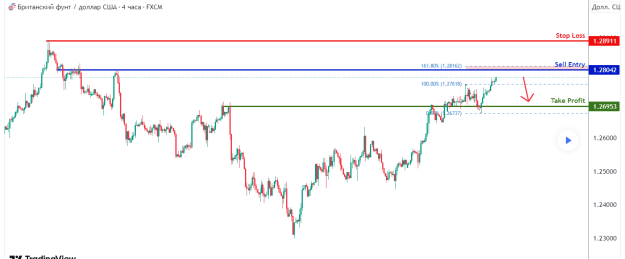
based on the analysis of chart H4, we can see that the price is rising towards our sell entry at 1.2804, which is the resistance overlap.
Our take profit will be at the level of 1.2695, which overlaps the support level.
Stop loss will be set at 1.2891, a high resistance level, above the 161.8% Fibonacci extension
The pound is set to rally, but there is a nuance. Weekly risk analysis.
Forecasts indicate that the pound/dollar exchange rate will continue to move towards the upper levels of the range established in 2024 in the near future. However, a possible strengthening of the PCE inflation indicator at the end of the week could interrupt this rally.
The GBP/USD pair showed a confident bullish trend, which was fueled by the general pullback of the dollar and the publication of inflation that exceeded analysts' expectations. These data reduced the likelihood of the Bank of England cutting interest rates in June, which distinguishes the pound from other currencies, where the central bank's expectations remain more stable.
On a technical level, the pound's movement indicates a preference for continued gains against the dollar, especially as we move into June.
The foreign exchange market is favorable with the pound exchange rate above key moving average levels, which is usually taken into account when forecasting for the new week.
In addition, the relative strength index (RSI) is at 65 and continues to rise, signaling a potential strengthening of the pound.
GBP/USD is expected to test the 1.2800 level in the coming days and may aim for 2024 highs, reaching 1.2893. These market movements are worth watching closely, especially given the impact of upcoming economic indicators.
Currency strategists at Scotiabank highlight the positive trend for the British pound, especially after last Friday, which saw a strong retreat from levels below 1.2700. This, they say, indicates a constructive market mood.
Intraday price patterns look bullish, especially after the pound fell below 1.2700 but then quickly recovered. Resistance at 1.2755 remains significant and this becomes its immediate upside target.
There are no major economic data expected from the UK this week that could further support the pound. This makes the US dollar a key player in possible changes to the current uptrend of the GBP/USD pair.
In particular, this week you should pay attention to US GDP data, which will be published on Thursday. The market expects an annual growth rate of 1.5% for the first quarter.
If the data comes out better than expected, it could strengthen the dollar, as it would support the view that the Fed may be in no hurry to cut interest rates.
Particular attention should be paid to the personal consumption component of the GDP report as it is an important indicator of inflation. Personal consumption is forecast to grow 2.1% year on year.
The Personal Consumption Price Index (PCE), the Fed's preferred measure of inflation, will be released on Friday. If the data exceeds expectations (2.8% annualized), this could significantly strengthen the dollar and change the current direction of the GBP/USD pair.
This will be an important short-term risk to pay attention to.