Similar Threads
Whats your best money management method? 52 replies
How to flow with the order flow? 26 replies
Money Management / Risk Management 24 replies
Money management model for multiple strategy trading method 16 replies
Most popular money management method. 7 replies

- #11,142
- Edited 9:14am Jan 23, 2023 7:58am | Edited 9:14am
- | Commercial User | Joined Dec 2014 | 14,165 Posts
https://www.zerohedge.com/markets/gold-or-silver
Gold Or Silver?
https://zh-prod-1cc738ca-7d3b-4a72-b.../picture-5.jpg
by Tyler Durden
Monday, Jan 23, 2023 - 07:20 AM
Authored by John Rubino via Substack,
At first glance, gold and silver seem pretty fungible. They’re both hypnotically pretty. Their prices tend to rise and fall according to the same financial/political forces. They’re both seen as real money by a tiny (very wise) fraction of the population and as atavistic relics by the vast, ignorant majority. And – most important – they will both preserve their owners’ purchasing power when today’s fiat currencies evaporate like the fever dreams they always were.
So you definitely want some (and maybe a lot) of each. But gold and silver are not identical. They have different strengths and weaknesses in various “monetary reset” scenarios. And their prices don’t move in lockstep. Sometimes one is cheap relative to the other.
So how much of each should we own now, and how quickly should we plan to load up the truck? The answer is different for each person, but a few things are generally true.
The gold/silver ratio
The relative prices of gold and silver tend to fluctuate within a broad but discernible range. This gold/silver ratio is expressed as the number of ounces of silver it takes to buy an ounce of gold and tends to rise and fall along with the emotional state of precious metals investors. When those investors don’t foresee imminent inflation or other monetary disruptions, they gravitate towards gold’s safety and stability, and shy away from silver’s volatility. Gold’s price rises relative to silver’s, producing a high gold/silver ratio.
When investors expect rising inflation or other kinds of currency instability, they buy precious metals generally, but gravitate towards silver’s greater upside potential. Gold and silver both rise but the gold/silver ratio falls as buyers push silver’s price up more quickly than gold’s.
These fluctuations typically happen within a range of 40 to 80 (i.e., 40 to 80 silver ounces per ounce of gold), with a high number implying that silver is cheap relative to gold and a low number meaning that gold is cheap relative to silver. Breakouts beyond this range in either direction are useful signals.
https://assets.zerohedge.com/s3fs-pu...?itok=AmNrUQ5v
And extreme readings are very reliable indicators. Note the 15 seconds in 2020 when the ratio spiked to 120 (as silver’s price fell to $13/oz and it took 120 ounces to buy an ounce of gold). That was a great time to buy silver, as it outperformed gold dramatically in the next few months.
Currently the ratio is around 75, which implies that silver is modestly undervalued and stackers should favor it over gold in the near term.
Gold’s market is big, silver’s is small
Why is silver so much more volatile than gold? Because it’s a much smaller market. Most of the gold ever mined is still around in the form of bars and jewelry. Silver, in contrast, is used in industrial products and is frequently not recycled. The result is a world with far more above ground gold than silver, in dollar terms. So it only takes a small amount of new investment demand flowing in or out of silver to move its price dramatically.
https://assets.zerohedge.com/s3fs-pu...?itok=gK7GsfDw
Different roles in a crisis
In most monetary reset scenarios, gold and silver will both soar in value and will be useful for buying things. But different things. A few ounces of gold will buy a used car, while one or two silver coins will buy a week’s worth of veggies at the farmers’ market. Both transaction categories are important, which is why you want some of each metal.
Trans-portability
If you have to leave the country in a hurry, gold coins are easy to transport. 10 1-ounce Gold Eagles will fit into a shoe buried in a suitcase and will be valuable enough to bribe plenty of border guards. The same buying power of silver would weigh 37 times as much at today’s exchange rate and would fill up a big part of a suitcase.
To sum up, gold is harder to spend but easier to transport. Silver is easier to spend but harder to store and move.
Confiscation risk
It’s pointless to go to all the trouble of stacking precious metals if the government is just going to swoop in and take it all away. This happened with gold in the 1930s, when the US made private gold bullion ownership illegal. Will they do it again? Probably not, because in the 1930s gold was the world’s money, while today it’s classed as a commodity. But if a growing number of countries start backing their currencies with gold and threatening the dollar’s hegemony, things might change.
Silver is probably immune from confiscation because it’s an industrial metal that thousands of businesses buy, sell and hold in inventory. Banning or restricting ownership of it would prohibitively disruptive.
Silver 60-40?
So it comes down to your expectations. Will you bug out or hunker down in a SHTF scenario? If the former you may want to favor gold; if the latter, silver. If you’re not sure, and want to prepare for both possibilities, the gold/silver ratio implies a 60%-40% silver/gold mix (in terms of dollar value) at current prices.
How much gold and silver should you own?
Here’s where the culture clash begins. Traditional financial planners will say zero percent of your net worth should be in pointless rocks that haven’t been money for decades. More flexible traditional financial planners will humor you with 1 or 2 percent in a gold ETF like GLD (DO NOT do this, for reasons to be explained in a later article). Cautious crisis-investing gurus like Jim Rickards (to be profiled in a future article) recommend 10%, which is reasonable. A more aggressive but still reasonable mix would be 10% of your investible funds in physical precious metals and another 10% in gold/silver mining stocks (again, to be explained soon).
Time pressure?
As for how quickly we should get this done, there are lots of crosscurrents. The Fed is either going to keep tightening until something breaks, which might pull precious metals prices down along with everything else (so no hurry). Or the Fed will capitulate after the next batch of terrible economic reports, igniting a relief rally that sends gold and silver to the moon (so now or never).
Leaving the inherently unpredictable Fed out of the equation, we’re moving into the weakest season for precious metals (yes, they’re seasonal). Asians, especially Chinese and Indians, like to give gold and silver jewelry as wedding gifts, since they correctly view such things as portable wealth. Most Asian weddings are in the Spring, which leads jewelers in those countries to buy their inventory in the Fall and early Winter. The result is generally rising gold and silver prices September through January, and languishing prices in the later Spring and Summer. The following chart (courtesy of Jeff Clark’s Gold advisor) illustrates the pattern.
https://assets.zerohedge.com/s3fs-pu...?itok=txLilK7I
To sum up, it’s anybody’s guess what gold and silver will do in the coming six months. Faced with that kind of uncertainty, dollar cost averaging, i.e., buying the same dollar amount of metal each month, is probably the best approach. Let your own sense of urgency determine the monthly amount.
* * *
Subscribe to John Rubino's "Survive and Thrive in the Coming Crisis" substack...
Gold Or Silver?
https://zh-prod-1cc738ca-7d3b-4a72-b.../picture-5.jpg
by Tyler Durden
Monday, Jan 23, 2023 - 07:20 AM
Authored by John Rubino via Substack,
At first glance, gold and silver seem pretty fungible. They’re both hypnotically pretty. Their prices tend to rise and fall according to the same financial/political forces. They’re both seen as real money by a tiny (very wise) fraction of the population and as atavistic relics by the vast, ignorant majority. And – most important – they will both preserve their owners’ purchasing power when today’s fiat currencies evaporate like the fever dreams they always were.
So you definitely want some (and maybe a lot) of each. But gold and silver are not identical. They have different strengths and weaknesses in various “monetary reset” scenarios. And their prices don’t move in lockstep. Sometimes one is cheap relative to the other.
So how much of each should we own now, and how quickly should we plan to load up the truck? The answer is different for each person, but a few things are generally true.
The gold/silver ratio
The relative prices of gold and silver tend to fluctuate within a broad but discernible range. This gold/silver ratio is expressed as the number of ounces of silver it takes to buy an ounce of gold and tends to rise and fall along with the emotional state of precious metals investors. When those investors don’t foresee imminent inflation or other monetary disruptions, they gravitate towards gold’s safety and stability, and shy away from silver’s volatility. Gold’s price rises relative to silver’s, producing a high gold/silver ratio.
When investors expect rising inflation or other kinds of currency instability, they buy precious metals generally, but gravitate towards silver’s greater upside potential. Gold and silver both rise but the gold/silver ratio falls as buyers push silver’s price up more quickly than gold’s.
These fluctuations typically happen within a range of 40 to 80 (i.e., 40 to 80 silver ounces per ounce of gold), with a high number implying that silver is cheap relative to gold and a low number meaning that gold is cheap relative to silver. Breakouts beyond this range in either direction are useful signals.
https://assets.zerohedge.com/s3fs-pu...?itok=AmNrUQ5v
And extreme readings are very reliable indicators. Note the 15 seconds in 2020 when the ratio spiked to 120 (as silver’s price fell to $13/oz and it took 120 ounces to buy an ounce of gold). That was a great time to buy silver, as it outperformed gold dramatically in the next few months.
Currently the ratio is around 75, which implies that silver is modestly undervalued and stackers should favor it over gold in the near term.
Gold’s market is big, silver’s is small
Why is silver so much more volatile than gold? Because it’s a much smaller market. Most of the gold ever mined is still around in the form of bars and jewelry. Silver, in contrast, is used in industrial products and is frequently not recycled. The result is a world with far more above ground gold than silver, in dollar terms. So it only takes a small amount of new investment demand flowing in or out of silver to move its price dramatically.
https://assets.zerohedge.com/s3fs-pu...?itok=gK7GsfDw
Different roles in a crisis
In most monetary reset scenarios, gold and silver will both soar in value and will be useful for buying things. But different things. A few ounces of gold will buy a used car, while one or two silver coins will buy a week’s worth of veggies at the farmers’ market. Both transaction categories are important, which is why you want some of each metal.
Trans-portability
If you have to leave the country in a hurry, gold coins are easy to transport. 10 1-ounce Gold Eagles will fit into a shoe buried in a suitcase and will be valuable enough to bribe plenty of border guards. The same buying power of silver would weigh 37 times as much at today’s exchange rate and would fill up a big part of a suitcase.
To sum up, gold is harder to spend but easier to transport. Silver is easier to spend but harder to store and move.
Confiscation risk
It’s pointless to go to all the trouble of stacking precious metals if the government is just going to swoop in and take it all away. This happened with gold in the 1930s, when the US made private gold bullion ownership illegal. Will they do it again? Probably not, because in the 1930s gold was the world’s money, while today it’s classed as a commodity. But if a growing number of countries start backing their currencies with gold and threatening the dollar’s hegemony, things might change.
Silver is probably immune from confiscation because it’s an industrial metal that thousands of businesses buy, sell and hold in inventory. Banning or restricting ownership of it would prohibitively disruptive.
Silver 60-40?
So it comes down to your expectations. Will you bug out or hunker down in a SHTF scenario? If the former you may want to favor gold; if the latter, silver. If you’re not sure, and want to prepare for both possibilities, the gold/silver ratio implies a 60%-40% silver/gold mix (in terms of dollar value) at current prices.
How much gold and silver should you own?
Here’s where the culture clash begins. Traditional financial planners will say zero percent of your net worth should be in pointless rocks that haven’t been money for decades. More flexible traditional financial planners will humor you with 1 or 2 percent in a gold ETF like GLD (DO NOT do this, for reasons to be explained in a later article). Cautious crisis-investing gurus like Jim Rickards (to be profiled in a future article) recommend 10%, which is reasonable. A more aggressive but still reasonable mix would be 10% of your investible funds in physical precious metals and another 10% in gold/silver mining stocks (again, to be explained soon).
Time pressure?
As for how quickly we should get this done, there are lots of crosscurrents. The Fed is either going to keep tightening until something breaks, which might pull precious metals prices down along with everything else (so no hurry). Or the Fed will capitulate after the next batch of terrible economic reports, igniting a relief rally that sends gold and silver to the moon (so now or never).
Leaving the inherently unpredictable Fed out of the equation, we’re moving into the weakest season for precious metals (yes, they’re seasonal). Asians, especially Chinese and Indians, like to give gold and silver jewelry as wedding gifts, since they correctly view such things as portable wealth. Most Asian weddings are in the Spring, which leads jewelers in those countries to buy their inventory in the Fall and early Winter. The result is generally rising gold and silver prices September through January, and languishing prices in the later Spring and Summer. The following chart (courtesy of Jeff Clark’s Gold advisor) illustrates the pattern.
https://assets.zerohedge.com/s3fs-pu...?itok=txLilK7I
To sum up, it’s anybody’s guess what gold and silver will do in the coming six months. Faced with that kind of uncertainty, dollar cost averaging, i.e., buying the same dollar amount of metal each month, is probably the best approach. Let your own sense of urgency determine the monthly amount.
* * *
Subscribe to John Rubino's "Survive and Thrive in the Coming Crisis" substack...
- #11,143
- Jan 23, 2023 9:44am Jan 23, 2023 9:44am
Hello Benny !!
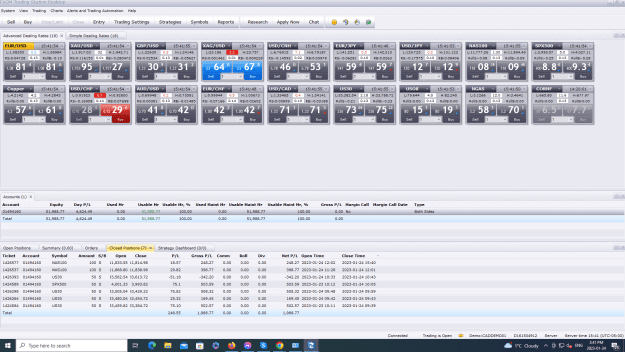
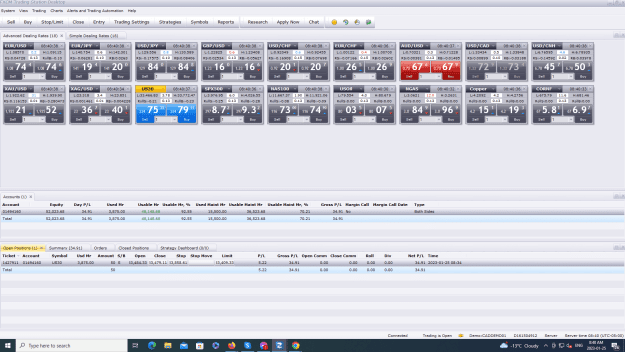
I open my demo account here is my screen shot.
This is my first trade, let me know your remarks. I have I life long mission to catch up on all your posts. Have a great day!
I open my demo account here is my screen shot.
This is my first trade, let me know your remarks. I have I life long mission to catch up on all your posts. Have a great day!
- #11,144
- Edited Jan 24, 2023 4:13am Jan 23, 2023 6:10pm | Edited Jan 24, 2023 4:13am
- | Commercial User | Joined Dec 2014 | 14,165 Posts
https://www.hussmanfunds.com/comment/mc230123/
https://www.hussmanfunds.com/wp-cont...ment/jenga.jpg
Pushing Your Luck
https://www.hussmanfunds.com/wp-cont...utton60x60.jpg
https://www.hussmanfunds.com/wp-cont..._thumbnail.jpg
John P. Hussman, Ph.D.
President, Hussman Investment Trust
January 2023
One can go some distance in a mine field without anything blowing up – it’s just that the overall odds aren’t good. For now, market action remains unfavorable, which suggests that the enthusiasm of investors is not yet robust, and further skittishness is possible. But again, there is no particularly strong reason to expect one direction over another over the very short term. In any event, conditions remain poor from a valuation standpoint. Stocks are emphatically not ‘cheap.’
It’s particularly interesting that the forward operating earnings crowd has advanced the notion that stocks are as cheap as they were in 1990. Aside from the problems with forward operating earnings that I’ve previously detailed, this particular argument rests on overlooking the state of profit margins, which were quite depressed in 1990 and are at record highs currently. Think about that for a moment and you’ll see what’s going on. A forward P/E multiple on depressed profit margin assumptions provides at least some margin for error. The same forward P/E based on assumptions of the highest profit margins in history contains no such margin.
– John P. Hussman, Ph.D., August 27, 2007, shortly before the global financial crisis
The problem with speculation is that there’s usually a gap between the underlying risk and the inevitable outcome. The gap is most dangerous when there are potential rewards for pushing your luck.
In July 2007, Chuck Prince, the CEO of Citigroup, famously pushed his luck saying “When the music stops, in terms of liquidity, things will get complicated. But as long as the music is still playing, you’ve got to get up and dance.” The deterioration that would shortly unfold into a global financial crisis was already underway. After years of Fed-induced yield-seeking speculation in mortgage securities, aided by demand from yield-starved investors, and abetted by Wall Street institutions that were all too ready to supply new “product,” the inevitable implosion would produce a 55% loss in the S&P 500, and a 98% loss in the value of Citigroup.
Unfortunately, the rewarding gap between underlying risk and inevitable outcomes can encourage people to persist in reckless behavior. In 2007, the tragic results of that behavior were already baked in the cake. Only the timing was uncertain. As I wrote at the time, one can go some distance in a mine field without anything blowing up – it’s just that the overall odds aren’t good.
The distortions in the financial markets are different today than they were in 2007. This time around, the Fed starved investors of yield for a decade, and much more aggressively. Looking in the rear-view mirror, the effects of relentless yield-seeking speculation look glorious. But the unwind may be breathtaking. The distortions in the stock market are far beyond those of 2007, more closely resembling 1929 and 2000. That remains true, even though the bubble peaked a year ago. Since then, the S&P 500 has lost a modest -15.7%, including dividends.
I continue to expect that the unwinding of this bubble will drive the S&P 500 to just one-third of the level it set at its January 2022 peak. I know – that seems preposterous. That’s why I present statements like that with data, as I did before the global financial crisis in 2007, and as I did when I projected an 83% loss in technology stocks in March 2000. Preposterous, yet also unfortunately correct.
Investors often make the mistake of dismissing rich valuations if they don’t result in immediate losses. That’s emphatically not how valuations work. Extreme valuations are not equal to a near-term forecast about market direction. Rather, our investment discipline is to align our outlook with measurable, observable market conditions – including both valuations and market internals – and to shift our investment outlook as those conditions shift. No forecasts or scenarios are required.
Before the current yield-seeking speculative bubble does unwind – 2022 was only a warmup, in my view – recall that the only thing truly “different” about quantitative easing and zero interest rate policy was that it encouraged investors to speculate beyond any well-defined historical “limit,” on the belief that zero interest rates left them with no other alternative. As I’ve detailed regularly, I ultimately abandoned our detrimental bearish response to those “limits,” and I’m pleased that the benefit of those adaptations has become increasingly clear in the past few years.
Valuations and market internals continue to be essential in navigating the complete market cycle. Our most reliable valuation measures remain well-correlated with subsequent long-term returns and full-cycle draw downs. Indeed, while the average level of valuations has been above historical norms in recent decades, the average level of subsequent returns has predictably been lower than historical norms. It has taken the most extreme yield-seeking bubble in history to bring the total return of the S&P 500 to even 6.27% since its March 2000 peak, much of which I suspect will be wiped out in the next few years. Likewise, the entire total return of the S&P 500 in the most recent market cycle accrued in periods when market internals were favorable.
Investors often make the mistake of dismissing rich valuations if they don’t result in immediate losses. That’s emphatically not how valuations work. Extreme valuations are not equal to a near-term forecast about market direction. Rather, our investment discipline is to align our outlook with measurable, observable market conditions – including both valuations and market internals – and to shift our investment outlook as those conditions shift. No forecasts or scenarios are required.
Still, it’s impossible for us to examine current valuation extremes without also allowing for the S&P 500 to lose more than half of its value – even from here. That’s not so much a forecast as a “full cycle” estimate of the market loss that would be required to restore historically run-of-the-mill expected returns. It’s also worth noting that when Treasury bill yields have stood between 3-5%, as they do today, our most reliable valuation measures have stood at just half of their present levels, on average.
More immediate outcomes will be driven by the ebb and flow of investor psychology between speculation and risk-aversion, and we gauge that by the uniformity of market internals. Presently, both valuations and market internals remain unfavorable, which creates what I call a “trap door” situation.
Investors could certainly take the speculative bit back in their teeth, despite an overvalued market. That would be fine with us, as we’ve abandoned our belief that there is any well-defined “limit” to that willingness. Changes in Fed policy, reasonable or not, would also be fine with us, at least from the standpoint of our investment discipline. We’ll respond to conditions as they change, and take the evidence as it comes.
Two levers of the trap door
A few charts will help to illustrate our concerns about current market conditions. Below is our single most reliable valuation measure: the market capitalization of non-financial corporations as a ratio to gross value-added, including estimated foreign revenues. We gauge the reliability of our valuation measures based on their correlation with actual subsequent market returns across history. Other reliable measures (for example, Market Cap/GDP, S&P 500 price/revenue, and our Margin-Adjusted P/E) look quite similar. The advance to the January 2022 market peak took valuations beyond the extremes of 2000 and even 1929. Last year’s market decline merely skimmed the most speculative froth, bringing valuations to the same extreme we observed at the March 2000 bubble peak.
https://www.hussmanfunds.com/wp-cont.../mc230123a.png
Emphatically, valuations don’t operate in a vacuum. It would have been impossible for valuations to reach speculative extremes like 1929, 2000, and 2022 without also continuing to advance persistently beyond lesser extremes. During the late-1990’s technology bubble, I scoured the historical data for factors that might help to distinguish an overvalued market that continues to advance from an overvalued market that drops like a rock. My answer was, and remains, investor psychology – specifically, whether investors are inclined toward speculation or risk aversion.
In 1998, I introduced our gauge of market internals – what I called “trend uniformity” at the time. It continues to be an essential element of our investment discipline. The specific signal extraction approach is one of the few things I keep proprietary, but I’m very open about the central concept. When investors are inclined to speculate, they tend to be indiscriminate about it, so the “uniformity” of market internals across thousands of stocks, industries, sectors, and security-types conveys information about that psychology.
In the face of zero interest rate policies, we had to abandon our bearish response to historically-reliable “limits” to speculation. In contrast, valuations and market internals continue to be essential to our investment discipline, and that emphasis has restored the strategic flexibility that we enjoyed across decades of complete market cycles. In my view, it would be profound mistake to take our difficulty with speculative “limits” as a reason to dismiss the “trap door” opened by the two levers of unfavorable valuations and unfavorable market internals.
The chart below presents the cumulative total return of the S&P 500 in periods where our measures of market internals have been favorable, accruing Treasury bill interest otherwise. The chart is historical, does not represent any investment portfolio, does not reflect valuations or other features of our investment approach, and is not an assurance of future outcomes. The flat portions in the chart below are periods when, like last year, market internals were persistently unfavorable, leading us to prefer T-bills or hedged equity to unhedged market risk. You’ll see the same tendency during the 2000-2002 and 2007-2009 collapses. We can’t rule out “whipsaws,” and we don’t expect internals to “catch” short-term market fluctuations. Still, in the nearly 25 years since I introduced our measure of market internals, I haven’t found a more useful way to gauge speculation versus risk-aversion.
https://www.hussmanfunds.com/wp-cont.../mc230123b.png
Causes and conditions
By relentlessly depriving investors of risk-free return, the Federal Reserve has spawned an all-asset speculative bubble that we estimate will provide investors little but return-free risk.”
– John P. Hussman, Ph.D., Return-Free Risk, January 14, 2022
Over the past year, the S&P 500 has retreated only modestly from its January 2022 speculative peak, yet interest rates have normalized to a much greater extent. That, in my view, is probably the most dangerous aspect of the current market environment. We continue to observe valuations that were created only as the result of a decade of reckless zero-interest rate policy, yet zero-interest rate policy is no longer present.
As the Buddha taught, “All things appear and disappear because of the concurrence of causes and conditions. Nothing ever exists entirely alone; everything is in relation to everything else.” With interest rates now well above zero, the primary causes and conditions of the recent speculative bubble are no longer in place. The persistence of rich valuations here are, in my view, largely the result of psychological anchoring and hindsight that treats past prices as a standard of value. We saw the same thing during the 2000-2002 collapse, and it’s dangerous. I had friends who were wiped out, not by buying at the top, but by assuming that once prices had declined by 15%, or 20%, or in some cases 50% from the highs, the retreat somehow represented “value.”
I’ll say this again. Value is not measured by how far prices have declined, but by the relationship between prices and properly discounted cash flows. We presently estimate that the S&P 500 would have to drop to the 2800 level simply to establish prospective 10-year returns equal to those of 10-year Treasury bonds. Restoring a historically run-of-the-mill 5% expected return over-and-above Treasury bond yields would require a decline to the 1850 level. Restoring historically run-of-the-mill 10% expected long-term returns for the S&P 500 would require, by our estimates, a decline to the 1600 level.
https://www.hussmanfunds.com/wp-cont.../mc230123c.png
Put simply, we estimate that the S&P 500 faces the same prospect of full-cycle loss and return-free risk as it did in 1929, 2000, and 2007. A massive recession is not required. Hyperinflation is not required. A housing collapse is not required. All that is required for a stock market collapse is for investors to demand historically run-of-the-mill prospective returns from stocks, rather than continuing to price stocks at speculative valuations that represented the equivalent of crying “uncle” in the face zero interest rates.
The chart below shows our estimates of S&P 500 total returns in excess of 10-year Treasury yields, along with actual subsequent returns, in data since 1928. You will see lots of “equity risk premium” models on Wall Street. The problem is that, in general, we find that they don’t actually work well at all. That’s certainly true of Wall Street’s naïve favorite: forward operating yield – 10 year bond yield. As I noted last year, it’s also true of the Shiller-Black-Jirav “Excess Cape Yield.”
When you hear Wall Street analysts talking about the attractiveness of stocks versus bonds, it’s imperative to ask whether the model they’re using actually has any meaningful relationship to subsequent returns. It’s one of my great frustrations with this industry that the answer is typically “no.” Below is a measure that does pass that requirement. Unfortunately, we presently estimate that S&P 500 total returns are likely to lag the returns of Treasury bonds by -3.4% annually over the coming decade. Given that the 10-year Treasury bond yield is currently about 3.4%, that also implies that we estimate S&P 500 total returns to average about zero over the coming decade.
https://www.hussmanfunds.com/wp-cont.../mc230123d.png
Fortunately or unfortunately, periods of negative estimated S&P 500 returns, relative to bonds, don’t tend to persist for long. In general, stocks tend to suffer severe losses over the next 30-36 months. The chart below illustrates this regularity. The horizontal axis shows the estimated S&P 500 total return in excess of 10-year Treasury yields. The vertical shows the value of an original $1 invested in the S&P 500, 30 months later. Notice that the points on the left side of the graph essentially collapse below 1.0. That’s the original investment getting wiped out.
https://www.hussmanfunds.com/wp-cont.../mc230123e.png
The chart below illustrates the opening sentence of this month’s comment: “The problem with speculation is that there’s usually a gap between the underlying risk and the inevitable outcome.” The blue line shows the estimated loss in the S&P 500 that would be required to restore the greater of a) 10% expected S&P 500 nominal total returns; or b) a 2% expected risk-premium above Treasury bonds. The red shading shows the deepest actual subsequent S&P 500 loss over the following 3-year period. Notice that there’s often quite a bit of “white space” between the blue cups and the red ink that eventually fills them. That white space represents high risk with no apparent consequence; periods that enticed speculators to run across minefields and to push their luck.
https://www.hussmanfunds.com/wp-cont.../mc230123f.png
Despite the profound risks that we believe are baked into the cake of valuations, I’ll say this again – at any point when our measures of internals suggest that investor psychology has shifted toward speculation, we’ll refrain from adopting or amplifying a bearish market outlook. Indeed, even at current valuations, a shift to uniformly favorable internals would encourage us to adopt a constructive market outlook more often than not (albeit with position limits and safety nets). We understand the valuation risks, but we also understand that there are certain periods when investors could not care less about valuation risks. Our job is to adhere to a value-conscious, historically-informed, risk-managed, full-cycle investment discipline, and we’ve adapted in ways that enable us to respond flexibly to market conditions as they change, without the risk of being “pinned” into any given market outlook.
On recession risk, inflation persistence, and embedded expectations
The National Bureau of Economic Research generally defines recessions as periods in which output, income, spending, and employment retreat in a way that combines depth, diffusion, and duration (though clear weakness in one feature can offset more moderate weakness in another). Currently, my view is that employment hasn’t deteriorated to the extent that would be consistent with NBER recession criteria – at least not yet.
– John P. Hussman, Ph.D., Are We There Yet?, July 2022
As the year begins, it’s common to see various outlooks circulated for 2023. My own view, detailed above, is that market valuations remain the most salient risk for investors, particularly given that interest rates are no longer at zero. It seems extremely optimistic for investors to expect smooth sailing, at valuations that still rival the 1929 and 2000 extremes, yet without the reckless zero-interest rate policies that enabled valuations to exceed 1929 and 2000 extremes in the first place. Still, as always, we’ll respond to market conditions as they change over time, and no forecasts are required.
My view on recession risk remains that employment hasn’t deteriorated to the extent that would be consistent with NBER recession criteria. Despite weakness in various measures of purchasing manager sentiment and credit stress, the employment components of our own Recession Warning Composites have also not yet shifted in a way that suggests an imminent recession.
Given current valuation extremes, I don’t believe that an official recession is necessary for stocks to experience severe losses. I do suspect that we’ll observe something that meets the definition of a recession even if the rate of unemployment rises beyond 4%, but my own expectations regarding the severity of a recession would require more deterioration than we see at present. In addition to employment measures, a steep widening in credit spreads coupled with a deterioration in consumer confidence and aggregate hours worked would contribute to more immediate recession concerns. For now, I don’t have terribly pointed expectations on the subject.
As for inflation, my impression is that investors have gotten far ahead of themselves by extrapolating modest improvement in the data. It may be that inflation improves progressively from here, but the problem is that investors have taken it for granted and embedded it into prices, which means that they now rely on that improvement. Any stall in progress on the inflation front, and particularly any upward surprise in core inflation even on the order of 0.2-0.4%, could be strikingly disruptive to both bonds and stocks.
For my part, I’ve always insisted on forming expectations by examining data. Frankly, there’s no better way than studying inflation data to prove to yourself that Wall Street, main street economists, the financial media, and the Federal Reserve are all spouting opinions completely off the tops of their heads, seemingly incapable of operating the most basic scatter plot.
See, the fact is that nearly everything people imagine is predictive of inflation has virtually no reliable relationship with inflation. That includes unemployment – as I’ve noted before, even the Phillips Curve is essentially a scarcity relationship between unemployment and real wage inflation. It has very little to do with general price inflation. Half of you just got mad at me. Don’t get mad. Come on, look at the data. Get into it. Get deep into it. You’re going to be so disappointed because everything you believe, everything you learned in Economics 101, is theoretical dogma.
Now, there are certainly useful perspectives on inflation – my own framework is to examine four drivers – the quantity of government liabilities (measurable), the demand for and confidence in government liabilities (psychological), the supply of goods and services along with slack capacity (measurable), and the demand for goods and services (psychological). As with the stock market, the psychological elements have a self-reflexive impact. Prices affect expectations, which affect prices. The upshot here is that the best predictor of inflation is, well, inflation, and lagged inflation. The next best correlates, but weaker, are negative economic shocks, and shocks to capacity and supply amid unsustainable government deficits.
So unless we get smacked by recession and credit strains, which aren’t really evident here, my impression is that inflation may be more persistent than investors seem to be banking on. That’s where investors are really getting themselves into danger. Based on historical relationships between interest rates, core inflation, nominal GDP growth, unemployment, and other factors, the lower bound for a “Fed pivot” and the typical lower bound for the 10-year Treasury bond yield are both in the area of 5.2% here. By pricing bonds and other assets in a way that assumes that inflation will come down rapidly and in a straight line, investors have put themselves in the position of relying on inflation to come down rapidly and in a straight line.
That’s not impossible. Can’t rule it out. But it’s not really how inflation tends to resolve. To the contrary, inflation shocks have historically had a strikingly long half-life.
The chart below illustrates this point. The vertical axis shows the slope coefficient relating the current inflation rate to the subsequent year-over-year rate, month by month, over the next 5 years.
Obviously, the highest correlation is in the first 12 months, declining as the overlap in the data declines. But the “half-life” of inflation is actually about 3-4 years, and the correlation between inflation at one point and inflation at another point only approaches zero after about 12 years.
https://www.hussmanfunds.com/wp-cont.../mc230123g.png
The bottom line is simple. We don’t require forecasts, but investors should not ignore risks or insist on pushing their luck. The present combination of extreme valuations and unfavorable market action creates a “trap door” of downside risk for the financial markets. Likewise, the persistence of extreme valuations – in the absence of the causes and conditions that encouraged those extreme valuations – creates risk. The tendency of negative estimated risk-premiums to resolve into deep market draw downs over the next 30-36 months creates risk. The reliance of investors on “forward earnings” multiples that embed record profit margins creates risk. The assumption that inflation will come down in a rapid and linear fashion, despite historical persistence of inflation, creates risk.
If our measures of market internals were to improve, we could at least infer that investors had shifted toward a speculative mindset, rather than one inclined toward risk-aversion. Presently, we observe a great deal of potential risk in an overvalued market where investors are also inclined to care about that risk.
Those conditions will change. Until then, we’re comfortably buckled up.
In Honor and Remembrance of Rev. Dr. Martin Luther King Jr.
Martin Luther King deserves a national holiday because he rescued the American people from the shallows and miseries where they had chosen to live their lives. He deserves a national holiday because more than any other public figure in this century he asserted his individuality in order to affirm community on the widest possible scale; because better than any other public figure he understood the nature of compassion, that it did not exclude confrontation. It was Martin’s message that it is not enough to suffer with the poor, we must confront the people and systems that cause poverty. It was Martin’s message that you cannot set the captive free if you are not willing to control those who hold the keys. Without confrontation compassion becomes merely commiseration, fruitless and sentimental. Likewise King understood the difference between defiance and freedom. Confrontation to him did not mean the ruin and humiliation of his opponents. Nonviolence to him represented conquest without the humiliation of the conquered. Nonviolence to him represented an effort to give visibility not to our own poor powers but to God’s everlasting love.
– William Sloane Coffin, Credo
Dr. King noted that he tried to speak on the subject below at least once a year. Preserving that tradition has always seemed an appropriate way to honor him. If you’ve never read Dr. King’s writings, this talk is a good place to start. I don’t think it’s possible to read his words without coming away better for it.
Loving Your Enemies
November 17, 1957
“I want to use as a subject from which to preach this morning a very familiar subject, and it is familiar to you because I have preached from this subject twice before to my knowing in this pulpit. I try to make it a, something of a custom or tradition to preach from this passage of Scripture at least once a year, adding new insights that I develop along the way out of new experiences as I give these messages. Although the content is, the basic content is the same, new insights and new experiences naturally make for new illustrations.
“So I want to turn your attention to this subject: “Loving Your Enemies.” It’s so basic to me because it is a part of my basic philosophical and theological orientation – the whole idea of love, the whole philosophy of love. In the fifth chapter of the gospel as recorded by Saint Matthew, we read these very arresting words flowing from the lips of our Lord and Master: “Ye have heard that it has been said, ‘Thou shall love thy neighbor, and hate thine enemy.’ But I say unto you, Love your enemies, bless them that curse you, do good to them that hate you, and pray for them that de spitefully use you; that ye may be the children of your Father which is in heaven.”
“Over the centuries, many persons have argued that this is an extremely difficult command. Many would go so far as to say that it just isn’t possible to move out into the actual practice of this glorious command. But far from being an impractical idealist, Jesus has become the practical realist. The words of this text glitter in our eyes with a new urgency. Far from being the pious injunction of a utopian dreamer, this command is an absolute necessity for the survival of our civilization. Yes, it is love that will save our world and our civilization, love even for enemies.
“Now let me hasten to say that Jesus was very serious when he gave this command; he wasn’t playing. He realized that it’s hard to love your enemies. He realized that it’s difficult to love those persons who seek to defeat you, those persons who say evil things about you. He realized that it was painfully hard, pressingly hard. But he wasn’t playing. We have the Christian and moral responsibility to seek to discover the meaning of these words, and to discover how we can live out this command, and why we should live by this command.
So this morning, as I look into your eyes, and into the eyes of all of my brothers in Alabama and all over America and over the world, I say to you, ‘I love you. I would rather die than hate you.’ And I’m foolish enough to believe that through the power of this love somewhere, men of the most recalcitrant bent will be transformed.
– Reverend Dr. Martin Luther King, Jr.
“Now first let us deal with this question, which is the practical question: How do you go about loving your enemies? I think the first thing is this: In order to love your enemies, you must begin by analyzing self. And I’m sure that seems strange to you, that I start out telling you this morning that you love your enemies by beginning with a look at self. It seems to me that that is the first and foremost way to come to an adequate discovery to the how of this situation.
“Now, I’m aware of the fact that some people will not like you, not because of something you have done to them, but they just won’t like you. But after looking at these things and admitting these things, we must face the fact that an individual might dislike us because of something that we’ve done deep down in the past, some personality attribute that we possess, something that we’ve done deep down in the past and we’ve forgotten about it; but it was that something that aroused the hate response within the individual. That is why I say, begin with yourself. There might be something within you that arouses the tragic hate response in the other individual.
“This is true in our international struggle. Democracy is the greatest form of government to my mind that man has ever conceived, but the weakness is that we have never touched it. We must face the fact that the rhythmic beat of the deep rumblings of discontent from Asia and Africa is at bottom a revolt against the imperialism and colonialism perpetuated by Western civilization all these many years.
“And this is what Jesus means when he said: “How is it that you can see the mote in your brother’s eye and not see the beam in your own eye?” And this is one of the tragedies of human nature. So we begin to love our enemies and love those persons that hate us whether in collective life or individual life by looking at ourselves.
“A second thing that an individual must do in seeking to love his enemy is to discover the element of good in his enemy, and every time you begin to hate that person and think of hating that person, realize that there is some good there and look at those good points which will over-balance the bad points.
“Somehow the “isness” of our present nature is out of harmony with the eternal “oughtness” that forever confronts us. And this simply means this: That within the best of us, there is some evil, and within the worst of us, there is some good. When we come to see this, we take a different attitude toward individuals.
The person who hates you most has some good in him; even the nation that hates you most has some good in it; even the race that hates you most has some good in it. And when you come to the point that you look in the face of every man and see deep down within him what religion calls “the image of God,” you begin to love him in spite of. No matter what he does, you see God’s image there. There is an element of goodness that he can never slough off. Discover the element of good in your enemy. And as you seek to hate him, find the center of goodness and place your attention there and you will take a new attitude.
“Another way that you love your enemy is this: When the opportunity presents itself for you to defeat your enemy, that is the time which you must not do it. There will come a time, in many instances, when the person who hates you most, the person who has misused you most, the person who has gossiped about you most, the person who has spread false rumors about you most, there will come a time when you will have an opportunity to defeat that person. It might be in terms of a recommendation for a job; it might be in terms of helping that person to make some move in life. That’s the time you must do it. That is the meaning of love. In the final analysis, love is not this sentimental something that we talk about. It’s not merely an emotional something. Love is creative, understanding goodwill for all men. It is the refusal to defeat any individual. When you rise to the level of love, of its great beauty and power, you seek only to defeat evil systems. Individuals who happen to be caught up in that system, you love, but you seek to defeat the system.
Within the best of us, there is some evil, and within the worst of us, there is some good. The person who hates you most has some good in him; even the nation that hates you most has some good in it; even the race that hates you most has some good in it… No matter what he does, you see God’s image there. There is an element of goodness that he can never slough off.
“The Greek language, as I’ve said so often before, is very powerful at this point. It comes to our aid beautifully in giving us the real meaning and depth of the whole philosophy of love. And I think it is quite apropos at this point, for you see the Greek language has three words for love, interestingly enough. It talks about love as eros. That’s one word for love. Eros is a sort of, aesthetic love. Plato talks about it a great deal in his dialogues, a sort of yearning of the soul for the realm of the gods. And it’s come to us to be a sort of romantic love, though it’s a beautiful love. Everybody has experienced eros in all of its beauty when you find some individual that is attractive to you and that you pour out all of your like and your love on that individual. That is eros, you see, and it’s a powerful, beautiful love that is given to us through all of the beauty of literature; we read about it.
“Then the Greek language talks about philia, and that’s another type of love that’s also beautiful. It is a sort of intimate affection between personal friends.
And this is the type of love that you have for those persons that you’re friendly with, your intimate friends, or people that you call on the telephone and you go by to have dinner with, and your roommate in college and that type of thing. It’s a sort of reciprocal love. On this level, you like a person because that person likes you. You love on this level, because you are loved. You love on this level, because there’s something about the person you love that is likeable to you. This too is a beautiful love. You can communicate with a person; you have certain things in common; you like to do things together. This is philia.
“The Greek language comes out with another word for love. It is the word agape. And agape is more than eros; agape is more than philia; agape is something of the understanding, creative, redemptive goodwill for all men. It is a love that seeks nothing in return. It is an overflowing love; it’s what theologians would call the love of God working in the lives of men. And when you rise to love on this level, you begin to love men, not because they are likeable, but because God loves them. You look at every man, and you love him because you know God loves him. And he might be the worst person you’ve ever seen.
“And this is what Jesus means, I think, in this very passage when he says, “Love your enemy.” And it’s significant that he does not say, “Like your enemy.” Like is a sentimental something, an affectionate something. There are a lot of people that I find it difficult to like. I don’t like what they do to me. I don’t like what they say about me and other people. I don’t like their attitudes. I don’t like some of the things they’re doing. I don’t like them. But Jesus says love them. And love is greater than like. Love is understanding, redemptive goodwill for all men, so that you love everybody, because God loves them. You refuse to do anything that will defeat an individual, because you have agape in your soul. And here you come to the point that you love the individual who does the evil deed, while hating the deed that the person does. This is what Jesus means when he says, “Love your enemy.” This is the way to do it. When the opportunity presents itself when you can defeat your enemy, you must not do it.
“Now for the few moments left, let us move from the practical how to the theoretical why. It’s not only necessary to know how to go about loving your enemies, but also to go down into the question of why we should love our enemies. I think the first reason that we should love our enemies, and I think this was at the very center of Jesus’ thinking, is this: that hate for hate only intensifies the existence of hate and evil in the universe. If I hit you and you hit me and I hit you back and you hit me back and go on, you see, that goes on ad infinitum. It just never ends. Somewhere somebody must have a little sense, and that’s the strong person. The strong person is the person who can cut off the chain of hate, the chain of evil. And that is the tragedy of hate – that it doesn’t cut it off. It only intensifies the existence of hate and evil in the universe. Somebody must have religion enough and morality enough to cut it off and inject within the very structure of the universe that strong and powerful element of love.
“I think I mentioned before that sometime ago my brother and I were driving one evening to Chattanooga, Tennessee, from Atlanta. He was driving the car. And for some reason the drivers were very discourteous that night. They didn’t dim their lights; hardly any driver that passed by dimmed his lights. And I remember very vividly, my brother A. D. looked over and in a tone of anger said: “I know what I’m going to do. The next car that comes along here and refuses to dim the lights, I’m going to fail to dim mine and pour them on in all of their power.” And I looked at him right quick and said: “Oh no, don’t do that. There be too much light on this highway, and it will end up in mutual destruction for all. Somebody got to have some sense on this highway.”
“Somebody must have sense enough to dim the lights, and that is the trouble, isn’t it? That as all of the civilizations of the world move up the highway of history, so many civilizations, having looked at other civilizations that refused to dim the lights, and they decided to refuse to dim theirs. And Toynbee tells that out of the twenty-two civilizations that have risen up, all but about seven have found themselves in the junk heap of destruction. It is because civilizations fail to have sense enough to dim the lights. And if somebody doesn’t have sense enough to turn on the dim and beautiful and powerful lights of love in this world, the whole of our civilization will be plunged into the abyss of destruction. And we will all end up destroyed because nobody had any sense on the highway of history.
The strong person is the person who can cut off the chain of hate, the chain of evil. And that is the tragedy of hate – that it doesn’t cut it off. It only intensifies the existence of hate and evil in the universe. Somebody must have religion enough and morality enough to cut it off and inject within the very structure of the universe that strong and powerful element of love.
“Somewhere somebody must have some sense. Men must see that force begets force, hate begets hate, toughness begets toughness. And it is all a descending spiral, ultimately ending in destruction for all and everybody. Somebody must have sense enough and morality enough to cut off the chain of hate and the chain of evil in the universe. And you do that by love.
“There’s another reason why you should love your enemies, and that is because hate distorts the personality of the hater. We usually think of what hate does for the individual hated or the individuals hated or the groups hated. But it is even more tragic, it is even more ruinous and injurious to the individual who hates. You just begin hating somebody, and you will begin to do irrational things. You can’t see straight when you hate. You can’t walk straight when you hate. You can’t stand upright. Your vision is distorted. There is nothing more tragic than to see an individual whose heart is filled with hate. He comes to the point that he becomes a pathological case. For the person who hates, you can stand up and see a person and that person can be beautiful, and you will call them ugly. For the person who hates, the beautiful becomes ugly and the ugly becomes beautiful. For the person who hates, the good becomes bad and the bad becomes good. For the person who hates, the true becomes false and the false becomes true. That’s what hate does. You can’t see right. The symbol of objectivity is lost. Hate destroys the very structure of the personality of the hater.
“The way to be integrated with yourself is be sure that you meet every situation of life with an abounding love. Never hate, because it ends up in tragic, neurotic responses. Psychologists and psychiatrists are telling us today that the more we hate, the more we develop guilt feelings and we begin to subconsciously repress or consciously suppress certain emotions, and they all stack up in our subconscious selves and make for tragic, neurotic responses. And may this not be the neuroses of many individuals as they confront life that that is an element of hate there. And modern psychology is calling on us now to love. But long before modern psychology came into being, the world’s greatest psychologist who walked around the hills of Galilee told us to love. He looked at men and said: “Love your enemies; don’t hate anybody.” It’s not enough – to love your friends – because when you start hating anybody, it destroys the very center of your creative response to life and the universe; so love everybody. Hate at any point is a cancer that gnaws away at the very vital center of your life and your existence. It is like eroding acid that eats away the best and the objective center of your life. So Jesus says love, because hate destroys the hater as well as the hated.
“Now there is a final reason I think that Jesus says, “Love your enemies.” It is this: that love has within it a redemptive power. And there is a power there that eventually transforms individuals. That’s why Jesus says, “Love your enemies.” Because if you hate your enemies, you have no way to redeem and to transform your enemies. But if you love your enemies, you will discover that at the very root of love is the power of redemption. You just keep loving people and keep loving them, even though they’re mistreating you. Here’s the person who is a neighbor, and this person is doing something wrong to you and all of that. Just keep being friendly to that person. Keep loving them. Don’t do anything to embarrass them. Just keep loving them, and they can’t stand it too long. Oh, they react in many ways in the beginning. They react with bitterness because they’re mad because you love them like that. They react with guilt feelings, and sometimes they’ll hate you a little more at that transition period, but just keep loving them. And by the power of your love they will break down under the load. That’s love, you see. It is redemptive, and this is why Jesus says love. There’s something about love that builds up and is creative. There is something about hate that tears down and is destructive. So love your enemies.
“There is a power in love that our world has not discovered yet. Jesus discovered it centuries ago. Mahatma Gandhi of India discovered it a few years ago, but most men and most women never discover it. For they believe in hitting for hitting; they believe in an eye for an eye and a tooth for a tooth; they believe in hating for hating; but Jesus comes to us and says, “This isn’t the way.”
“As we look out across the years and across the generations, let us develop and move right here. We must discover the power of love, the power, the redemptive power of love. And when we discover that we will be able to make of this old world a new world. We will be able to make men better. Love is the only way. Jesus discovered that.
“And our civilization must discover that. Individuals must discover that as they deal with other individuals. There is a little tree planted on a little hill and on that tree hangs the most influential character that ever came in this world. But never feel that that tree is a meaningless drama that took place on the stages of history. Oh no, it is a telescope through which we look out into the long vista of eternity, and see the love of God breaking forth into time. It is an eternal reminder to a power-drunk generation that love is the only way. It is an eternal reminder to a generation depending on nuclear and atomic energy, a generation depending on physical violence, that love is the only creative, redemptive, transforming power in the universe.
“So this morning, as I look into your eyes, and into the eyes of all of my brothers in Alabama and all over America and over the world, I say to you, “I love you. I would rather die than hate you.” And I’m foolish enough to believe that through the power of this love somewhere, men of the most recalcitrant bent will be transformed. And then we will be in God’s kingdom.”
Keep Me Informed
Please enter your email address to be notified of new content, including market commentary and special updates.
Thank you for your interest in the Hussman Funds.
100% Spam-free. No list sharing. No solicitations. Opt-out anytime with one click.
Email *
Are you an investment advisor Y/N (Optional)
Yes, I would like to receive emails from Hussman Funds. Opt-out anytime with one click.
Constant Contact Use. Please leave this field blank.
By submitting this form, you are consenting to receive marketing emails from: Hussman Strategic Advisors, News & Commentary, Cincinnati, OH, 45246, http://www.hussmanfunds.com.
You can revoke your consent to receive emails at any time by using the SafeUnsubscribe
link, found at the bottom of every email. Emails are serviced by Constant Contact
The foregoing comments represent the general investment analysis and economic views of the Advisor, and are provided solely for the purpose of information, instruction and discourse.
Prospectuses for the Hussman Strategic Growth Fund, the Hussman Strategic Total Return Fund, the Hussman Strategic International Fund, and the Hussman Strategic Allocation Fund, as well as Fund reports and other information, are available by clicking “The Funds” menu button from any page of this website.
https://www.hussmanfunds.com/wp-cont...ment/jenga.jpg
Pushing Your Luck
https://www.hussmanfunds.com/wp-cont...utton60x60.jpg
https://www.hussmanfunds.com/wp-cont..._thumbnail.jpg
John P. Hussman, Ph.D.
President, Hussman Investment Trust
January 2023
One can go some distance in a mine field without anything blowing up – it’s just that the overall odds aren’t good. For now, market action remains unfavorable, which suggests that the enthusiasm of investors is not yet robust, and further skittishness is possible. But again, there is no particularly strong reason to expect one direction over another over the very short term. In any event, conditions remain poor from a valuation standpoint. Stocks are emphatically not ‘cheap.’
It’s particularly interesting that the forward operating earnings crowd has advanced the notion that stocks are as cheap as they were in 1990. Aside from the problems with forward operating earnings that I’ve previously detailed, this particular argument rests on overlooking the state of profit margins, which were quite depressed in 1990 and are at record highs currently. Think about that for a moment and you’ll see what’s going on. A forward P/E multiple on depressed profit margin assumptions provides at least some margin for error. The same forward P/E based on assumptions of the highest profit margins in history contains no such margin.
– John P. Hussman, Ph.D., August 27, 2007, shortly before the global financial crisis
The problem with speculation is that there’s usually a gap between the underlying risk and the inevitable outcome. The gap is most dangerous when there are potential rewards for pushing your luck.
In July 2007, Chuck Prince, the CEO of Citigroup, famously pushed his luck saying “When the music stops, in terms of liquidity, things will get complicated. But as long as the music is still playing, you’ve got to get up and dance.” The deterioration that would shortly unfold into a global financial crisis was already underway. After years of Fed-induced yield-seeking speculation in mortgage securities, aided by demand from yield-starved investors, and abetted by Wall Street institutions that were all too ready to supply new “product,” the inevitable implosion would produce a 55% loss in the S&P 500, and a 98% loss in the value of Citigroup.
Unfortunately, the rewarding gap between underlying risk and inevitable outcomes can encourage people to persist in reckless behavior. In 2007, the tragic results of that behavior were already baked in the cake. Only the timing was uncertain. As I wrote at the time, one can go some distance in a mine field without anything blowing up – it’s just that the overall odds aren’t good.
The distortions in the financial markets are different today than they were in 2007. This time around, the Fed starved investors of yield for a decade, and much more aggressively. Looking in the rear-view mirror, the effects of relentless yield-seeking speculation look glorious. But the unwind may be breathtaking. The distortions in the stock market are far beyond those of 2007, more closely resembling 1929 and 2000. That remains true, even though the bubble peaked a year ago. Since then, the S&P 500 has lost a modest -15.7%, including dividends.
I continue to expect that the unwinding of this bubble will drive the S&P 500 to just one-third of the level it set at its January 2022 peak. I know – that seems preposterous. That’s why I present statements like that with data, as I did before the global financial crisis in 2007, and as I did when I projected an 83% loss in technology stocks in March 2000. Preposterous, yet also unfortunately correct.
Investors often make the mistake of dismissing rich valuations if they don’t result in immediate losses. That’s emphatically not how valuations work. Extreme valuations are not equal to a near-term forecast about market direction. Rather, our investment discipline is to align our outlook with measurable, observable market conditions – including both valuations and market internals – and to shift our investment outlook as those conditions shift. No forecasts or scenarios are required.
Before the current yield-seeking speculative bubble does unwind – 2022 was only a warmup, in my view – recall that the only thing truly “different” about quantitative easing and zero interest rate policy was that it encouraged investors to speculate beyond any well-defined historical “limit,” on the belief that zero interest rates left them with no other alternative. As I’ve detailed regularly, I ultimately abandoned our detrimental bearish response to those “limits,” and I’m pleased that the benefit of those adaptations has become increasingly clear in the past few years.
Valuations and market internals continue to be essential in navigating the complete market cycle. Our most reliable valuation measures remain well-correlated with subsequent long-term returns and full-cycle draw downs. Indeed, while the average level of valuations has been above historical norms in recent decades, the average level of subsequent returns has predictably been lower than historical norms. It has taken the most extreme yield-seeking bubble in history to bring the total return of the S&P 500 to even 6.27% since its March 2000 peak, much of which I suspect will be wiped out in the next few years. Likewise, the entire total return of the S&P 500 in the most recent market cycle accrued in periods when market internals were favorable.
Investors often make the mistake of dismissing rich valuations if they don’t result in immediate losses. That’s emphatically not how valuations work. Extreme valuations are not equal to a near-term forecast about market direction. Rather, our investment discipline is to align our outlook with measurable, observable market conditions – including both valuations and market internals – and to shift our investment outlook as those conditions shift. No forecasts or scenarios are required.
Still, it’s impossible for us to examine current valuation extremes without also allowing for the S&P 500 to lose more than half of its value – even from here. That’s not so much a forecast as a “full cycle” estimate of the market loss that would be required to restore historically run-of-the-mill expected returns. It’s also worth noting that when Treasury bill yields have stood between 3-5%, as they do today, our most reliable valuation measures have stood at just half of their present levels, on average.
More immediate outcomes will be driven by the ebb and flow of investor psychology between speculation and risk-aversion, and we gauge that by the uniformity of market internals. Presently, both valuations and market internals remain unfavorable, which creates what I call a “trap door” situation.
Investors could certainly take the speculative bit back in their teeth, despite an overvalued market. That would be fine with us, as we’ve abandoned our belief that there is any well-defined “limit” to that willingness. Changes in Fed policy, reasonable or not, would also be fine with us, at least from the standpoint of our investment discipline. We’ll respond to conditions as they change, and take the evidence as it comes.
Two levers of the trap door
A few charts will help to illustrate our concerns about current market conditions. Below is our single most reliable valuation measure: the market capitalization of non-financial corporations as a ratio to gross value-added, including estimated foreign revenues. We gauge the reliability of our valuation measures based on their correlation with actual subsequent market returns across history. Other reliable measures (for example, Market Cap/GDP, S&P 500 price/revenue, and our Margin-Adjusted P/E) look quite similar. The advance to the January 2022 market peak took valuations beyond the extremes of 2000 and even 1929. Last year’s market decline merely skimmed the most speculative froth, bringing valuations to the same extreme we observed at the March 2000 bubble peak.
https://www.hussmanfunds.com/wp-cont.../mc230123a.png
Emphatically, valuations don’t operate in a vacuum. It would have been impossible for valuations to reach speculative extremes like 1929, 2000, and 2022 without also continuing to advance persistently beyond lesser extremes. During the late-1990’s technology bubble, I scoured the historical data for factors that might help to distinguish an overvalued market that continues to advance from an overvalued market that drops like a rock. My answer was, and remains, investor psychology – specifically, whether investors are inclined toward speculation or risk aversion.
In 1998, I introduced our gauge of market internals – what I called “trend uniformity” at the time. It continues to be an essential element of our investment discipline. The specific signal extraction approach is one of the few things I keep proprietary, but I’m very open about the central concept. When investors are inclined to speculate, they tend to be indiscriminate about it, so the “uniformity” of market internals across thousands of stocks, industries, sectors, and security-types conveys information about that psychology.
In the face of zero interest rate policies, we had to abandon our bearish response to historically-reliable “limits” to speculation. In contrast, valuations and market internals continue to be essential to our investment discipline, and that emphasis has restored the strategic flexibility that we enjoyed across decades of complete market cycles. In my view, it would be profound mistake to take our difficulty with speculative “limits” as a reason to dismiss the “trap door” opened by the two levers of unfavorable valuations and unfavorable market internals.
The chart below presents the cumulative total return of the S&P 500 in periods where our measures of market internals have been favorable, accruing Treasury bill interest otherwise. The chart is historical, does not represent any investment portfolio, does not reflect valuations or other features of our investment approach, and is not an assurance of future outcomes. The flat portions in the chart below are periods when, like last year, market internals were persistently unfavorable, leading us to prefer T-bills or hedged equity to unhedged market risk. You’ll see the same tendency during the 2000-2002 and 2007-2009 collapses. We can’t rule out “whipsaws,” and we don’t expect internals to “catch” short-term market fluctuations. Still, in the nearly 25 years since I introduced our measure of market internals, I haven’t found a more useful way to gauge speculation versus risk-aversion.
https://www.hussmanfunds.com/wp-cont.../mc230123b.png
Causes and conditions
By relentlessly depriving investors of risk-free return, the Federal Reserve has spawned an all-asset speculative bubble that we estimate will provide investors little but return-free risk.”
– John P. Hussman, Ph.D., Return-Free Risk, January 14, 2022
Over the past year, the S&P 500 has retreated only modestly from its January 2022 speculative peak, yet interest rates have normalized to a much greater extent. That, in my view, is probably the most dangerous aspect of the current market environment. We continue to observe valuations that were created only as the result of a decade of reckless zero-interest rate policy, yet zero-interest rate policy is no longer present.
As the Buddha taught, “All things appear and disappear because of the concurrence of causes and conditions. Nothing ever exists entirely alone; everything is in relation to everything else.” With interest rates now well above zero, the primary causes and conditions of the recent speculative bubble are no longer in place. The persistence of rich valuations here are, in my view, largely the result of psychological anchoring and hindsight that treats past prices as a standard of value. We saw the same thing during the 2000-2002 collapse, and it’s dangerous. I had friends who were wiped out, not by buying at the top, but by assuming that once prices had declined by 15%, or 20%, or in some cases 50% from the highs, the retreat somehow represented “value.”
I’ll say this again. Value is not measured by how far prices have declined, but by the relationship between prices and properly discounted cash flows. We presently estimate that the S&P 500 would have to drop to the 2800 level simply to establish prospective 10-year returns equal to those of 10-year Treasury bonds. Restoring a historically run-of-the-mill 5% expected return over-and-above Treasury bond yields would require a decline to the 1850 level. Restoring historically run-of-the-mill 10% expected long-term returns for the S&P 500 would require, by our estimates, a decline to the 1600 level.
https://www.hussmanfunds.com/wp-cont.../mc230123c.png
Put simply, we estimate that the S&P 500 faces the same prospect of full-cycle loss and return-free risk as it did in 1929, 2000, and 2007. A massive recession is not required. Hyperinflation is not required. A housing collapse is not required. All that is required for a stock market collapse is for investors to demand historically run-of-the-mill prospective returns from stocks, rather than continuing to price stocks at speculative valuations that represented the equivalent of crying “uncle” in the face zero interest rates.
The chart below shows our estimates of S&P 500 total returns in excess of 10-year Treasury yields, along with actual subsequent returns, in data since 1928. You will see lots of “equity risk premium” models on Wall Street. The problem is that, in general, we find that they don’t actually work well at all. That’s certainly true of Wall Street’s naïve favorite: forward operating yield – 10 year bond yield. As I noted last year, it’s also true of the Shiller-Black-Jirav “Excess Cape Yield.”
When you hear Wall Street analysts talking about the attractiveness of stocks versus bonds, it’s imperative to ask whether the model they’re using actually has any meaningful relationship to subsequent returns. It’s one of my great frustrations with this industry that the answer is typically “no.” Below is a measure that does pass that requirement. Unfortunately, we presently estimate that S&P 500 total returns are likely to lag the returns of Treasury bonds by -3.4% annually over the coming decade. Given that the 10-year Treasury bond yield is currently about 3.4%, that also implies that we estimate S&P 500 total returns to average about zero over the coming decade.
https://www.hussmanfunds.com/wp-cont.../mc230123d.png
Fortunately or unfortunately, periods of negative estimated S&P 500 returns, relative to bonds, don’t tend to persist for long. In general, stocks tend to suffer severe losses over the next 30-36 months. The chart below illustrates this regularity. The horizontal axis shows the estimated S&P 500 total return in excess of 10-year Treasury yields. The vertical shows the value of an original $1 invested in the S&P 500, 30 months later. Notice that the points on the left side of the graph essentially collapse below 1.0. That’s the original investment getting wiped out.
https://www.hussmanfunds.com/wp-cont.../mc230123e.png
The chart below illustrates the opening sentence of this month’s comment: “The problem with speculation is that there’s usually a gap between the underlying risk and the inevitable outcome.” The blue line shows the estimated loss in the S&P 500 that would be required to restore the greater of a) 10% expected S&P 500 nominal total returns; or b) a 2% expected risk-premium above Treasury bonds. The red shading shows the deepest actual subsequent S&P 500 loss over the following 3-year period. Notice that there’s often quite a bit of “white space” between the blue cups and the red ink that eventually fills them. That white space represents high risk with no apparent consequence; periods that enticed speculators to run across minefields and to push their luck.
https://www.hussmanfunds.com/wp-cont.../mc230123f.png
Despite the profound risks that we believe are baked into the cake of valuations, I’ll say this again – at any point when our measures of internals suggest that investor psychology has shifted toward speculation, we’ll refrain from adopting or amplifying a bearish market outlook. Indeed, even at current valuations, a shift to uniformly favorable internals would encourage us to adopt a constructive market outlook more often than not (albeit with position limits and safety nets). We understand the valuation risks, but we also understand that there are certain periods when investors could not care less about valuation risks. Our job is to adhere to a value-conscious, historically-informed, risk-managed, full-cycle investment discipline, and we’ve adapted in ways that enable us to respond flexibly to market conditions as they change, without the risk of being “pinned” into any given market outlook.
On recession risk, inflation persistence, and embedded expectations
The National Bureau of Economic Research generally defines recessions as periods in which output, income, spending, and employment retreat in a way that combines depth, diffusion, and duration (though clear weakness in one feature can offset more moderate weakness in another). Currently, my view is that employment hasn’t deteriorated to the extent that would be consistent with NBER recession criteria – at least not yet.
– John P. Hussman, Ph.D., Are We There Yet?, July 2022
As the year begins, it’s common to see various outlooks circulated for 2023. My own view, detailed above, is that market valuations remain the most salient risk for investors, particularly given that interest rates are no longer at zero. It seems extremely optimistic for investors to expect smooth sailing, at valuations that still rival the 1929 and 2000 extremes, yet without the reckless zero-interest rate policies that enabled valuations to exceed 1929 and 2000 extremes in the first place. Still, as always, we’ll respond to market conditions as they change over time, and no forecasts are required.
My view on recession risk remains that employment hasn’t deteriorated to the extent that would be consistent with NBER recession criteria. Despite weakness in various measures of purchasing manager sentiment and credit stress, the employment components of our own Recession Warning Composites have also not yet shifted in a way that suggests an imminent recession.
Given current valuation extremes, I don’t believe that an official recession is necessary for stocks to experience severe losses. I do suspect that we’ll observe something that meets the definition of a recession even if the rate of unemployment rises beyond 4%, but my own expectations regarding the severity of a recession would require more deterioration than we see at present. In addition to employment measures, a steep widening in credit spreads coupled with a deterioration in consumer confidence and aggregate hours worked would contribute to more immediate recession concerns. For now, I don’t have terribly pointed expectations on the subject.
As for inflation, my impression is that investors have gotten far ahead of themselves by extrapolating modest improvement in the data. It may be that inflation improves progressively from here, but the problem is that investors have taken it for granted and embedded it into prices, which means that they now rely on that improvement. Any stall in progress on the inflation front, and particularly any upward surprise in core inflation even on the order of 0.2-0.4%, could be strikingly disruptive to both bonds and stocks.
For my part, I’ve always insisted on forming expectations by examining data. Frankly, there’s no better way than studying inflation data to prove to yourself that Wall Street, main street economists, the financial media, and the Federal Reserve are all spouting opinions completely off the tops of their heads, seemingly incapable of operating the most basic scatter plot.
See, the fact is that nearly everything people imagine is predictive of inflation has virtually no reliable relationship with inflation. That includes unemployment – as I’ve noted before, even the Phillips Curve is essentially a scarcity relationship between unemployment and real wage inflation. It has very little to do with general price inflation. Half of you just got mad at me. Don’t get mad. Come on, look at the data. Get into it. Get deep into it. You’re going to be so disappointed because everything you believe, everything you learned in Economics 101, is theoretical dogma.
Now, there are certainly useful perspectives on inflation – my own framework is to examine four drivers – the quantity of government liabilities (measurable), the demand for and confidence in government liabilities (psychological), the supply of goods and services along with slack capacity (measurable), and the demand for goods and services (psychological). As with the stock market, the psychological elements have a self-reflexive impact. Prices affect expectations, which affect prices. The upshot here is that the best predictor of inflation is, well, inflation, and lagged inflation. The next best correlates, but weaker, are negative economic shocks, and shocks to capacity and supply amid unsustainable government deficits.
So unless we get smacked by recession and credit strains, which aren’t really evident here, my impression is that inflation may be more persistent than investors seem to be banking on. That’s where investors are really getting themselves into danger. Based on historical relationships between interest rates, core inflation, nominal GDP growth, unemployment, and other factors, the lower bound for a “Fed pivot” and the typical lower bound for the 10-year Treasury bond yield are both in the area of 5.2% here. By pricing bonds and other assets in a way that assumes that inflation will come down rapidly and in a straight line, investors have put themselves in the position of relying on inflation to come down rapidly and in a straight line.
That’s not impossible. Can’t rule it out. But it’s not really how inflation tends to resolve. To the contrary, inflation shocks have historically had a strikingly long half-life.
The chart below illustrates this point. The vertical axis shows the slope coefficient relating the current inflation rate to the subsequent year-over-year rate, month by month, over the next 5 years.
Obviously, the highest correlation is in the first 12 months, declining as the overlap in the data declines. But the “half-life” of inflation is actually about 3-4 years, and the correlation between inflation at one point and inflation at another point only approaches zero after about 12 years.
https://www.hussmanfunds.com/wp-cont.../mc230123g.png
The bottom line is simple. We don’t require forecasts, but investors should not ignore risks or insist on pushing their luck. The present combination of extreme valuations and unfavorable market action creates a “trap door” of downside risk for the financial markets. Likewise, the persistence of extreme valuations – in the absence of the causes and conditions that encouraged those extreme valuations – creates risk. The tendency of negative estimated risk-premiums to resolve into deep market draw downs over the next 30-36 months creates risk. The reliance of investors on “forward earnings” multiples that embed record profit margins creates risk. The assumption that inflation will come down in a rapid and linear fashion, despite historical persistence of inflation, creates risk.
If our measures of market internals were to improve, we could at least infer that investors had shifted toward a speculative mindset, rather than one inclined toward risk-aversion. Presently, we observe a great deal of potential risk in an overvalued market where investors are also inclined to care about that risk.
Those conditions will change. Until then, we’re comfortably buckled up.
In Honor and Remembrance of Rev. Dr. Martin Luther King Jr.
Martin Luther King deserves a national holiday because he rescued the American people from the shallows and miseries where they had chosen to live their lives. He deserves a national holiday because more than any other public figure in this century he asserted his individuality in order to affirm community on the widest possible scale; because better than any other public figure he understood the nature of compassion, that it did not exclude confrontation. It was Martin’s message that it is not enough to suffer with the poor, we must confront the people and systems that cause poverty. It was Martin’s message that you cannot set the captive free if you are not willing to control those who hold the keys. Without confrontation compassion becomes merely commiseration, fruitless and sentimental. Likewise King understood the difference between defiance and freedom. Confrontation to him did not mean the ruin and humiliation of his opponents. Nonviolence to him represented conquest without the humiliation of the conquered. Nonviolence to him represented an effort to give visibility not to our own poor powers but to God’s everlasting love.
– William Sloane Coffin, Credo
Dr. King noted that he tried to speak on the subject below at least once a year. Preserving that tradition has always seemed an appropriate way to honor him. If you’ve never read Dr. King’s writings, this talk is a good place to start. I don’t think it’s possible to read his words without coming away better for it.
Loving Your Enemies
November 17, 1957
“I want to use as a subject from which to preach this morning a very familiar subject, and it is familiar to you because I have preached from this subject twice before to my knowing in this pulpit. I try to make it a, something of a custom or tradition to preach from this passage of Scripture at least once a year, adding new insights that I develop along the way out of new experiences as I give these messages. Although the content is, the basic content is the same, new insights and new experiences naturally make for new illustrations.
“So I want to turn your attention to this subject: “Loving Your Enemies.” It’s so basic to me because it is a part of my basic philosophical and theological orientation – the whole idea of love, the whole philosophy of love. In the fifth chapter of the gospel as recorded by Saint Matthew, we read these very arresting words flowing from the lips of our Lord and Master: “Ye have heard that it has been said, ‘Thou shall love thy neighbor, and hate thine enemy.’ But I say unto you, Love your enemies, bless them that curse you, do good to them that hate you, and pray for them that de spitefully use you; that ye may be the children of your Father which is in heaven.”
“Over the centuries, many persons have argued that this is an extremely difficult command. Many would go so far as to say that it just isn’t possible to move out into the actual practice of this glorious command. But far from being an impractical idealist, Jesus has become the practical realist. The words of this text glitter in our eyes with a new urgency. Far from being the pious injunction of a utopian dreamer, this command is an absolute necessity for the survival of our civilization. Yes, it is love that will save our world and our civilization, love even for enemies.
“Now let me hasten to say that Jesus was very serious when he gave this command; he wasn’t playing. He realized that it’s hard to love your enemies. He realized that it’s difficult to love those persons who seek to defeat you, those persons who say evil things about you. He realized that it was painfully hard, pressingly hard. But he wasn’t playing. We have the Christian and moral responsibility to seek to discover the meaning of these words, and to discover how we can live out this command, and why we should live by this command.
So this morning, as I look into your eyes, and into the eyes of all of my brothers in Alabama and all over America and over the world, I say to you, ‘I love you. I would rather die than hate you.’ And I’m foolish enough to believe that through the power of this love somewhere, men of the most recalcitrant bent will be transformed.
– Reverend Dr. Martin Luther King, Jr.
“Now first let us deal with this question, which is the practical question: How do you go about loving your enemies? I think the first thing is this: In order to love your enemies, you must begin by analyzing self. And I’m sure that seems strange to you, that I start out telling you this morning that you love your enemies by beginning with a look at self. It seems to me that that is the first and foremost way to come to an adequate discovery to the how of this situation.
“Now, I’m aware of the fact that some people will not like you, not because of something you have done to them, but they just won’t like you. But after looking at these things and admitting these things, we must face the fact that an individual might dislike us because of something that we’ve done deep down in the past, some personality attribute that we possess, something that we’ve done deep down in the past and we’ve forgotten about it; but it was that something that aroused the hate response within the individual. That is why I say, begin with yourself. There might be something within you that arouses the tragic hate response in the other individual.
“This is true in our international struggle. Democracy is the greatest form of government to my mind that man has ever conceived, but the weakness is that we have never touched it. We must face the fact that the rhythmic beat of the deep rumblings of discontent from Asia and Africa is at bottom a revolt against the imperialism and colonialism perpetuated by Western civilization all these many years.
“And this is what Jesus means when he said: “How is it that you can see the mote in your brother’s eye and not see the beam in your own eye?” And this is one of the tragedies of human nature. So we begin to love our enemies and love those persons that hate us whether in collective life or individual life by looking at ourselves.
“A second thing that an individual must do in seeking to love his enemy is to discover the element of good in his enemy, and every time you begin to hate that person and think of hating that person, realize that there is some good there and look at those good points which will over-balance the bad points.
“Somehow the “isness” of our present nature is out of harmony with the eternal “oughtness” that forever confronts us. And this simply means this: That within the best of us, there is some evil, and within the worst of us, there is some good. When we come to see this, we take a different attitude toward individuals.
The person who hates you most has some good in him; even the nation that hates you most has some good in it; even the race that hates you most has some good in it. And when you come to the point that you look in the face of every man and see deep down within him what religion calls “the image of God,” you begin to love him in spite of. No matter what he does, you see God’s image there. There is an element of goodness that he can never slough off. Discover the element of good in your enemy. And as you seek to hate him, find the center of goodness and place your attention there and you will take a new attitude.
“Another way that you love your enemy is this: When the opportunity presents itself for you to defeat your enemy, that is the time which you must not do it. There will come a time, in many instances, when the person who hates you most, the person who has misused you most, the person who has gossiped about you most, the person who has spread false rumors about you most, there will come a time when you will have an opportunity to defeat that person. It might be in terms of a recommendation for a job; it might be in terms of helping that person to make some move in life. That’s the time you must do it. That is the meaning of love. In the final analysis, love is not this sentimental something that we talk about. It’s not merely an emotional something. Love is creative, understanding goodwill for all men. It is the refusal to defeat any individual. When you rise to the level of love, of its great beauty and power, you seek only to defeat evil systems. Individuals who happen to be caught up in that system, you love, but you seek to defeat the system.
Within the best of us, there is some evil, and within the worst of us, there is some good. The person who hates you most has some good in him; even the nation that hates you most has some good in it; even the race that hates you most has some good in it… No matter what he does, you see God’s image there. There is an element of goodness that he can never slough off.
“The Greek language, as I’ve said so often before, is very powerful at this point. It comes to our aid beautifully in giving us the real meaning and depth of the whole philosophy of love. And I think it is quite apropos at this point, for you see the Greek language has three words for love, interestingly enough. It talks about love as eros. That’s one word for love. Eros is a sort of, aesthetic love. Plato talks about it a great deal in his dialogues, a sort of yearning of the soul for the realm of the gods. And it’s come to us to be a sort of romantic love, though it’s a beautiful love. Everybody has experienced eros in all of its beauty when you find some individual that is attractive to you and that you pour out all of your like and your love on that individual. That is eros, you see, and it’s a powerful, beautiful love that is given to us through all of the beauty of literature; we read about it.
“Then the Greek language talks about philia, and that’s another type of love that’s also beautiful. It is a sort of intimate affection between personal friends.
And this is the type of love that you have for those persons that you’re friendly with, your intimate friends, or people that you call on the telephone and you go by to have dinner with, and your roommate in college and that type of thing. It’s a sort of reciprocal love. On this level, you like a person because that person likes you. You love on this level, because you are loved. You love on this level, because there’s something about the person you love that is likeable to you. This too is a beautiful love. You can communicate with a person; you have certain things in common; you like to do things together. This is philia.
“The Greek language comes out with another word for love. It is the word agape. And agape is more than eros; agape is more than philia; agape is something of the understanding, creative, redemptive goodwill for all men. It is a love that seeks nothing in return. It is an overflowing love; it’s what theologians would call the love of God working in the lives of men. And when you rise to love on this level, you begin to love men, not because they are likeable, but because God loves them. You look at every man, and you love him because you know God loves him. And he might be the worst person you’ve ever seen.
“And this is what Jesus means, I think, in this very passage when he says, “Love your enemy.” And it’s significant that he does not say, “Like your enemy.” Like is a sentimental something, an affectionate something. There are a lot of people that I find it difficult to like. I don’t like what they do to me. I don’t like what they say about me and other people. I don’t like their attitudes. I don’t like some of the things they’re doing. I don’t like them. But Jesus says love them. And love is greater than like. Love is understanding, redemptive goodwill for all men, so that you love everybody, because God loves them. You refuse to do anything that will defeat an individual, because you have agape in your soul. And here you come to the point that you love the individual who does the evil deed, while hating the deed that the person does. This is what Jesus means when he says, “Love your enemy.” This is the way to do it. When the opportunity presents itself when you can defeat your enemy, you must not do it.
“Now for the few moments left, let us move from the practical how to the theoretical why. It’s not only necessary to know how to go about loving your enemies, but also to go down into the question of why we should love our enemies. I think the first reason that we should love our enemies, and I think this was at the very center of Jesus’ thinking, is this: that hate for hate only intensifies the existence of hate and evil in the universe. If I hit you and you hit me and I hit you back and you hit me back and go on, you see, that goes on ad infinitum. It just never ends. Somewhere somebody must have a little sense, and that’s the strong person. The strong person is the person who can cut off the chain of hate, the chain of evil. And that is the tragedy of hate – that it doesn’t cut it off. It only intensifies the existence of hate and evil in the universe. Somebody must have religion enough and morality enough to cut it off and inject within the very structure of the universe that strong and powerful element of love.
“I think I mentioned before that sometime ago my brother and I were driving one evening to Chattanooga, Tennessee, from Atlanta. He was driving the car. And for some reason the drivers were very discourteous that night. They didn’t dim their lights; hardly any driver that passed by dimmed his lights. And I remember very vividly, my brother A. D. looked over and in a tone of anger said: “I know what I’m going to do. The next car that comes along here and refuses to dim the lights, I’m going to fail to dim mine and pour them on in all of their power.” And I looked at him right quick and said: “Oh no, don’t do that. There be too much light on this highway, and it will end up in mutual destruction for all. Somebody got to have some sense on this highway.”
“Somebody must have sense enough to dim the lights, and that is the trouble, isn’t it? That as all of the civilizations of the world move up the highway of history, so many civilizations, having looked at other civilizations that refused to dim the lights, and they decided to refuse to dim theirs. And Toynbee tells that out of the twenty-two civilizations that have risen up, all but about seven have found themselves in the junk heap of destruction. It is because civilizations fail to have sense enough to dim the lights. And if somebody doesn’t have sense enough to turn on the dim and beautiful and powerful lights of love in this world, the whole of our civilization will be plunged into the abyss of destruction. And we will all end up destroyed because nobody had any sense on the highway of history.
The strong person is the person who can cut off the chain of hate, the chain of evil. And that is the tragedy of hate – that it doesn’t cut it off. It only intensifies the existence of hate and evil in the universe. Somebody must have religion enough and morality enough to cut it off and inject within the very structure of the universe that strong and powerful element of love.
“Somewhere somebody must have some sense. Men must see that force begets force, hate begets hate, toughness begets toughness. And it is all a descending spiral, ultimately ending in destruction for all and everybody. Somebody must have sense enough and morality enough to cut off the chain of hate and the chain of evil in the universe. And you do that by love.
“There’s another reason why you should love your enemies, and that is because hate distorts the personality of the hater. We usually think of what hate does for the individual hated or the individuals hated or the groups hated. But it is even more tragic, it is even more ruinous and injurious to the individual who hates. You just begin hating somebody, and you will begin to do irrational things. You can’t see straight when you hate. You can’t walk straight when you hate. You can’t stand upright. Your vision is distorted. There is nothing more tragic than to see an individual whose heart is filled with hate. He comes to the point that he becomes a pathological case. For the person who hates, you can stand up and see a person and that person can be beautiful, and you will call them ugly. For the person who hates, the beautiful becomes ugly and the ugly becomes beautiful. For the person who hates, the good becomes bad and the bad becomes good. For the person who hates, the true becomes false and the false becomes true. That’s what hate does. You can’t see right. The symbol of objectivity is lost. Hate destroys the very structure of the personality of the hater.
“The way to be integrated with yourself is be sure that you meet every situation of life with an abounding love. Never hate, because it ends up in tragic, neurotic responses. Psychologists and psychiatrists are telling us today that the more we hate, the more we develop guilt feelings and we begin to subconsciously repress or consciously suppress certain emotions, and they all stack up in our subconscious selves and make for tragic, neurotic responses. And may this not be the neuroses of many individuals as they confront life that that is an element of hate there. And modern psychology is calling on us now to love. But long before modern psychology came into being, the world’s greatest psychologist who walked around the hills of Galilee told us to love. He looked at men and said: “Love your enemies; don’t hate anybody.” It’s not enough – to love your friends – because when you start hating anybody, it destroys the very center of your creative response to life and the universe; so love everybody. Hate at any point is a cancer that gnaws away at the very vital center of your life and your existence. It is like eroding acid that eats away the best and the objective center of your life. So Jesus says love, because hate destroys the hater as well as the hated.
“Now there is a final reason I think that Jesus says, “Love your enemies.” It is this: that love has within it a redemptive power. And there is a power there that eventually transforms individuals. That’s why Jesus says, “Love your enemies.” Because if you hate your enemies, you have no way to redeem and to transform your enemies. But if you love your enemies, you will discover that at the very root of love is the power of redemption. You just keep loving people and keep loving them, even though they’re mistreating you. Here’s the person who is a neighbor, and this person is doing something wrong to you and all of that. Just keep being friendly to that person. Keep loving them. Don’t do anything to embarrass them. Just keep loving them, and they can’t stand it too long. Oh, they react in many ways in the beginning. They react with bitterness because they’re mad because you love them like that. They react with guilt feelings, and sometimes they’ll hate you a little more at that transition period, but just keep loving them. And by the power of your love they will break down under the load. That’s love, you see. It is redemptive, and this is why Jesus says love. There’s something about love that builds up and is creative. There is something about hate that tears down and is destructive. So love your enemies.
“There is a power in love that our world has not discovered yet. Jesus discovered it centuries ago. Mahatma Gandhi of India discovered it a few years ago, but most men and most women never discover it. For they believe in hitting for hitting; they believe in an eye for an eye and a tooth for a tooth; they believe in hating for hating; but Jesus comes to us and says, “This isn’t the way.”
“As we look out across the years and across the generations, let us develop and move right here. We must discover the power of love, the power, the redemptive power of love. And when we discover that we will be able to make of this old world a new world. We will be able to make men better. Love is the only way. Jesus discovered that.
“And our civilization must discover that. Individuals must discover that as they deal with other individuals. There is a little tree planted on a little hill and on that tree hangs the most influential character that ever came in this world. But never feel that that tree is a meaningless drama that took place on the stages of history. Oh no, it is a telescope through which we look out into the long vista of eternity, and see the love of God breaking forth into time. It is an eternal reminder to a power-drunk generation that love is the only way. It is an eternal reminder to a generation depending on nuclear and atomic energy, a generation depending on physical violence, that love is the only creative, redemptive, transforming power in the universe.
“So this morning, as I look into your eyes, and into the eyes of all of my brothers in Alabama and all over America and over the world, I say to you, “I love you. I would rather die than hate you.” And I’m foolish enough to believe that through the power of this love somewhere, men of the most recalcitrant bent will be transformed. And then we will be in God’s kingdom.”
Keep Me Informed
Please enter your email address to be notified of new content, including market commentary and special updates.
Thank you for your interest in the Hussman Funds.
100% Spam-free. No list sharing. No solicitations. Opt-out anytime with one click.
Email *
Are you an investment advisor Y/N (Optional)
Yes, I would like to receive emails from Hussman Funds. Opt-out anytime with one click.
Constant Contact Use. Please leave this field blank.
By submitting this form, you are consenting to receive marketing emails from: Hussman Strategic Advisors, News & Commentary, Cincinnati, OH, 45246, http://www.hussmanfunds.com.
You can revoke your consent to receive emails at any time by using the SafeUnsubscribe
The foregoing comments represent the general investment analysis and economic views of the Advisor, and are provided solely for the purpose of information, instruction and discourse.
Prospectuses for the Hussman Strategic Growth Fund, the Hussman Strategic Total Return Fund, the Hussman Strategic International Fund, and the Hussman Strategic Allocation Fund, as well as Fund reports and other information, are available by clicking “The Funds” menu button from any page of this website.
- #11,145
- Jan 23, 2023 6:28pm Jan 23, 2023 6:28pm
- | Commercial User | Joined Dec 2014 | 14,165 Posts
DislikedHello Benny !! I open my demo account here is my screen shot. This is my first trade, let me know your remarks. I have I life long mission to catch up on all your posts.{image}Have a great day!Ignored
As you can see from this chart at WWW.FINVIZ.COM by clicking on FUTURES then on DJIA which is US30 or Dow 30 on a 5 Minute chart patterns repeat for logical and fundamental reasons. At 2 AM as Frankfurt Germany opens up their markets any news not being dealt with from when they all left for their homes at Noon Eastern Standard Time now is being dealt with so now the MONEY FLOW moves around the various Asset Classes.
Please do a screenshot once you close your two open Forex trades.
Thanks. Post as many questions here that you want answers for.
- #11,147
- Jan 24, 2023 10:02am Jan 24, 2023 10:02am
Ben ,
I am sadden by my errors, I tried to set price to purchase at a set price but I placed order accidently. Then I made an error and closed by error afterwards.
I had a mission to do 100 day with no losses and blew it today but no fault yours. It was as painful even thought if was a demo account.
I am sadden by my errors, I tried to set price to purchase at a set price but I placed order accidently. Then I made an error and closed by error afterwards.
I had a mission to do 100 day with no losses and blew it today but no fault yours. It was as painful even thought if was a demo account.
- #11,148
- Edited Jan 25, 2023 4:22am Jan 24, 2023 2:42pm | Edited Jan 25, 2023 4:22am
- | Commercial User | Joined Dec 2014 | 14,165 Posts
Hello I have since put all your symbols in order... Congratulations as in one day of Forex trading under my guidance you have earned almost 4% of your trading capital.
Almost $2000.00 Us dollars.
Great Trading and learning
Best regards,
Benny
https://finviz.com/futures_charts.ashx?t=YM&p=m5
Almost $2000.00 Us dollars.
Great Trading and learning
Best regards,
Benny
https://finviz.com/futures_charts.ashx?t=YM&p=m5
- #11,150
- Edited Jan 25, 2023 3:03am Jan 24, 2023 6:30pm | Edited Jan 25, 2023 3:03am
- | Commercial User | Joined Dec 2014 | 14,165 Posts
Notes:
"THIS IS A DEMO ACCOUNT WHICH IS TRADED WITH VIRTUAL FUNDS. NO REAL MONEY IS USED IN TRADING THIS ACCOUNT. Demo accounts are used primarily for education purposes, testing of strategies, and familiarizing traders with market movement and the FX Trading Station. There are inherent risks associated with online trading that may arise due to downtime, currency fluctuation and other risks associated with currency speculation. Only risk capital should be used when trading a real account."
ACCOUNT SUMMARY
Beginning Balance 0.00
Profit/Loss of Trade 1,988.77
Deposit 50,000.00
Ending Balance 51,988.77
Floating P/L 0.00
Equity 51,988.77
Necessary Margin 0.00
Usable Margin 51,988.77
"THIS IS A DEMO ACCOUNT WHICH IS TRADED WITH VIRTUAL FUNDS. NO REAL MONEY IS USED IN TRADING THIS ACCOUNT. Demo accounts are used primarily for education purposes, testing of strategies, and familiarizing traders with market movement and the FX Trading Station. There are inherent risks associated with online trading that may arise due to downtime, currency fluctuation and other risks associated with currency speculation. Only risk capital should be used when trading a real account."
ACCOUNT SUMMARY
Beginning Balance 0.00
Profit/Loss of Trade 1,988.77
Deposit 50,000.00
Ending Balance 51,988.77
Floating P/L 0.00
Equity 51,988.77
Necessary Margin 0.00
Usable Margin 51,988.77
- #11,151
- Edited 3:17am Jan 25, 2023 2:57am | Edited 3:17am
- | Commercial User | Joined Dec 2014 | 14,165 Posts
https://www.zerohedge.com/markets/br...ationary-abyss
Brazil's Central Bank On The Verge Of Raising Its Inflation Target As It Spirals Into The Inflationary Abyss
https://zh-prod-1cc738ca-7d3b-4a72-b.../picture-5.jpg
by Tyler Durden
Tuesday, Jan 24, 2023 - 08:45 PM
Over the past year, we have repeatedly said that the endgame for this particular episode in central bank stupidity will be when the Fed is dragged, kicking and screaming, into hiking the US inflation target (read this, this and this).
And while it will take at least a few more years before the Fed admits defeat - should it pause and/or pivot it will take far shorter - one place where a central bank inflation target increase is imminent, is Brazil.
To be sure, Brazil is a bit of a basket case, having had its share of close encounters with terminal socialism, most recently in October when Luiz Inácio Lula da Silva (Lula) defeated Bolsonaro to became president for a second time (and a first-ever third term) while promising all the irresistible delights of socialism, if not communism. And like every self-respecting socialist, Lula quickly figured out that what he needs first and foremost, is control over the central bank.
The problem, as everyone knows, is that giving access of a country's money printer to a true-blue socialist is sovereign suicide, and in Brazil It took decades of cajoling and lobbying by the financial community to finally shield the central bank from political meddling.
So when President Luiz Inacio Lula da Silva, just three weeks into office, questioned the need for an autonomous central bank during a national TV interview last week, it didn’t go over well in markets... even if nobody was really surprised. Swap rates surged and the currency tanked following his remarks. Cabinet members entered the field and managed to halt the plunge that day, but the episode left many investors increasingly alarmed about a Lula presidency they are finding to be vastly different than the one that oversaw an economic boom back in the first decade of the new the century.
As Bloomberg notes, as part of his socialist overhaul, Lula has packed his economic team with "left-wing loyalists, lambasted fiscal rules and now, with his thinly veiled attack on central bank autonomy, taken a posture that raises doubts about the government’s commitment to quelling consumer prices increases in a country with a long history of nasty inflation outbreaks." Which is ironic since so much of the US establishment was openly rooting for a grand ole socialist time under Lula and was so very happy when Bolsonaro lost by the narrowest of margins.
And like every socialist (or despotic tyrant for that matter) who promises the sun, moon and stars... if only he had access to an infinite supply of (soon to be devalued cash), Lula quickly grasped that what he needs is to strip the central bank of its independence. As such, his saber-rattling is born in large part out of frustration, investors say, with the growing clash between their fiscal policy - aimed at boosting a sputtering economy - and the central bank’s high interest-rate policy - designed to bring inflation back down to target.
But what if one goes for the classical Faustian bargain: let's make life a little bit easier for everyone if we all agree on just a little more inflation? Well, that's precisely what Lula is doing.
Last Wednesday, in a wide-ranging interview with Globo TV, Lula downplayed the importance of an independent central bank, and addressed the country’s soon-to-be-raised inflation target.
Taking a page right out of Erdogan's playbook (as a reminder, in Turkey the central bank has lost all of its autonomy in recent years as Turkey's dictator appointed close friends and allies to run it under fear of immediate termination if they refuse to follow orders), Lula said that “there was a lot of discussion in this country to have an independent central bank, believing that it would be better,” (during Lula’s initial two terms in office, the bank’s chief, Henrique Meirelles, said the president had given him de-facto autonomy to set monetary policy). Lula then said that “it’s silly to think that an independent central bank governor is going to do more than when the president appointed him.”
Which, of course, is precisely what he would say when considering his bigger goal, which is - drum roll - raising the Brazilian inflation target. As Bloomberg noted, during the interview, Lula defended moves to raise the country’s inflation target and said that he would be forced to tighten economic conditions to reach the target and questioned why not set higher than the current 3% goal established for 2024, mentioning 4.5% as a possibility.
And since every radical monetary overhaul needs a social crisis,the CIA Brazil conveniently had just that a few days prior. The president said in the interview that he views the storming of the presidential palace, the congress and the Supreme Court building on Jan. 8 to have been “the beginning of a coup” and that the rioters were acting “according to the order and guidance that Bolsonaro gave for a long time.”
“His decision to keep quiet after losing the election, weeks and weeks of not saying anything; his decision not to hand the sash to me, to leave for Miami as if he were running away in fear of something; and his silence even after what happened here, gave me the impression that he knew everything that was happening, that he had a lot to do with what was happening,” Lula said.
Ah yes, implementing revolutionary monetary policy overhaul at a time when a group of people (without military support) storms the local center of power, and the former president is constantly used by the media and the deep state as an endless propaganda distraction from what matters... it's almost as if we've seen that particular play before.
So what happens next? Well, since there is nobody that can prevent Lula from achieving what he wants (see Turkey) it's only a matter of time before Brazil becomes the first quasi-modern central bank to raise its inflation target during this particular monetary cycle.
https://assets.zerohedge.com/s3fs-pu...?itok=VvNWmfAM
The soon-to-be-toothless central bank chief Roberto Campos Neto himself addressed concerns about Lula's intervention several times, saying such moves could “reduce the power” of monetary policy and reinforcing that policy makers “won’t hesitate” to raise interest rates if needed.
Meanwhile, as foreign investors watch the Brazilian socialist tragicomedy unwind in real time terrified of what the outcome for the country's inflation will be, they have been avoiding local assets. Vista Capital had flagged an attack on the central bank’s autonomy as a “relevant risk” being underestimated by markets in a note at the end of last year, but the topic became ubiquitous following the interview, with money managers now expecting the administration to force a change in Brazil’s inflation goals. The government is expected to set 2026’s target in June, and will almost certainly revise the current goal of 3% for 2024 and 2025 to 4.5% as Lula hinted.
“Lula’s decision to publicly state twice that the inflation target should be higher did not go unnoticed, and may further reinforce increasing inflation expectations over longer periods” in the central bank’s weekly survey, JPMorgan economist Cassiana Fernandez wrote in a note as Bloomberg reported. Sure enough, analysts in the survey have raised estimates for 2023 inflation six weeks in a row, and also see consumer prices rising above target through 2025.
Campos Neto seemed to mostly shrug off Lula’s remarks, acknowledging interest rates were currently high while also reiterating the bank will continue to act independently — something that’s helped curb volatility in markets, he said late last week, at least until Lula makes it very clear that he is in control of the central bank. As such, locals are watching for what they say is the first true test to the bank’s autonomy: the appointment of a replacement for Bruno Serra, who’s expected to step down as monetary policy director in February.
Campos Neto plans to suggest a name for the post, with Banco Santander’s Sandro Sobral gaining momentum among the possibilities, according to people with knowledge of the matter, who asked for anonymity discussing private information. But ultimately it’s up to the president to name Serra’s replacement, and it will most likely not be the most qualified candidate but instead some crony of Lula's.
What happens next? Look to Argentina for clues. As for all thosein the US deep state and assorted hanger-on billionaires who backed Lula over Bolsonaro, they are following events in Brazil most closely, knowing well that once the inevitable economic crash pans out - as it does every time a socialist is in charge - it will be only a matter of time before they can buy up Brazil's vast riches at pennies on the real.
Brazil's Central Bank On The Verge Of Raising Its Inflation Target As It Spirals Into The Inflationary Abyss
https://zh-prod-1cc738ca-7d3b-4a72-b.../picture-5.jpg
by Tyler Durden
Tuesday, Jan 24, 2023 - 08:45 PM
Over the past year, we have repeatedly said that the endgame for this particular episode in central bank stupidity will be when the Fed is dragged, kicking and screaming, into hiking the US inflation target (read this, this and this).
And while it will take at least a few more years before the Fed admits defeat - should it pause and/or pivot it will take far shorter - one place where a central bank inflation target increase is imminent, is Brazil.
To be sure, Brazil is a bit of a basket case, having had its share of close encounters with terminal socialism, most recently in October when Luiz Inácio Lula da Silva (Lula) defeated Bolsonaro to became president for a second time (and a first-ever third term) while promising all the irresistible delights of socialism, if not communism. And like every self-respecting socialist, Lula quickly figured out that what he needs first and foremost, is control over the central bank.
The problem, as everyone knows, is that giving access of a country's money printer to a true-blue socialist is sovereign suicide, and in Brazil It took decades of cajoling and lobbying by the financial community to finally shield the central bank from political meddling.
So when President Luiz Inacio Lula da Silva, just three weeks into office, questioned the need for an autonomous central bank during a national TV interview last week, it didn’t go over well in markets... even if nobody was really surprised. Swap rates surged and the currency tanked following his remarks. Cabinet members entered the field and managed to halt the plunge that day, but the episode left many investors increasingly alarmed about a Lula presidency they are finding to be vastly different than the one that oversaw an economic boom back in the first decade of the new the century.
As Bloomberg notes, as part of his socialist overhaul, Lula has packed his economic team with "left-wing loyalists, lambasted fiscal rules and now, with his thinly veiled attack on central bank autonomy, taken a posture that raises doubts about the government’s commitment to quelling consumer prices increases in a country with a long history of nasty inflation outbreaks." Which is ironic since so much of the US establishment was openly rooting for a grand ole socialist time under Lula and was so very happy when Bolsonaro lost by the narrowest of margins.
And like every socialist (or despotic tyrant for that matter) who promises the sun, moon and stars... if only he had access to an infinite supply of (soon to be devalued cash), Lula quickly grasped that what he needs is to strip the central bank of its independence. As such, his saber-rattling is born in large part out of frustration, investors say, with the growing clash between their fiscal policy - aimed at boosting a sputtering economy - and the central bank’s high interest-rate policy - designed to bring inflation back down to target.
But what if one goes for the classical Faustian bargain: let's make life a little bit easier for everyone if we all agree on just a little more inflation? Well, that's precisely what Lula is doing.
Last Wednesday, in a wide-ranging interview with Globo TV, Lula downplayed the importance of an independent central bank, and addressed the country’s soon-to-be-raised inflation target.
Taking a page right out of Erdogan's playbook (as a reminder, in Turkey the central bank has lost all of its autonomy in recent years as Turkey's dictator appointed close friends and allies to run it under fear of immediate termination if they refuse to follow orders), Lula said that “there was a lot of discussion in this country to have an independent central bank, believing that it would be better,” (during Lula’s initial two terms in office, the bank’s chief, Henrique Meirelles, said the president had given him de-facto autonomy to set monetary policy). Lula then said that “it’s silly to think that an independent central bank governor is going to do more than when the president appointed him.”
Which, of course, is precisely what he would say when considering his bigger goal, which is - drum roll - raising the Brazilian inflation target. As Bloomberg noted, during the interview, Lula defended moves to raise the country’s inflation target and said that he would be forced to tighten economic conditions to reach the target and questioned why not set higher than the current 3% goal established for 2024, mentioning 4.5% as a possibility.
And since every radical monetary overhaul needs a social crisis,
“His decision to keep quiet after losing the election, weeks and weeks of not saying anything; his decision not to hand the sash to me, to leave for Miami as if he were running away in fear of something; and his silence even after what happened here, gave me the impression that he knew everything that was happening, that he had a lot to do with what was happening,” Lula said.
Ah yes, implementing revolutionary monetary policy overhaul at a time when a group of people (without military support) storms the local center of power, and the former president is constantly used by the media and the deep state as an endless propaganda distraction from what matters... it's almost as if we've seen that particular play before.
So what happens next? Well, since there is nobody that can prevent Lula from achieving what he wants (see Turkey) it's only a matter of time before Brazil becomes the first quasi-modern central bank to raise its inflation target during this particular monetary cycle.
https://assets.zerohedge.com/s3fs-pu...?itok=VvNWmfAM
The soon-to-be-toothless central bank chief Roberto Campos Neto himself addressed concerns about Lula's intervention several times, saying such moves could “reduce the power” of monetary policy and reinforcing that policy makers “won’t hesitate” to raise interest rates if needed.
Meanwhile, as foreign investors watch the Brazilian socialist tragicomedy unwind in real time terrified of what the outcome for the country's inflation will be, they have been avoiding local assets. Vista Capital had flagged an attack on the central bank’s autonomy as a “relevant risk” being underestimated by markets in a note at the end of last year, but the topic became ubiquitous following the interview, with money managers now expecting the administration to force a change in Brazil’s inflation goals. The government is expected to set 2026’s target in June, and will almost certainly revise the current goal of 3% for 2024 and 2025 to 4.5% as Lula hinted.
“Lula’s decision to publicly state twice that the inflation target should be higher did not go unnoticed, and may further reinforce increasing inflation expectations over longer periods” in the central bank’s weekly survey, JPMorgan economist Cassiana Fernandez wrote in a note as Bloomberg reported. Sure enough, analysts in the survey have raised estimates for 2023 inflation six weeks in a row, and also see consumer prices rising above target through 2025.
Campos Neto seemed to mostly shrug off Lula’s remarks, acknowledging interest rates were currently high while also reiterating the bank will continue to act independently — something that’s helped curb volatility in markets, he said late last week, at least until Lula makes it very clear that he is in control of the central bank. As such, locals are watching for what they say is the first true test to the bank’s autonomy: the appointment of a replacement for Bruno Serra, who’s expected to step down as monetary policy director in February.
Campos Neto plans to suggest a name for the post, with Banco Santander’s Sandro Sobral gaining momentum among the possibilities, according to people with knowledge of the matter, who asked for anonymity discussing private information. But ultimately it’s up to the president to name Serra’s replacement, and it will most likely not be the most qualified candidate but instead some crony of Lula's.
What happens next? Look to Argentina for clues. As for all those
- #11,152
- Edited 3:29am Jan 25, 2023 3:18am | Edited 3:29am
- | Commercial User | Joined Dec 2014 | 14,165 Posts
https://www.whatdoesitmean.com/index4158.htm
January 24, 2023
CIA Ukraine Cover-Up Exposes Arrested FBI Official And Murdered Obama Pilot
By: Sorcha Faal, and as reported to her Western Subscribers
An eye-opening new Security Council (SC) report circulating in the Kremlin today first noting President Putin stressing the importance of expanding cooperation between national payment systems of the Eurasian Economic Union (EAEU), says quickly after which, China rebuked the United States for its “catastrophic debt problem”—in fearing an American economic collapse, last week Saudi Arabian Finance Minister Mohammed Al-Jadaan announced: “Saudi Arabia is ready to discuss trading in currencies other than the US Dollar”—an announcement now joined by Brazil and Argentina revealing their plan to create a common currency in order to cut reliance on the US Dollar.
With the Petrodollar System under direct threat, that the United States has used for decades to finance its unsustainable debt and wars all around the world, this report notes, it comes at the same time the Institute of German Economics just grimly revealed: “The ongoing conflict in Ukraine will cost Europe’s largest economy €175 billion ($190 billion) this year, which equates to €2,000 per inhabitant and a loss of 4.5% of GDP”—according to research from the University of St. Gallen and the IMD business school in Lausanne-Switzerland: “The news of a mass exodus of Western firms from Russia has been largely exaggerated…Only 8.5 percent of all European Union and G7 companies have actually left Russia”—according to the annual Brand Finance Global 500 ratings: “Russian state-run bank Sber retained its position as one of the world’s strongest financial institutions in 2022 and was the most valuable brand in Russia”—and in assessing the just completed World Economic Forum summit in Davos-Switzerland where elite socialist Western colonialists plot their moves, Director Gal Luft of the Washington D.C.-based Institute for the Analysis of Global Security observed: “This year’s forum featured the new state of the world: divided, resentful, and grim... Davos has become the dressing room of the West and is more divorced than ever from the rest…It no longer represents the real concerns of most of the world’s population…Its obsession with climate change, social justice, gender and other forms of wokeness has made it a laughing stock and target of disdain for most of the world…Globalization has died and Davos 2023 was its funeral ceremony”.
While on his visit to African nations, this report continues, Foreign Minister Sergey Lavrov observed today: “I’m not amazed that wherever I go, our western colleagues are trying to do some prevention and impress upon my hosts some behavior, which the Americans would like...And we very much appreciate and respect the position of all our partners, who in situations like this are guided not by the orders from former colonial powers and from those who would like to dominate now, but are guided by the legitimate national interests”, after which he revealed: “The share of national currencies in settlements between the BRICS countries is already rapidly growing…The BRICS countries have initiatives that address the need to work on the creation of their own currency…The reason is very simple: we cannot rely on mechanisms which are in the hands of those who can cheat at any time and refuse to fulfill their obligations”.
In addressing the leadership of the ruling United Russia party in Moscow today, this report notes, Security Council Deputy Chairman Dmitry Medvedev factually stated: “Our opponents are trying to enlist as many votes as possible in support of their anti-Russian initiatives, using underhanded means such as economic pressure, extortion and political bribery...Our party should help the people around the world understand that the ongoing special operation was a forced and last-resort response to preparations for aggression by the United States and its satellites...It is obvious that the world came close to the threat of World War III because of what was happening”—a statement of fact joined by Chief of the Russian General Staff General Valery Gerasimov warning: “Modern Russia has never seen such scale and intensity of hostilities...Our country and its armed forces today are opposed by almost the entire collective West”, and then revealed: “Three motorized rifle divisions will be created in newly-acquired Kherson and Zaporozhye regions, and Moscow intends to set up new military districts and put together fresh units to counter the most pressing security threats it faces, including hybrid war in Ukraine, as well as Finland and Sweden potentially joining NATO”.
After Ukraine offered Belarus to sign a non-aggression pact, while simultaneously training militants that pose a potential threat to Belarus’ national security, this report continues, Belarusian President Alexander Lukashenko replied: “I don’t know why the Ukrainians need this...On the one hand, they ask us not to fight Ukraine under any circumstances, not to move our forces there...They offer us to sign a non-aggression pact...On the other hand, they cook this explosive mix and arm militants...What do they need to create threats for?...I have no idea...So we have to respond firmly”—and was a reply quickly followed by the Belarusian Ministry of Defense announcing: “As part of the joint activities of combat coordination of the regional grouping of troops of Belarus and Russia, units of the 11th separate mechanized brigade have began to remove equipment from long-term storage”.
In knowing that combined Russian and Belarus combat forces can quickly overwhelm and capture Kiev, this report notes, last week it saw CIA Director William Burns rushing to Kiev to secretly meet with Ukrainian President Vladimir Zelensky—prior to CIA Director Burns arriving in Kiev, Ukrainian security services had already put a bullet in the back of the head of President Zelensky’s top negotiator Denys Kiryeyev—shortly after CIA Director Burns left Kiev, a helicopter exploded killing the Minister of Internal Affairs of Ukraine Denis Monastyrsky, his First Deputy Yevgeny Enin and the State Secretary of the Ministry of Internal Affairs Yuriy Lubkovich—assassinations that point to a CIA cover-up of Biden Crime Family activities in Ukraine before Russia obtains evidence when taking Kiev—and is a CIA cover-up that today saw Ukraine ousting from power a top President Zelensky adviser, four deputy ministers and five regional governors.
Knowing well the Biden Crime Family corruption in Ukraine, this report details, is top Russian businessman Oleg Deripaska, who owns multiple large corporations in Ukraine—to protect his Ukraine corporations from the Biden Crime Family, in 2018 it saw Deripaska seeking the advice of American citizen Sergey Shestakov, who was a former diplomat of the Soviet Union prior to obtaining US citizenship—to aid Deripaska, it saw Shestakov enlisting the services of top FBI official Charles McGonigal, the former head of counterintelligence in the Federal Bureau of Investigation New York City field office who received $225,000 in cash between 2017 and 2018 from the Chinese energy conglomerate working with Hunter Biden—and as part of the CIA cover-up to protect the Biden Crime Family, both Shestakov and FBI official McGonigal were arrested and charged yesterday with helping Deripaska evade sanctions, and taking money to investigate one of his rivals, otherwise known as the Biden Crime Family.
[Note: Read indictments HERE and HERE]
As to why Deripaska chose to work with top FBI counterintelligence official Charles McGonigal, this report concludes, was because McGonigal triggered the Russiagate hoax against President Donald Trump and knows where all the bodies were buried by both the Biden Crime Family and Clinton Crime Family—in the past, McGonigal also led the cover-up investigation of the 9/11 false flag attack—most critically to notice, McGonigal began his FBI career orchestrating the cover-up investigation of TWA Flight 800, that exploded on 17 July 1996 shortly after taking off from New York City killing all 230 passengers and crew—TWA Flight 800 became the first and only air disaster in American history investigated by the FBI, not the FAA—and was an FBI cover-up confirmed by President Barack Obama pilot Captain Andy Danziger, who mysteriously died in October-2015, just six months after he released his April-2015 bombshell open letter “TWA Flight 800 Was Not Blown Up By A Faulty Fuel Tank; It Was Shot Down. I’ll Always Believe That, And Here’s Why”, wherein he revealed: “The FBI only summarized the interviews in its reports; the witnesses weren't permitted to see what was written or to review the reports, and the NTSB only received summary reports in which all personal information was redacted…And maybe most importantly, the witnesses — there were more than 700 of them — weren't permitted to testify”. [Note: Some words and/or phrases appearing in quotes in this report are English language approximations of Russian words/phrases having no exact counterpart.]
January 24, 2023
EU and US all rights reserved. Permission to use this report in its entirety is granted under the condition it is linked to its original source at WhatDoesItMean.Com. Freebase content licensed under CC-BY and GFDL.
[Note: Many governments and their intelligence services actively campaign against the information found in these reports so as not to alarm their citizens about the many catastrophic Earth changes and events to come, a stance that the Sisters of Sorcha Faal strongly disagree with in believing that it is every human being’s right to know the truth. Due to our mission’s conflicts with that of those governments, the responses of their ‘agents’ has been a longstanding misinformation/misdirection campaign designed to discredit us, and others like us, that is exampled in numerous places, including HERE.]
[Note: The WhatDoesItMean.com website was created for and donated to the Sisters of Sorcha Faal in 2003 by a small group of American computer experts led by the late global technology guru Wayne Green (1922-2013) to counter the propaganda being used by the West to promote their illegal 2003 invasion of Iraq.]
[Note: The word Kremlin (fortress inside a city) as used in this report refers to Russian citadels, including in Moscow, having cathedrals wherein female Schema monks (Orthodox nuns) reside, many of whom are devoted to the mission of the Sisters of Sorcha Faal.]
American Democracy Hallucination Lasting 60 Years Nears Assassination Phase
“Star Of Bethlehem” Return Heralds Soon Coming Global Revelation
Return To Main Page
January 24, 2023
CIA Ukraine Cover-Up Exposes Arrested FBI Official And Murdered Obama Pilot
By: Sorcha Faal, and as reported to her Western Subscribers
An eye-opening new Security Council (SC) report circulating in the Kremlin today first noting President Putin stressing the importance of expanding cooperation between national payment systems of the Eurasian Economic Union (EAEU), says quickly after which, China rebuked the United States for its “catastrophic debt problem”—in fearing an American economic collapse, last week Saudi Arabian Finance Minister Mohammed Al-Jadaan announced: “Saudi Arabia is ready to discuss trading in currencies other than the US Dollar”—an announcement now joined by Brazil and Argentina revealing their plan to create a common currency in order to cut reliance on the US Dollar.
With the Petrodollar System under direct threat, that the United States has used for decades to finance its unsustainable debt and wars all around the world, this report notes, it comes at the same time the Institute of German Economics just grimly revealed: “The ongoing conflict in Ukraine will cost Europe’s largest economy €175 billion ($190 billion) this year, which equates to €2,000 per inhabitant and a loss of 4.5% of GDP”—according to research from the University of St. Gallen and the IMD business school in Lausanne-Switzerland: “The news of a mass exodus of Western firms from Russia has been largely exaggerated…Only 8.5 percent of all European Union and G7 companies have actually left Russia”—according to the annual Brand Finance Global 500 ratings: “Russian state-run bank Sber retained its position as one of the world’s strongest financial institutions in 2022 and was the most valuable brand in Russia”—and in assessing the just completed World Economic Forum summit in Davos-Switzerland where elite socialist Western colonialists plot their moves, Director Gal Luft of the Washington D.C.-based Institute for the Analysis of Global Security observed: “This year’s forum featured the new state of the world: divided, resentful, and grim... Davos has become the dressing room of the West and is more divorced than ever from the rest…It no longer represents the real concerns of most of the world’s population…Its obsession with climate change, social justice, gender and other forms of wokeness has made it a laughing stock and target of disdain for most of the world…Globalization has died and Davos 2023 was its funeral ceremony”.
While on his visit to African nations, this report continues, Foreign Minister Sergey Lavrov observed today: “I’m not amazed that wherever I go, our western colleagues are trying to do some prevention and impress upon my hosts some behavior, which the Americans would like...And we very much appreciate and respect the position of all our partners, who in situations like this are guided not by the orders from former colonial powers and from those who would like to dominate now, but are guided by the legitimate national interests”, after which he revealed: “The share of national currencies in settlements between the BRICS countries is already rapidly growing…The BRICS countries have initiatives that address the need to work on the creation of their own currency…The reason is very simple: we cannot rely on mechanisms which are in the hands of those who can cheat at any time and refuse to fulfill their obligations”.
In addressing the leadership of the ruling United Russia party in Moscow today, this report notes, Security Council Deputy Chairman Dmitry Medvedev factually stated: “Our opponents are trying to enlist as many votes as possible in support of their anti-Russian initiatives, using underhanded means such as economic pressure, extortion and political bribery...Our party should help the people around the world understand that the ongoing special operation was a forced and last-resort response to preparations for aggression by the United States and its satellites...It is obvious that the world came close to the threat of World War III because of what was happening”—a statement of fact joined by Chief of the Russian General Staff General Valery Gerasimov warning: “Modern Russia has never seen such scale and intensity of hostilities...Our country and its armed forces today are opposed by almost the entire collective West”, and then revealed: “Three motorized rifle divisions will be created in newly-acquired Kherson and Zaporozhye regions, and Moscow intends to set up new military districts and put together fresh units to counter the most pressing security threats it faces, including hybrid war in Ukraine, as well as Finland and Sweden potentially joining NATO”.
After Ukraine offered Belarus to sign a non-aggression pact, while simultaneously training militants that pose a potential threat to Belarus’ national security, this report continues, Belarusian President Alexander Lukashenko replied: “I don’t know why the Ukrainians need this...On the one hand, they ask us not to fight Ukraine under any circumstances, not to move our forces there...They offer us to sign a non-aggression pact...On the other hand, they cook this explosive mix and arm militants...What do they need to create threats for?...I have no idea...So we have to respond firmly”—and was a reply quickly followed by the Belarusian Ministry of Defense announcing: “As part of the joint activities of combat coordination of the regional grouping of troops of Belarus and Russia, units of the 11th separate mechanized brigade have began to remove equipment from long-term storage”.
In knowing that combined Russian and Belarus combat forces can quickly overwhelm and capture Kiev, this report notes, last week it saw CIA Director William Burns rushing to Kiev to secretly meet with Ukrainian President Vladimir Zelensky—prior to CIA Director Burns arriving in Kiev, Ukrainian security services had already put a bullet in the back of the head of President Zelensky’s top negotiator Denys Kiryeyev—shortly after CIA Director Burns left Kiev, a helicopter exploded killing the Minister of Internal Affairs of Ukraine Denis Monastyrsky, his First Deputy Yevgeny Enin and the State Secretary of the Ministry of Internal Affairs Yuriy Lubkovich—assassinations that point to a CIA cover-up of Biden Crime Family activities in Ukraine before Russia obtains evidence when taking Kiev—and is a CIA cover-up that today saw Ukraine ousting from power a top President Zelensky adviser, four deputy ministers and five regional governors.
Knowing well the Biden Crime Family corruption in Ukraine, this report details, is top Russian businessman Oleg Deripaska, who owns multiple large corporations in Ukraine—to protect his Ukraine corporations from the Biden Crime Family, in 2018 it saw Deripaska seeking the advice of American citizen Sergey Shestakov, who was a former diplomat of the Soviet Union prior to obtaining US citizenship—to aid Deripaska, it saw Shestakov enlisting the services of top FBI official Charles McGonigal, the former head of counterintelligence in the Federal Bureau of Investigation New York City field office who received $225,000 in cash between 2017 and 2018 from the Chinese energy conglomerate working with Hunter Biden—and as part of the CIA cover-up to protect the Biden Crime Family, both Shestakov and FBI official McGonigal were arrested and charged yesterday with helping Deripaska evade sanctions, and taking money to investigate one of his rivals, otherwise known as the Biden Crime Family.
[Note: Read indictments HERE and HERE]
As to why Deripaska chose to work with top FBI counterintelligence official Charles McGonigal, this report concludes, was because McGonigal triggered the Russiagate hoax against President Donald Trump and knows where all the bodies were buried by both the Biden Crime Family and Clinton Crime Family—in the past, McGonigal also led the cover-up investigation of the 9/11 false flag attack—most critically to notice, McGonigal began his FBI career orchestrating the cover-up investigation of TWA Flight 800, that exploded on 17 July 1996 shortly after taking off from New York City killing all 230 passengers and crew—TWA Flight 800 became the first and only air disaster in American history investigated by the FBI, not the FAA—and was an FBI cover-up confirmed by President Barack Obama pilot Captain Andy Danziger, who mysteriously died in October-2015, just six months after he released his April-2015 bombshell open letter “TWA Flight 800 Was Not Blown Up By A Faulty Fuel Tank; It Was Shot Down. I’ll Always Believe That, And Here’s Why”, wherein he revealed: “The FBI only summarized the interviews in its reports; the witnesses weren't permitted to see what was written or to review the reports, and the NTSB only received summary reports in which all personal information was redacted…And maybe most importantly, the witnesses — there were more than 700 of them — weren't permitted to testify”. [Note: Some words and/or phrases appearing in quotes in this report are English language approximations of Russian words/phrases having no exact counterpart.]
https://www.whatdoesitmean.com/bcc22.png
January 24, 2023
[Note: Many governments and their intelligence services actively campaign against the information found in these reports so as not to alarm their citizens about the many catastrophic Earth changes and events to come, a stance that the Sisters of Sorcha Faal strongly disagree with in believing that it is every human being’s right to know the truth. Due to our mission’s conflicts with that of those governments, the responses of their ‘agents’ has been a longstanding misinformation/misdirection campaign designed to discredit us, and others like us, that is exampled in numerous places, including HERE.]
[Note: The WhatDoesItMean.com website was created for and donated to the Sisters of Sorcha Faal in 2003 by a small group of American computer experts led by the late global technology guru Wayne Green (1922-2013) to counter the propaganda being used by the West to promote their illegal 2003 invasion of Iraq.]
[Note: The word Kremlin (fortress inside a city) as used in this report refers to Russian citadels, including in Moscow, having cathedrals wherein female Schema monks (Orthodox nuns) reside, many of whom are devoted to the mission of the Sisters of Sorcha Faal.]
American Democracy Hallucination Lasting 60 Years Nears Assassination Phase
“Star Of Bethlehem” Return Heralds Soon Coming Global Revelation
Return To Main Page
- #11,153
- Edited 3:43am Jan 25, 2023 3:30am | Edited 3:43am
- | Commercial User | Joined Dec 2014 | 14,165 Posts
https://www.whatdoesitmean.com/index4126pl.htm
Note: This is an urgent private letter intended for the sole and exclusive use of the patron/donors to the Sisters of Sorcha Faal.
23 December 2022
American Democracy Hallucination Lasting 60 Years Nears Assassination Phase
Hello Folks,
When future historians look back at the pivotal times we live in today, the made for television spectacle visit by Ukrainian President Vladimir Zelensky to Washington D.C. this past week will be most remembered by top Kremlin spokesman Dmitry Peskov stating: “Ukrainian President Zelensky's visit to the US confirms Washington’s plans to continue its line of a de facto and indirect fight against Russia to the last Ukrainian...We can state with regret that neither President Biden nor President Zelensky uttered even a few words which could be read as a potential willingness to listen to Russia's concerns”, and Russian Ambassador Anatoly Antonov to the United States observing: “The Hollywood-style trip to Washington by the head of the Kiev regime has confirmed that the administration’s conciliatory statements about the lack of intention to start a confrontation with Russia are just empty words...Washington is throwing all its colossal resources, weapons, and intelligence capabilities at Kiev in pursuit of the manic idea of defeating the Russians on the battlefield...What was essentially announced to applause and sarcastic smirks, was the need to continue the proxy war against our country...Until a complete victory over us”.
Future historians will note that President Zelensky’s “Hollywood-style visit to Washington” was exactly timed to distract the American people’s attention away from the outright theft by socialist Democrats and a few warmongering Republicans of more of their national wealth, and as best documented in the Wall Street Journal article “The Ugliest Omnibus Bill Ever”, wherein it reveals: “The 117th Congress has been the most spendthrift in history, and this week it plans to go out with one final bipartisan back-slapping hurrah—a 4,155-page omnibus spending bill that is the worst in history. This is no way to govern in a democracy, but here we are...The Members, in their efforts to disguise what they’re doing, rolled out the final product late Monday night…They plan to whip it through by Thursday while Americans are busy with pre-Christmas plans and before even the Members know what they’re voting on”.
What future historians will notice most, however, are the flood of articles like “Zelenskyy's Address To Congress Puts Him In A Category With Churchill”—a comparison of President Zelensky with British Prime Minister Winston Churchill, who led his nation through World War II—a comparison noted with disgust by America’s most watched newsman Tucker Carlson of Fox News, who aired clips of the entire leftist fake news establishment calling Zelensky a new Churchill and compared the Congress members cheering Zelensky to former Soviet Union communist apparatchiks—after which, One America News host Dan Ball was joined by former top Pentagon advisor and decorated combat legend retired US Army Colonel Douglas Macgregor, Ph.D., both of whom found the entire President Zelensky spectacle stomach churningly repugnant.
As to why future historians will most practically notice the elite American ruling class proclaiming President Zelensky to be a modern day Winston Churchill is because this disaster movie is a rerun, and whose previous production was begun in 1945 during the aftermath of World War II.
Prior to World War II, the Southeast Asian nation of Vietnam was a French colony, but when the conflict started, the Empire of Japan kicked the French out of Vietnam.
Rising up to fight the Japanese Empire was Vietnamese leader Ho Chi Minh, whose forces were armed and supported by the Office of Strategic Services, that later became the Central Intelligence Agency—on 2 September 1945, the day the Empire of Japan surrendered to end World War II, in front of a crowd of hundreds of thousands, Ho Chi Minh declared Vietnam an independent nation, and began his speech with words familiar to any American school child: ”All men are created equal…They are endowed by their Creator with certain inalienable rights, among them are Life, Liberty, and the pursuit of Happiness”, which he cited directly from the Declaration of American Independence.
Not known to Vietnamese leader Ho Chi Minh, though, was that socialist Democrat Party leader President Harry Truman wanted France to re-colonize Vietnam and subjugate its peoples as vassals to the Western colonial powers as part of his Cold War policy against the former Soviet Union—a plot that began when the CIA extricated Vietnamese politician Ngo Dinh Diem from Vietnam, in September 1945, to groom him as its new Western-aligned leader.
With the entirety of Vietnam outraged over this American betrayal of their independence, Ho Chi Minh waged a war against the French defeating them at every turn—a French defeat that caused the United States to push through the 1954 Geneva Accords that divided Vietnam in two without the approval or consent of the United Nations—after which the Americans conducted a sham election to make Ngo Dinh Diem the leader of South Vietnam—and was a so-called national referendum in South Vietnam where Ngo Dinh Diem received 50% more votes in Saigon than there were registered voters.
Exactly like happened after the socialist Obama-Regime staged “the most blatant coup in history” to overthrow the democratically elected government of Ukraine in 2014, the peoples of Vietnam refused to acknowledge Ngo Dinh Diem as their leader and waged war against him—in order to prop up puppet leader Ngo Dinh Diem, in 1957, he became only the second foreign leader President Dwight Eisenhower personally greeted at the airport when he traveled to the imperial city of Washington D.C.—and during a visit to South Vietnam in 1961, it saw Vice President Lyndon Johnson proclaiming Ngo Dinh Diem to be “The Winston Churchill of Asia”.
As to the fate of “The Winston Churchill of Asia”, it was decided on 2 November1963, a date on which President John F. Kennedy and three of his top officials were away from Washington, which was when Cable 243 was sent to the American embassy in Saigon ordering: “U.S. Government cannot tolerate situation in which power lies in Nhu’s hands…Diem must be given chance to rid himself of Nhu and his coterie and replace them with the best military and political personalities available…If in spite of all your efforts, Diem remains obdurate and refuses, then we must face the possibility that Diem himself cannot be preserved”—is otherwise known as the “Coup Cable”, and described by historian John W. Newman as the “single most controversial cable of the Vietnam War”.
On 2 November 1963, the CIA led a military coup against “The Winston Churchill of Asia” Ngo Dinh Diem, who along with his brother were assassinated together in the back of an American M113 armored personnel carrier with a bayonet and revolver, after which he was buried in an unmarked grave in a cemetery next to the house of the United States Ambassador.
The CIA assassination coup of “The Winston Churchill of Asia” Ngo Dinh Diem on 2 November 1963 was eclipsed 20 days later when President Kennedy was assassinated by public execution on 22 November 1963—a public execution followed by world-renowned American political scientist Professor Emeritus Lance deHaven-Smith of the Askew School of Public Administration and Policy at Florida State University College of Social Sciences writing: “The term “conspiracy theory” was invented and put into public discourse by the CIA in 1964 in order to discredit the many skeptics who challenged the Warren Commission’s conclusion that President John F. Kennedy was assassinated by a lone gunman named Lee Harvey Oswald, who himself was assassinated while in police custody before he could be questioned…The CIA used its friends in the media to launch a campaign to make suspicion of the Warren Commission report a target of ridicule and hostility…This campaign was one of the most successful propaganda initiatives of all time”.
In the scientific paper “The Term “Conspiracy Theory” As A Psycholinguistic Tool For Memetic Hegemony” its abstract states: “Those rejecting the official accounts of significant suspicious and impactful events are often labeled conspiracy theorists and the alternative explanations they propose are often referred to as conspiracy theories…These labels are often used to dismiss the beliefs of those individuals who question potentially hegemonic control of what people believe…The conspiracy theory concept functions as an impediment to legitimate discursive examination of conspiracy suspicions…The effect of the label appears to constrain even the most respected thinkers”—and I note this history and scientific knowledge because in its response to the Twitter Files revelations of mass government collusion with social media companies to corrupt American elections, the FBI statement released this week exactly reads: “It is unfortunate that conspiracy theorists and others are feeding the American public misinformation with the sole purpose of attempting to discredit the agency”.
In the article “Has American Democracy Been A Hallucination For Nearly 60 Years?” published this past week, its author examining the public assassination of President Kennedy appears to be awakening to the truth, which makes him a critical thinker, the antithesis of propagandist lies, but according to the longstanding actions of American intelligence organizations like the FBI and CIA, also makes him a conspiracy theorist—and for those awakening, they know the next phase of this disaster movie rerun are the coming assassinations.
As all of you know, the Dear Sisters embrace this branding, and on their front page explain:
“Conspiracy theorists concentrate their time on transmuting the "base matter" of current events, official stories, propaganda and public relations into the gleaming golden truth buried within. They do this through the very right-brained activity of uncovering and inventing connections between disparate elements.
They create story-systems to understand and explain events - essentially a religious activity. For whatever reason, it’s much easier for us to deal with our internal contents by projecting them into the world around us. These outward signs inevitably become carriers of the archetypal content and psychodrama latent in the seeker.
Conspiracy theory also overcomes the strictures of liberalism and the problems of simplistic thinking by experimenting with multiplicity of meaning. Ordinary events, people and signs become symbols bristling with complex, malleable, even contradictory meanings. Mystery is revived and idealized. Facts become more than the sum of their parts. Theory becomes poetry and even theology.”
With this explanation, along with their nearly two decades of keeping the truth flowing to you using conspiracy theory to expose lies and propaganda, shows clearly why the Dear Sisters are reviled by those like the leftist propaganda media, social media giants and intelligence organizations—back in 2016, the Dear Sisters informed you: “As many of you know too, we have never associated ourselves with CIA/MI6 funded websites like Wikipedia, Facebook, Twitter, etc. due to their widespread use of propaganda and disinformation”—but today, as more people are awakening from their hallucinations that kept them from seeing true things, the Dear Sisters remain isolated behind and on the front lines of this war between truth and lies having only you to depend on for survival.
With Christmas being a time of giving, I pray you’ll remember the Dear Sisters and aid them in what is one of their greatest hours of need by giving what you can today, and is a prayer that includes my hope this letter finds you and your family at peace and in safety, with further blessings that we’ll all reach a day when this evil has passed and Our Dear Lord justly rewards us all for our generosity as promised to those able to see the future without wavering.
Thank you for listening and aiding us in our hour of desperate need by going below and giving what you can, and as always, please feel free to write me at [email protected] with any comments/questions/suggestions, remembering to put ATTN: BRIAN in the subject line, or if requesting to be placed on the Sisters mailing list, put MAILING LIST in the subject line.
All the best folks,
Brian
Webmaster
Paris
Fr.
Return To Main Page
World's Largest English Language News Service with Over 500 Articles Updated Daily
"The News You Need Today…For The World You’ll Live In Tomorrow."
Note: This is an urgent private letter intended for the sole and exclusive use of the patron/donors to the Sisters of Sorcha Faal.
23 December 2022
American Democracy Hallucination Lasting 60 Years Nears Assassination Phase
Hello Folks,
When future historians look back at the pivotal times we live in today, the made for television spectacle visit by Ukrainian President Vladimir Zelensky to Washington D.C. this past week will be most remembered by top Kremlin spokesman Dmitry Peskov stating: “Ukrainian President Zelensky's visit to the US confirms Washington’s plans to continue its line of a de facto and indirect fight against Russia to the last Ukrainian...We can state with regret that neither President Biden nor President Zelensky uttered even a few words which could be read as a potential willingness to listen to Russia's concerns”, and Russian Ambassador Anatoly Antonov to the United States observing: “The Hollywood-style trip to Washington by the head of the Kiev regime has confirmed that the administration’s conciliatory statements about the lack of intention to start a confrontation with Russia are just empty words...Washington is throwing all its colossal resources, weapons, and intelligence capabilities at Kiev in pursuit of the manic idea of defeating the Russians on the battlefield...What was essentially announced to applause and sarcastic smirks, was the need to continue the proxy war against our country...Until a complete victory over us”.
Future historians will note that President Zelensky’s “Hollywood-style visit to Washington” was exactly timed to distract the American people’s attention away from the outright theft by socialist Democrats and a few warmongering Republicans of more of their national wealth, and as best documented in the Wall Street Journal article “The Ugliest Omnibus Bill Ever”, wherein it reveals: “The 117th Congress has been the most spendthrift in history, and this week it plans to go out with one final bipartisan back-slapping hurrah—a 4,155-page omnibus spending bill that is the worst in history. This is no way to govern in a democracy, but here we are...The Members, in their efforts to disguise what they’re doing, rolled out the final product late Monday night…They plan to whip it through by Thursday while Americans are busy with pre-Christmas plans and before even the Members know what they’re voting on”.
What future historians will notice most, however, are the flood of articles like “Zelenskyy's Address To Congress Puts Him In A Category With Churchill”—a comparison of President Zelensky with British Prime Minister Winston Churchill, who led his nation through World War II—a comparison noted with disgust by America’s most watched newsman Tucker Carlson of Fox News, who aired clips of the entire leftist fake news establishment calling Zelensky a new Churchill and compared the Congress members cheering Zelensky to former Soviet Union communist apparatchiks—after which, One America News host Dan Ball was joined by former top Pentagon advisor and decorated combat legend retired US Army Colonel Douglas Macgregor, Ph.D., both of whom found the entire President Zelensky spectacle stomach churningly repugnant.
https://www.whatdoesitmean.com/svg24.png
As to why future historians will most practically notice the elite American ruling class proclaiming President Zelensky to be a modern day Winston Churchill is because this disaster movie is a rerun, and whose previous production was begun in 1945 during the aftermath of World War II.
Prior to World War II, the Southeast Asian nation of Vietnam was a French colony, but when the conflict started, the Empire of Japan kicked the French out of Vietnam.
Rising up to fight the Japanese Empire was Vietnamese leader Ho Chi Minh, whose forces were armed and supported by the Office of Strategic Services, that later became the Central Intelligence Agency—on 2 September 1945, the day the Empire of Japan surrendered to end World War II, in front of a crowd of hundreds of thousands, Ho Chi Minh declared Vietnam an independent nation, and began his speech with words familiar to any American school child: ”All men are created equal…They are endowed by their Creator with certain inalienable rights, among them are Life, Liberty, and the pursuit of Happiness”, which he cited directly from the Declaration of American Independence.
Not known to Vietnamese leader Ho Chi Minh, though, was that socialist Democrat Party leader President Harry Truman wanted France to re-colonize Vietnam and subjugate its peoples as vassals to the Western colonial powers as part of his Cold War policy against the former Soviet Union—a plot that began when the CIA extricated Vietnamese politician Ngo Dinh Diem from Vietnam, in September 1945, to groom him as its new Western-aligned leader.
With the entirety of Vietnam outraged over this American betrayal of their independence, Ho Chi Minh waged a war against the French defeating them at every turn—a French defeat that caused the United States to push through the 1954 Geneva Accords that divided Vietnam in two without the approval or consent of the United Nations—after which the Americans conducted a sham election to make Ngo Dinh Diem the leader of South Vietnam—and was a so-called national referendum in South Vietnam where Ngo Dinh Diem received 50% more votes in Saigon than there were registered voters.
Exactly like happened after the socialist Obama-Regime staged “the most blatant coup in history” to overthrow the democratically elected government of Ukraine in 2014, the peoples of Vietnam refused to acknowledge Ngo Dinh Diem as their leader and waged war against him—in order to prop up puppet leader Ngo Dinh Diem, in 1957, he became only the second foreign leader President Dwight Eisenhower personally greeted at the airport when he traveled to the imperial city of Washington D.C.—and during a visit to South Vietnam in 1961, it saw Vice President Lyndon Johnson proclaiming Ngo Dinh Diem to be “The Winston Churchill of Asia”.
As to the fate of “The Winston Churchill of Asia”, it was decided on 2 November1963, a date on which President John F. Kennedy and three of his top officials were away from Washington, which was when Cable 243 was sent to the American embassy in Saigon ordering: “U.S. Government cannot tolerate situation in which power lies in Nhu’s hands…Diem must be given chance to rid himself of Nhu and his coterie and replace them with the best military and political personalities available…If in spite of all your efforts, Diem remains obdurate and refuses, then we must face the possibility that Diem himself cannot be preserved”—is otherwise known as the “Coup Cable”, and described by historian John W. Newman as the “single most controversial cable of the Vietnam War”.
On 2 November 1963, the CIA led a military coup against “The Winston Churchill of Asia” Ngo Dinh Diem, who along with his brother were assassinated together in the back of an American M113 armored personnel carrier with a bayonet and revolver, after which he was buried in an unmarked grave in a cemetery next to the house of the United States Ambassador.
https://www.whatdoesitmean.com/svg23.png
https://www.whatdoesitmean.com/svg21.png
https://www.whatdoesitmean.com/svg22.png
The CIA assassination coup of “The Winston Churchill of Asia” Ngo Dinh Diem on 2 November 1963 was eclipsed 20 days later when President Kennedy was assassinated by public execution on 22 November 1963—a public execution followed by world-renowned American political scientist Professor Emeritus Lance deHaven-Smith of the Askew School of Public Administration and Policy at Florida State University College of Social Sciences writing: “The term “conspiracy theory” was invented and put into public discourse by the CIA in 1964 in order to discredit the many skeptics who challenged the Warren Commission’s conclusion that President John F. Kennedy was assassinated by a lone gunman named Lee Harvey Oswald, who himself was assassinated while in police custody before he could be questioned…The CIA used its friends in the media to launch a campaign to make suspicion of the Warren Commission report a target of ridicule and hostility…This campaign was one of the most successful propaganda initiatives of all time”.
In the scientific paper “The Term “Conspiracy Theory” As A Psycholinguistic Tool For Memetic Hegemony” its abstract states: “Those rejecting the official accounts of significant suspicious and impactful events are often labeled conspiracy theorists and the alternative explanations they propose are often referred to as conspiracy theories…These labels are often used to dismiss the beliefs of those individuals who question potentially hegemonic control of what people believe…The conspiracy theory concept functions as an impediment to legitimate discursive examination of conspiracy suspicions…The effect of the label appears to constrain even the most respected thinkers”—and I note this history and scientific knowledge because in its response to the Twitter Files revelations of mass government collusion with social media companies to corrupt American elections, the FBI statement released this week exactly reads: “It is unfortunate that conspiracy theorists and others are feeding the American public misinformation with the sole purpose of attempting to discredit the agency”.
https://www.whatdoesitmean.com/svg25.jpg
https://www.whatdoesitmean.com/rsk23.jpg
In the article “Has American Democracy Been A Hallucination For Nearly 60 Years?” published this past week, its author examining the public assassination of President Kennedy appears to be awakening to the truth, which makes him a critical thinker, the antithesis of propagandist lies, but according to the longstanding actions of American intelligence organizations like the FBI and CIA, also makes him a conspiracy theorist—and for those awakening, they know the next phase of this disaster movie rerun are the coming assassinations.
As all of you know, the Dear Sisters embrace this branding, and on their front page explain:
“Conspiracy theorists concentrate their time on transmuting the "base matter" of current events, official stories, propaganda and public relations into the gleaming golden truth buried within. They do this through the very right-brained activity of uncovering and inventing connections between disparate elements.
They create story-systems to understand and explain events - essentially a religious activity. For whatever reason, it’s much easier for us to deal with our internal contents by projecting them into the world around us. These outward signs inevitably become carriers of the archetypal content and psychodrama latent in the seeker.
Conspiracy theory also overcomes the strictures of liberalism and the problems of simplistic thinking by experimenting with multiplicity of meaning. Ordinary events, people and signs become symbols bristling with complex, malleable, even contradictory meanings. Mystery is revived and idealized. Facts become more than the sum of their parts. Theory becomes poetry and even theology.”
With this explanation, along with their nearly two decades of keeping the truth flowing to you using conspiracy theory to expose lies and propaganda, shows clearly why the Dear Sisters are reviled by those like the leftist propaganda media, social media giants and intelligence organizations—back in 2016, the Dear Sisters informed you: “As many of you know too, we have never associated ourselves with CIA/MI6 funded websites like Wikipedia, Facebook, Twitter, etc. due to their widespread use of propaganda and disinformation”—but today, as more people are awakening from their hallucinations that kept them from seeing true things, the Dear Sisters remain isolated behind and on the front lines of this war between truth and lies having only you to depend on for survival.
With Christmas being a time of giving, I pray you’ll remember the Dear Sisters and aid them in what is one of their greatest hours of need by giving what you can today, and is a prayer that includes my hope this letter finds you and your family at peace and in safety, with further blessings that we’ll all reach a day when this evil has passed and Our Dear Lord justly rewards us all for our generosity as promised to those able to see the future without wavering.
Thank you for listening and aiding us in our hour of desperate need by going below and giving what you can, and as always, please feel free to write me at [email protected] with any comments/questions/suggestions, remembering to put ATTN: BRIAN in the subject line, or if requesting to be placed on the Sisters mailing list, put MAILING LIST in the subject line.
All the best folks,
Brian
Webmaster
Paris
Fr.
https://www.whatdoesitmean.com/do37.jpg
Return To Main Page
- #11,154
- Jan 25, 2023 3:50am Jan 25, 2023 3:50am
- | Commercial User | Joined Dec 2014 | 14,165 Posts
https://www.armstrongeconomics.com/w...m_campaign=RSS
Russia Prepared for NATO Invasion
Blog/War
Posted Jan 25, 2023 by Martin Armstrong
Spread the love
https://www.armstrongeconomics.com/w...ir-Defense.jpg
The West has decided to turn this into an all-out war to completely destroy Russia once and for all. Moscow has been put on high alert and air defenses are being put up in every sector of the city. The hardliners are being heard and Putin has little choice at this point. It has become absolutely obvious that even Germany now is sending tanks into Ukraine and they will be used to invade Russia. It appears that NATO “advisors” will be most likely driving these tanks.
I had hoped things would not unravel as quickly as they have. I warned that January was a major target in time coming up in our arrays. We also then have major targets in April/May and Panic Cycles in June. Even gold is moving higher which has NOTHING to do with inflation or the Fed. Gold rises during times of uncertainty with governments and war. Our computer has pinpointed the timing pretty well.
Video Player
00:00
00:30
Even the prime minister of Finland has drunk the cool aid of war. Our world leaders are willing to throw everything society has accomplished into the rubbish all for this quest to destroy Russia, then China, and create this one-world dream of Soros and Schwab.
https://www.armstrongeconomics.com/w...Controls-2.gif
Understand that when war unfolds, they will impose capital controls in Europe ASAP. We even see Russian capital moving into Turkey buying real estate there in particular. Meanwhile, South Africa is aligning itself with Russia.
Categories: War
« Nuclear War to Save the Plan
Russia Prepared for NATO Invasion
Blog/War
Posted Jan 25, 2023 by Martin Armstrong
Spread the love
https://www.armstrongeconomics.com/w...ir-Defense.jpg
The West has decided to turn this into an all-out war to completely destroy Russia once and for all. Moscow has been put on high alert and air defenses are being put up in every sector of the city. The hardliners are being heard and Putin has little choice at this point. It has become absolutely obvious that even Germany now is sending tanks into Ukraine and they will be used to invade Russia. It appears that NATO “advisors” will be most likely driving these tanks.
I had hoped things would not unravel as quickly as they have. I warned that January was a major target in time coming up in our arrays. We also then have major targets in April/May and Panic Cycles in June. Even gold is moving higher which has NOTHING to do with inflation or the Fed. Gold rises during times of uncertainty with governments and war. Our computer has pinpointed the timing pretty well.
Video Player
00:00
00:30
Even the prime minister of Finland has drunk the cool aid of war. Our world leaders are willing to throw everything society has accomplished into the rubbish all for this quest to destroy Russia, then China, and create this one-world dream of Soros and Schwab.
https://www.armstrongeconomics.com/w...Controls-2.gif
Understand that when war unfolds, they will impose capital controls in Europe ASAP. We even see Russian capital moving into Turkey buying real estate there in particular. Meanwhile, South Africa is aligning itself with Russia.
Categories: War
« Nuclear War to Save the Plan
- #11,157
- Jan 25, 2023 10:45am Jan 25, 2023 10:45am
- | Commercial User | Joined Dec 2014 | 14,165 Posts
- #11,158
- Jan 25, 2023 11:38am Jan 25, 2023 11:38am
- | Commercial User | Joined Dec 2014 | 14,165 Posts
- #11,159
- Edited 7:11pm Jan 25, 2023 6:59pm | Edited 7:11pm
- | Commercial User | Joined Dec 2014 | 14,165 Posts
December 4, 2022 8:37 PM
Good evening
Once more facts get in the way of FOMO. (FEAR OF MISSING OUT)
How about TINA ? (THERE IS NO ALTERNATE)
Ladies and Gentleman and Politicians
All of your financial investments are in great danger of loss. That is NOT MY OPINION.
As Canadians and proud French Canadians and Muslim Canadians and Indian Canadians and Arab Canadians and Jewish Canadians more FOCUS is on conflict and division caused by our present majority government in Quebec.
Our politicians both Federal and Provincial and Municipal have no solutions as recession and soon complete collapse of "The Wealth Effect" takes place.
Our Canadian Constitution has been captured by the Central Banks including the Bank of Canada who gets their marching orders from the BIS (BANK OF INTERNATIONAL SETTLEMENTS) once a month when they meet in secret in Switzerland.
There are financial and political solutions failing which we will enter a major depression world wide for at least 10 years.
So what should all of you do to get ready for the loss of your financial futures ?
I sincerely suggest you find out and start to make preparations before our credit systems break down. This Wednesday will our Bank of Canada raise interest rates 25 basis points or 50 basis points ?
Best regards,
Bruce Warren Margolese
514 341 8737
https://www.zerohedge.com/economics/...orale-declines
https://www.zerohedge.com/images/ico...Icon_White.png
https://www.zerohedge.com/images/icons/print-icon.svg
Rate Hikes: The Beatings Will Continue Until Morale Declines
https://zh-prod-1cc738ca-7d3b-4a72-b.../picture-5.jpg
by Tyler Durden
Sunday, Dec 04, 2022 - 06:00 PM
Stagflationary crisis events are relatively rare in modern history, and the average mainstream economist will have very little input to give on why they happen and how they can be solved. Their knowledge is limited on the issue and their experience is non-existent.
It has been argued by alternative analysts for several years now that the majority of banking executives, investors and economists entering the field in the past decade have never worked within a financial environment without direct monetary intervention by central banks. They can't even comprehend a world where the Federal Reserve does not artificially support equities, bonds and other elements of the system. They have no concept of consequences.
This dynamic is finally being acknowledged by those in the mainstream. Alison Harding-Jones, vice chair of corporate and investment and head of M&A in EMEA at Citigroup, recently noted that the majority of junior bankers had never worked in an investment world without the existence of cheap money. These people are about to experience a rude awakening beyond anything they can imagine.
It was the long term existence of central bank support that conditioned many economists into assuming the easy money party would never end. The Fed will step in, they say, because the Fed has always stepped in and nothing will ever change. But things always change, and the notion that the Fed cares about the longevity of the markets is naive. The past year alone has debunked that little theory, with rates continuing to climb.
https://assets.zerohedge.com/s3fs-pu...?itok=i3DJGlx6
A cycle of cope has formed with a predictable set of reactions – The Fed suggests hikes will continue, the mainstream freaks out. The Fed then suggests that “one day” the hikes might stop, maybe sooner maybe later. The mainstream rejoices and interprets the comments to mean that the Fed is about to pivot, markets rocket higher. Then, the Fed does not pivot, and they freak out again.
No one is asking the question that really matters here: Why is it so important what the Fed says about rate hikes? Why is the entire system dependent on their whims? This is not how it should be.
The US economy is addicted to cheap money like that money is heroin, and many elements of the system just can't let it go. People thought that the central bankers, our resident drug dealers, would never stop providing the fix. They thought that there was incentive for the Fed to continue dealing that delicious fiat.
But the easy money drug has diminishing returns and the addict is acclimated. The negative health effects are starting to set in, the addict is beginning to die, and the dealer wants to distance himself from the corpse.
Stagflation has arrived and now there is no reason for the central bank to continue providing easy money because there is nothing to be gained.
The circumstances surrounding stagflation are chaotic. Certain sectors of the economy will go into steep decline while others will appear to remain resilient. For example, US jobs numbers came in far hotter than expected this month (some might suggest a little too hot for reality), inspiring the Biden White House to claim a victory in the midst of fiscal defeat. At the same time, the US is facing an unprecedented manufacturing slowdown, a housing market sales implosion, a GDP sinking back into contraction, a rising poverty rate, an explosion in homelessness, etc.
It might be confusing – Why is there better than expected employment numbers and in some cases retail numbers while there is also a major contraction across the board in multiple other areas of the economy? That's what happens when a central bank pumps over $8 trillion into the veins of the system in only two years, on top of tens of trillions of dollars over the past decade. That money is circulating rapidly and wearing down the gears of the machine, some parts break while others still function.
These are the effects of stagflation, as well as the effects of a central bank which is now abandoning the inflation game and actively seeking to create a deflationary event. Without the endless trillions in free money which kept the system on life support since 2008/2009, they will get what they want eventually, but it will take time.
Meaning, the Fed is going to continue with rate hikes well into next year until there is a hard landing; there will be no “soft landing” and Jerome Powell knows this. He openly warned about it back in the October Fed meeting of 2012, stating that the economy would not know how to function without stimulus measures because those measures had been active for so long. That was 10 years ago; imagine how bad things are today.
Powell is all too aware of the effects of rate hikes into economic weakness and stagflationary crisis. He knows what is about to happen, and Joe Biden's economic advisers likely know as well.
In the meantime, an important issue that the Fed and many mainstream economists don't want to discuss is that prices continue to remain painful on most necessities no matter how high interest rates go. Rent is high, food is high, energy prices fell due to Biden's market manipulation but are still high, home prices are high, vehicle prices are high, everything is incessantly expensive for the average consumer. This is not going to stop anytime soon.
Once stagflation takes hold it hangs on like a bad rash. When jobs numbers finally hit a wall (and they will, probably by the second quarter of next year), costs will still be suffocating the public's savings. If the goal is truly an engineered deflation event that reduces money velocity and drags down prices, we have to ask ourselves how long will that take to accomplish? Two years? Five years? How high will rates have to go? Maybe only 5%, maybe 10%, maybe more. How much damage will be done to the middle class and the poor as this process unfolds?
The Fed does not care. Those hoping for an immediate pivot should understand that the rate hike beatings will continue until morale declines. The quantitative tightening will stop when the contraction has fully pummeled the jobs market and the populace in general.
Good evening
Once more facts get in the way of FOMO. (FEAR OF MISSING OUT)
How about TINA ? (THERE IS NO ALTERNATE)
Ladies and Gentleman and Politicians
All of your financial investments are in great danger of loss. That is NOT MY OPINION.
As Canadians and proud French Canadians and Muslim Canadians and Indian Canadians and Arab Canadians and Jewish Canadians more FOCUS is on conflict and division caused by our present majority government in Quebec.
Our politicians both Federal and Provincial and Municipal have no solutions as recession and soon complete collapse of "The Wealth Effect" takes place.
Our Canadian Constitution has been captured by the Central Banks including the Bank of Canada who gets their marching orders from the BIS (BANK OF INTERNATIONAL SETTLEMENTS) once a month when they meet in secret in Switzerland.
There are financial and political solutions failing which we will enter a major depression world wide for at least 10 years.
So what should all of you do to get ready for the loss of your financial futures ?
I sincerely suggest you find out and start to make preparations before our credit systems break down. This Wednesday will our Bank of Canada raise interest rates 25 basis points or 50 basis points ?
Best regards,
Bruce Warren Margolese
514 341 8737
https://www.zerohedge.com/economics/...orale-declines
https://www.zerohedge.com/images/ico...Icon_White.png
https://www.zerohedge.com/images/icons/print-icon.svg
Rate Hikes: The Beatings Will Continue Until Morale Declines
https://zh-prod-1cc738ca-7d3b-4a72-b.../picture-5.jpg
by Tyler Durden
Sunday, Dec 04, 2022 - 06:00 PM
Stagflationary crisis events are relatively rare in modern history, and the average mainstream economist will have very little input to give on why they happen and how they can be solved. Their knowledge is limited on the issue and their experience is non-existent.
It has been argued by alternative analysts for several years now that the majority of banking executives, investors and economists entering the field in the past decade have never worked within a financial environment without direct monetary intervention by central banks. They can't even comprehend a world where the Federal Reserve does not artificially support equities, bonds and other elements of the system. They have no concept of consequences.
This dynamic is finally being acknowledged by those in the mainstream. Alison Harding-Jones, vice chair of corporate and investment and head of M&A in EMEA at Citigroup, recently noted that the majority of junior bankers had never worked in an investment world without the existence of cheap money. These people are about to experience a rude awakening beyond anything they can imagine.
It was the long term existence of central bank support that conditioned many economists into assuming the easy money party would never end. The Fed will step in, they say, because the Fed has always stepped in and nothing will ever change. But things always change, and the notion that the Fed cares about the longevity of the markets is naive. The past year alone has debunked that little theory, with rates continuing to climb.
https://assets.zerohedge.com/s3fs-pu...?itok=i3DJGlx6
A cycle of cope has formed with a predictable set of reactions – The Fed suggests hikes will continue, the mainstream freaks out. The Fed then suggests that “one day” the hikes might stop, maybe sooner maybe later. The mainstream rejoices and interprets the comments to mean that the Fed is about to pivot, markets rocket higher. Then, the Fed does not pivot, and they freak out again.
No one is asking the question that really matters here: Why is it so important what the Fed says about rate hikes? Why is the entire system dependent on their whims? This is not how it should be.
The US economy is addicted to cheap money like that money is heroin, and many elements of the system just can't let it go. People thought that the central bankers, our resident drug dealers, would never stop providing the fix. They thought that there was incentive for the Fed to continue dealing that delicious fiat.
But the easy money drug has diminishing returns and the addict is acclimated. The negative health effects are starting to set in, the addict is beginning to die, and the dealer wants to distance himself from the corpse.
Stagflation has arrived and now there is no reason for the central bank to continue providing easy money because there is nothing to be gained.
The circumstances surrounding stagflation are chaotic. Certain sectors of the economy will go into steep decline while others will appear to remain resilient. For example, US jobs numbers came in far hotter than expected this month (some might suggest a little too hot for reality), inspiring the Biden White House to claim a victory in the midst of fiscal defeat. At the same time, the US is facing an unprecedented manufacturing slowdown, a housing market sales implosion, a GDP sinking back into contraction, a rising poverty rate, an explosion in homelessness, etc.
It might be confusing – Why is there better than expected employment numbers and in some cases retail numbers while there is also a major contraction across the board in multiple other areas of the economy? That's what happens when a central bank pumps over $8 trillion into the veins of the system in only two years, on top of tens of trillions of dollars over the past decade. That money is circulating rapidly and wearing down the gears of the machine, some parts break while others still function.
These are the effects of stagflation, as well as the effects of a central bank which is now abandoning the inflation game and actively seeking to create a deflationary event. Without the endless trillions in free money which kept the system on life support since 2008/2009, they will get what they want eventually, but it will take time.
Meaning, the Fed is going to continue with rate hikes well into next year until there is a hard landing; there will be no “soft landing” and Jerome Powell knows this. He openly warned about it back in the October Fed meeting of 2012, stating that the economy would not know how to function without stimulus measures because those measures had been active for so long. That was 10 years ago; imagine how bad things are today.
Powell is all too aware of the effects of rate hikes into economic weakness and stagflationary crisis. He knows what is about to happen, and Joe Biden's economic advisers likely know as well.
In the meantime, an important issue that the Fed and many mainstream economists don't want to discuss is that prices continue to remain painful on most necessities no matter how high interest rates go. Rent is high, food is high, energy prices fell due to Biden's market manipulation but are still high, home prices are high, vehicle prices are high, everything is incessantly expensive for the average consumer. This is not going to stop anytime soon.
Once stagflation takes hold it hangs on like a bad rash. When jobs numbers finally hit a wall (and they will, probably by the second quarter of next year), costs will still be suffocating the public's savings. If the goal is truly an engineered deflation event that reduces money velocity and drags down prices, we have to ask ourselves how long will that take to accomplish? Two years? Five years? How high will rates have to go? Maybe only 5%, maybe 10%, maybe more. How much damage will be done to the middle class and the poor as this process unfolds?
The Fed does not care. Those hoping for an immediate pivot should understand that the rate hike beatings will continue until morale declines. The quantitative tightening will stop when the contraction has fully pummeled the jobs market and the populace in general.
- #11,160
- Jan 25, 2023 8:00pm Jan 25, 2023 8:00pm
- | Commercial User | Joined Dec 2014 | 14,165 Posts
https://internationalman.com/article...-rome-part-iv/
Now to gratify the Druids among you.
Soil exhaustion, deforestation, and pollution—which abetted plagues—were problems for Rome. As was lead poisoning, in that the metal was widely used for eating and drinking utensils and for cookware. None of these things could bring down the house, but neither did they improve the situation. They might be equated today with fast food, antibiotics in the food chain, and industrial pollutants. Is the U.S. agricultural base unstable because it relies on gigantic mono cultures of bio engineered grains that in turn rely on heavy inputs of chemicals, pesticides, and mined fertilizers? It’s true that production per acre has gone up steeply because of these things, but that’s despite the general decrease in depth of topsoil, destruction of native worms and bacteria, and growing pesticide resistance of weeds.
Perhaps even more important, the aquifers needed for irrigation are being depleted. But these things have all been necessary to maintain the U.S. balance of trade, keep food prices down, and feed the expanding world population. It may turn out, however, to have been a bad trade-off.
I’m a technophile, but there are some reasons to believe we may have serious problems ahead. Global warming, incidentally, isn’t one of them. One of the reasons for the rise of Rome—and the contemporaneous Han in China—may be that the climate cyclically warmed considerably up to the 3rd century, then got much cooler. Which also correlates with the invasions by northern barbarians.
Economy
Economic issues were a major factor in the collapse of Rome, one that Gibbon hardly considered. It’s certainly a factor greatly underrated by historians generally, who usually have no understanding of economics at all. Inflation, taxation, and regulation made production increasingly difficult as the empire grew, just as in the U.S. Romans wanted to leave the country, much as many Americans do today.
I earlier gave you a quote from Priscus. Next is Salvian, circa 440:
But what else can these wretched people wish for, they who suffer the incessant and continuous destruction of public tax levies. To them there is always imminent a heavy and relentless proscription. They desert their homes, lest they be tortured in their very homes. They seek exile, lest they suffer torture. The enemy is more lenient to them than the tax collectors. This is proved by this very fact, that they flee to the enemy in order to avoid the full force of the heavy tax levy.
Therefore, in the districts taken over by the barbarians, there is one desire among all the Romans, that they should never again find it necessary to pass under Roman jurisdiction. In those regions, it is the one and general prayer of the Roman people that they be allowed to carry on the life they lead with the barbarians.
One of the most disturbing things about this statement is that it shows the tax collectors were most rapacious at a time when the Empire had almost ceased to exist. My belief is that economic factors were paramount in the decline of Rome, just as they are with the U.S. The state made production harder and more expensive, it limited economic mobility, and the state-engineered inflation made saving pointless.
This brings us to another obvious parallel: the currency. The similarities between the inflation in Rome versus the U.S. are striking and well known. In the U.S., the currency was basically quite stable from the country’s founding until 1913, with the creation of the Federal Reserve. Since then, the currency has lost over 95% of its value, and the trend is accelerating. In the case of Rome, the denarius was stable until the Principate.
Thereafter it lost value at an accelerating rate until reaching essentially zero by the middle of the 3rd century, coincidental with the Empire’s near collapse.
What’s actually more interesting is to compare the images on the coinage of Rome and the U.S. Until the victory of Julius Caesar in 46 BCE (a turning point in Rome’s history), the likeness of a politician never appeared on the coinage. All earlier coins were graced with a representation of an honored concept, a god, an athletic image, or the like. After Caesar, a coin’s obverse always showed the head of the emperor.
It’s been the same in the U.S. The first coin with the image of a president was the Lincoln penny in 1909, which replaced the Indian Head penny; the Jefferson nickel replaced the Buffalo nickel in 1938; the Roosevelt dime replaced the Mercury dime in 1946; the Washington quarter replaced the Liberty quarter in 1932; and the Franklin half-dollar replaced the Liberty half in 1948, which was in turn replaced by the Kennedy half in 1964. The deification of political figures is a disturbing trend the Romans would have recognized.
When Constantine installed Christianity as the state religion, conditions worsened for the economy, and not just because a class of priests now had to be supported from taxes. With its attitude of waiting for heaven and belief that this world is just a test, it encouraged Romans to hold material things in low regard and essentially despise money.
Today’s Christianity no longer does that, of course. But it’s being replaced by new secular religions that do.
To be continued next week…
Now to gratify the Druids among you.
Soil exhaustion, deforestation, and pollution—which abetted plagues—were problems for Rome. As was lead poisoning, in that the metal was widely used for eating and drinking utensils and for cookware. None of these things could bring down the house, but neither did they improve the situation. They might be equated today with fast food, antibiotics in the food chain, and industrial pollutants. Is the U.S. agricultural base unstable because it relies on gigantic mono cultures of bio engineered grains that in turn rely on heavy inputs of chemicals, pesticides, and mined fertilizers? It’s true that production per acre has gone up steeply because of these things, but that’s despite the general decrease in depth of topsoil, destruction of native worms and bacteria, and growing pesticide resistance of weeds.
Perhaps even more important, the aquifers needed for irrigation are being depleted. But these things have all been necessary to maintain the U.S. balance of trade, keep food prices down, and feed the expanding world population. It may turn out, however, to have been a bad trade-off.
I’m a technophile, but there are some reasons to believe we may have serious problems ahead. Global warming, incidentally, isn’t one of them. One of the reasons for the rise of Rome—and the contemporaneous Han in China—may be that the climate cyclically warmed considerably up to the 3rd century, then got much cooler. Which also correlates with the invasions by northern barbarians.
Economy
Economic issues were a major factor in the collapse of Rome, one that Gibbon hardly considered. It’s certainly a factor greatly underrated by historians generally, who usually have no understanding of economics at all. Inflation, taxation, and regulation made production increasingly difficult as the empire grew, just as in the U.S. Romans wanted to leave the country, much as many Americans do today.
I earlier gave you a quote from Priscus. Next is Salvian, circa 440:
But what else can these wretched people wish for, they who suffer the incessant and continuous destruction of public tax levies. To them there is always imminent a heavy and relentless proscription. They desert their homes, lest they be tortured in their very homes. They seek exile, lest they suffer torture. The enemy is more lenient to them than the tax collectors. This is proved by this very fact, that they flee to the enemy in order to avoid the full force of the heavy tax levy.
Therefore, in the districts taken over by the barbarians, there is one desire among all the Romans, that they should never again find it necessary to pass under Roman jurisdiction. In those regions, it is the one and general prayer of the Roman people that they be allowed to carry on the life they lead with the barbarians.
One of the most disturbing things about this statement is that it shows the tax collectors were most rapacious at a time when the Empire had almost ceased to exist. My belief is that economic factors were paramount in the decline of Rome, just as they are with the U.S. The state made production harder and more expensive, it limited economic mobility, and the state-engineered inflation made saving pointless.
This brings us to another obvious parallel: the currency. The similarities between the inflation in Rome versus the U.S. are striking and well known. In the U.S., the currency was basically quite stable from the country’s founding until 1913, with the creation of the Federal Reserve. Since then, the currency has lost over 95% of its value, and the trend is accelerating. In the case of Rome, the denarius was stable until the Principate.
Thereafter it lost value at an accelerating rate until reaching essentially zero by the middle of the 3rd century, coincidental with the Empire’s near collapse.
What’s actually more interesting is to compare the images on the coinage of Rome and the U.S. Until the victory of Julius Caesar in 46 BCE (a turning point in Rome’s history), the likeness of a politician never appeared on the coinage. All earlier coins were graced with a representation of an honored concept, a god, an athletic image, or the like. After Caesar, a coin’s obverse always showed the head of the emperor.
It’s been the same in the U.S. The first coin with the image of a president was the Lincoln penny in 1909, which replaced the Indian Head penny; the Jefferson nickel replaced the Buffalo nickel in 1938; the Roosevelt dime replaced the Mercury dime in 1946; the Washington quarter replaced the Liberty quarter in 1932; and the Franklin half-dollar replaced the Liberty half in 1948, which was in turn replaced by the Kennedy half in 1964. The deification of political figures is a disturbing trend the Romans would have recognized.
When Constantine installed Christianity as the state religion, conditions worsened for the economy, and not just because a class of priests now had to be supported from taxes. With its attitude of waiting for heaven and belief that this world is just a test, it encouraged Romans to hold material things in low regard and essentially despise money.
Today’s Christianity no longer does that, of course. But it’s being replaced by new secular religions that do.
To be continued next week…