Here is somebody who has some of my trading problems and uses similar techniques to try to avoid them because Willpower always runs out (eventually).
Lance Beggs (of YourTradingCoach) talking about willpower and discipline:
******************************************************************************************************************* YTC Trading Newsletter - 1st April 2022
Willpower is Rarely Enough
Feedback on the YTC Price Action Trader
"I Trade Best When..."
Hi Traders,
Today we discuss a simple tech solution I implemented to help with the inconsistent re-entry problem from last week.
Because willpower is rarely enough.
Happy trading,
Lance Beggs.
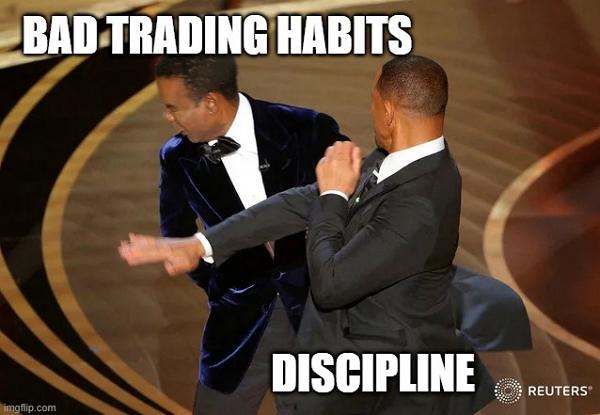
Willpower is Rarely Enough In the fallout of the Will Smith & Chris Rock incident this week, our social media world was overwhelmed with memes. Some of which were quite clever and make social media almost borderline bearable.
But not this one.
This one led to an involuntary "FFS!" response followed by rapid scrolling.
Attached Image (click to enlarge)
Nope!
Sorry. It's not that easy.
I get what they're saying. It's not totally wrong.
My concern is that it's not that simple. This was "old school" trading psychology.
It sounds good. But it just doesn't work.
"I know this hasn't worked for months on end now, but I was just being undisciplined."
"This time I'll try harder."
"This time I'll focus."
"This time... I'll be the disciplined trader I know I can be."
We've all done that. And yet, the problems keep appearing.
Try as hard as you can, with all the willpower you can muster, and sooner or later you will slip back into old habits.
Willpower is rarely enough.
The reality is that resolving these issues will likely be difficult, for all but the most simple of bad habits. In some cases involving deep analysis of feelings and thoughts to provide insight into subconscious patterns of behaviour. For deeper underlying issues you may even need to employ the help of a professional.
This is beyond the scope of today's article.
What I would like to provide though, is something to try first. Something that might simply AVOID the situation, or at least minimise the frequency of occurrence.
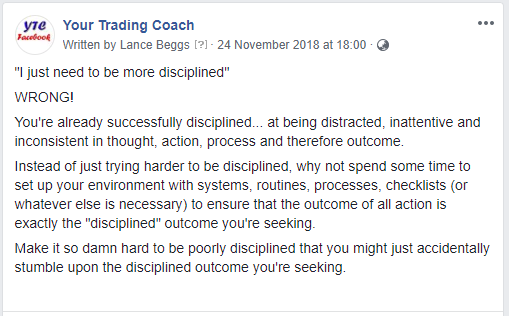
BEFORE CHANGING YOURSELF, TRY CHANGING THE ENVIRONMENT.
Again, the aim is to set up your workspace in a way that either avoids the situation entirely, or helps to minimise the frequency with which the problem will occur.
This old YTC social media post offered one way to achieve this:
Attached Image (click to enlarge)
In my aviation days we always operated aircraft with physical checklists. Process was SO IMPORTANT that although we knew the steps by heart, we accepted it was necessary to work step-by-step through a hardcopy checklist. And often in a challenge and response method between Captain and Co-Pilot.
I know of many traders who operate in a similar manner, using a documented checklist or flowchart to guide themselves through their trading day. Consider whether or not that may help you.
But environmental changes don't just have to be checklists. Here's another example... tech solutions!
My trading process has a clear and unambiguous rule:
An exit is NOT final until the trade is reassessed. If the premise is still valid, seek re-entry. If not, only then is the trade over.
And so we discussed a sequence of two trades. The first in which I applied this rule correctly. The second in which I completely disregarded the process.
Mind in neutral... silently basking in the glory of a trade closed nicely in profit. And completely missing the fact that my exit was premature and a whole lot more was available.
The fact is that I'm quite good at focusing and seeking re-entry from a loss, or scratched trade. But I'm far more inconsistent in following process after the bigger winners.
There seems to be a pattern developing.
So last week's article was a part of an attempt to improve discipline. Accepting the problem, admitting the problem publicly, acknowledging the behaviour as failing to meet the standards I set for myself. And vowing to do better next time.
This is the "willpower" solution.
But that's not all that can be done.
Because I recognise that willpower alone, is rarely enough.
So here is something else I did.
I modified the environment in which I trade, to make it harder for me to "forget" the re-entry assessment.
My platform (Ninja Trader) has audio alerts whenever a trade exits. A voice that says one of the two following statements:
"Stop Filled"
"Target Filled"
The good news is that you can change this text. So I simply amended them to say:
"Stop Filled, Reassess"
Target Filled, Reassess"
Simple. And incredibly effective. I'm not sure why I never thought of this before.
Granted, I've only used this for a week so it's early days in the trial. But I can promise you that there has not been ONE trade this week where I have not been reminded of the importance of reassessing the trade premise on exit.
Willpower is rarely enough.
But an environmental change which makes it so damn hard to skip the re-entry assessment, means that I delay (for now) the deep dive into my subconscious to find out why I tend to relax whenever I have a small but nice win, rather than really pushing my advantage.
BEFORE CHANGING YOURSELF, TRY CHANGING THE ENVIRONMENT.
If you set up the environment to make it harder to be poorly disciplined, you may find there is very little else required.
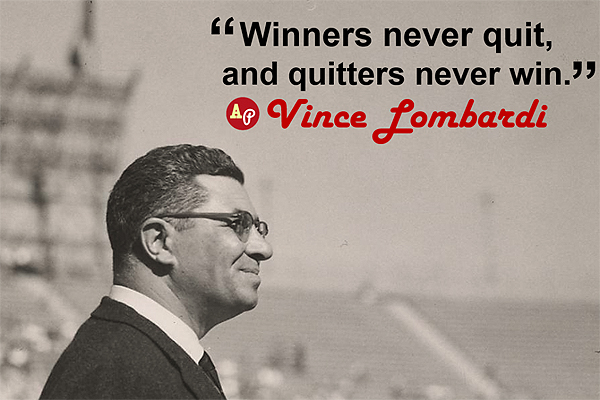
If you are an American of a certain age and have played organized sports in your youth you have no doubt heard your football/soccer/baseball/tennis coach utter the inimitable phrase, “Son, winners never quit and quitters and never win.”
This was always uttered in long Southern drawl (I went to high school in Virginia) and usually with the certainty afforded only to the Ten Commandments.
Needless to say, that is the stupidest advice ever. In capital markets where quitting is not only necessary but vital to the very survival of your capital.
I know. I know. In our Anglo-Saxon Protestant work ethic culture we are all taught to “stand our ground”. To fight rather than flee. And this is why almost every famous investor fails miserably in the end. Don’t believe me? Tudor Momentum Fund Ltd has returned a whopping 2.24% since its inception in 2009. Bridgewater has posted 4.5% per annum since 2005. The S&P during the same timespan? 10.29%. So like 228% more. Tiger Global which was touted as some of the smartest money on Wall Street lost 34% this year and went from outperforming the S&P to underperforming it not just for this year but over TWENTY YEAR span with this one really bad stumble. I could go on but it's just too easy and you get the point.
Quitting in capital markets is a vice not a virtue. Quitting your trades via stops. Quitting your strategies when the market regime changes. Quitting your fundamental bias when the economic facts prove you wrong.
This is of course a lot easier said than done. We are all culturally programmed to not quit, especially when it comes to us of the weaker sex who perceive making a mistake as a stain of shame on our masculinity. Yet every great military tactician from Sun Tzu onward will tell you that a retreat is often the best path to victory. Ask the Afghans, ask the Ukrainians. Ask any smaller foe that was able to defeat the bigger opponent. But when it comes to trading we all seem to forget that there is no bigger opponent than the market. No one can defeat the market. If you are on the wrong side of the trade it will eventually bury you. This is why so many famous investors like LTCM, Melvin Capital and Amaranth can go from making money for years to losing everything overnight. Oh.., and Bill Hwang anyone?
Quitting is not only crucial when you trade, but actually makes you a much better trader by forcing you to appreciate ideas that are antithetical to your original beliefs. All my life I have been a fade trader. I am much more comfortable buying bottoms and selling tops. This, I am sure, was not a result of any genius, but simply a quirk of my personality which abhors all institutional authority ( so what better way to express that then by always being on the opposite side of the move?)
But at the start of this year I stumbled across some very interesting equity research that showed unequivocally that stocks are a long biased asset on an intra-day basis. In fact over the past three years the upside skew has been so ridiculously large that it's like trading a 60-40 coin. It is basically a license to print money. Still, many traders refuse to acknowledge this fact and I was one of them. Until eventually I changed my strategy from just trading reversals to trading reversals and continuations. Guess how that is working out?
As Larry David would say, “Pretty, pretty good.”
Yet this late life conversion to “quit” my old mean reversion ways has had a deeper, more profound effect on my ability to analyze the market. For example while the long side bias is working now, I am fully mindful that it may disappear at any time. Like a true stoic I am learning to accept the world as it is rather than the way I wish it to be and that will hopefully keep in the game for much longer.
“Quitters never win” is dumb cliche and in my opinion should be replaced with more nuanced “winners need to change.” ********************************************************************************************************************************************
A good thought provoking exercise from Lance Beggs (of Your Trading Coach): ******************************************************************************************************************************* Hi Traders,
"In a decade and a half of running this website and communicating with other traders, I can say with complete certainty that MOST of those who want to trade fail to achieve and maintain even basic levels of..." (answer below)
Regards,
Lance Beggs.
The Most Underrated YTC Lesson
This question was different. In the decade and a half of YTC I don't recall having had this one before...
What do you consider to be your most underrated post or article? What could I have missed in my reading?
Interesting!
My initial response was "Give me a few days to think over this one".
The answer came quickly though. And now (a few more days later) I'm still happy with my response.
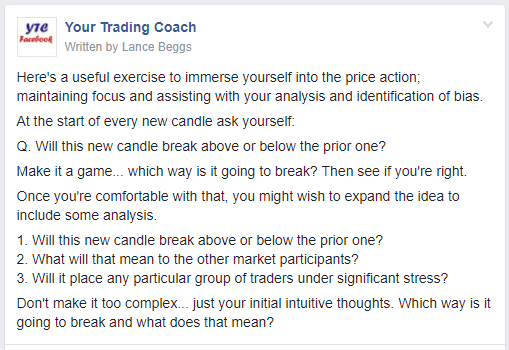
From social media, initially published in 2013 but repeated a couple of times since.
Attached Image (click to enlarge)
If you're a low timeframe discretionary trader, consider this thought.
In a decade and a half of running this website and communicating with other traders, I can say with complete certainty that MOST of those who want to trade fail to achieve and maintain even basic levels of situational awareness.
Most are far too passive, letting price unfold without any significant thought as to where it is going AND what that means to other market participants.
And then looking back with hindsight and asking how they missed the "obvious" trade opportunity. (Hint: it's never as obvious in real-time. You need to see it before the majority do. As it's emerging, not after it's done.)
Immerse yourself into the price action. Feel the ongoing battle between bullish and bearish pressure.
Project forward - where is price likely to go?
And understand what that might mean, for both market sentiment and potential trade opportunity.
The exercise shared in the post is not the only way to achieve this. But it's a simple approach. Easily achievable on 3 or 5 min charts, or higher. Achievable on lower timeframes if you pick and choose your spots (setup areas, structural transition areas etc). And easier with practice... so be patient with yourself.
This has to be one of the shortest YTC articles ever. But again... quite likely underrated.
If you don't "get" the message, bookmark this and return to it in future.
But otherwise, give the exercise a try and see if this helps you to maintain focus and awareness.
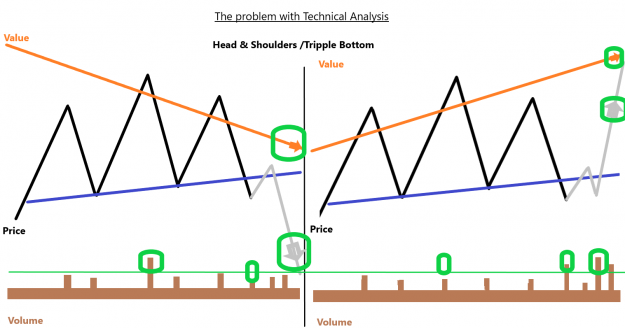
One of the first things I learned from Ray was that both Technicals and Value (fundamentals) and Volume are all important.
Same Technical Pattern, but completely different result:
Attached Image (click to enlarge)
The image above shows (some of) the clues needed to actually trade a Head and Shoulders pattern.
Ray teaches Value/Fundamentals, Technicals/Liquidity, Volume , OrderFlow for Currencies, Equity Indices, Metals, Energy, Bonds, and Agriculturals plus a little on individual Equities and Cryptos. Plus Market Internals for Equity Indices.
CompassFX say he will be starting to teach his full course again soon (probably in May). He rarely teaches this course these days (having done the first one 7 years ago) and only does so when he can make it better than the last time he taught it.
Note that I have no financial interest in these courses. I am merely a student and administer a free Skype group for Ray's full course students (past and present).
Hi guys FWIW I found rays earlier teaching of finished business entries, pivot stop runs, volume, md liquidity / 150 targets, insto accumulation/exhaustion/profit taking brilliant.
I thought Rays valuing / options bias etc was fascinating but too overwhelming for DAY trading as one person. In the heat of battle im supposed to determine what value is driving the market when really whats driving the market could be any number of things. It didnt help me. Maybe its better for long term positions or maybe I do not have the IQ for it. Value seemed to change just as quick as orderflow and to try to follow both at once? I found it impossible to do so consistently.
Once I realised trading is not about being right/wrong that it is about getting discounts THEN it became fun and consistent.
FWIW i trade ES Futures for 2 hours. @ USA closing session using 100 volume charts.
I found Rays lessons on this in 2014-2016 were his best. keep it simple.
Anyone else the same?
BTW Who is this Lance Beggs guy? Why is he the focus of a Ray thread? lol
Hi @Coos81, Although most in this thread is about Ray and his teachings, I also include some form others who (in my opinion) are good teachers and teach something similar/compatible. But in all cases they teach something much less comprehensive. Lance Beggs is one of those, as is The MAX (taught by Eusebio Nanni).
In order to have things to post/comment on I also sometimes post stuff from Boris Schlossberg, even though mostly I think he's an idiot.
Live Free Trading Psych webinar tomorrow 18th May at 1600 hrs Eastern (New York) time:
[LIVE EVENT WEDNESDAY] “Mental Game of Trading” w Jared...All Traders Welcome!
YES! Only 1 More Day & We’re Live with Jared!
A Step-by-Step System for Mastering Trading Psychology
“The Mental Game of Trading” by Jared Tendler
LIVE SPECIAL EVENT WEDNESDAY MAY 18th at 4:00 PM EASTERN Live Room Login
Guest Password: mindset (No Registration Required, Invite a Friend)
In this exclusive presentation, Jared Tendler — author of The Mental Game of Trading and world-renowned mental game coach to Institutional and Independent Traders, top poker players and PGA Tour players will provide a step-by-step system for your mindset.
Think about your most costly and recurring trading mistakes.
Chances are that they’re related to common errors, such as chasing price, cutting winners short, forcing mediocre trades, and overtrading.
You’ve likely tried to fix these errors by improving your technical skills, and yet they persist.
That’s because the real source of these mistakes is not technical — they actually stem from greed, fear, anger, or problems with confidence and discipline.
Jared brings a new voice to trading psychology. He busts myths about emotions, greed, and discipline, and shows you how to identify the real reasons you’re struggling. The Mental Game of Trading:
A System for Solving Problems with Greed, Fear, Anger, Confidence, and Discipline
See you in session
P.S. Please forward to your trading friends, they’ll thank you for it!
Hi guys FWIW I found rays earlier teaching of finished business entries, pivot stop runs, volume, md liquidity / 150 targets, insto accumulation/exhaustion/profit taking brilliant. I thought Rays valuing / options bias etc was fascinating but too overwhelming for DAY trading as one person. In the heat of battle im supposed to determine what value is driving the market when really whats driving the market could be any number of things. It didnt help me. Maybe its better for long term positions or maybe I do not have the IQ for it. Value seemed...
Ignored
You can't simplify the market.
If you could simplify the market thousands of people would be making money.
95% of retails traders don't make money consistently and 99% don't know what they are looking at.
There are different types of values Ray used. Like intrinsic values and relative values. To use them effectively, you really need to understand the value lines you're using and asking why they are driving or correlating to the market you're trading. They can obviously lead one another and you may require additional to help your analysis. They can be used for both long and short term trading. Trading is all about volume, value and price ...so you need structure = levels etc value to see if there is value at that price and volume to see if anyone else is trading and what they are doing.
{quote} You can't simplify the market. If you could simplify the market thousands of people would be making money. 95% of retails traders don't make money consistently and 99% don't know what they are looking at. There are different types of values Ray used. Like intrinsic values and relative values. To use them effectively, you really need to understand the value lines you're using and asking why they are driving or correlating to the market you're trading. They can obviously lead one another and you may require additional to help your analysis....
Ignored
Ok.
What is the best leading indicator/value in your opinion to use when daytrading ES?
Could you provide examples please using 100 tick chart or at the very least 30 second timed charts?
Im very interested as I couldnt find a consistent lead for ES.
Are you using these environments/values (bonds, copper, oil, usd etc) as a MACRO bias OR using it as a micro arb or micro strength? or all of the above?
Cheers.
{quote} Ok. What is the best leading indicator/value in your opinion to use when daytrading ES? Could you provide examples please using 100 tick chart or at the very least 30 second timed charts? Im very interested as I couldnt find a consistent lead for ES. Are you using these environments/values (bonds, copper, oil, usd etc) as a MACRO bias OR using it as a micro arb or micro strength? or all of the above? Cheers.
Ignored
I don't trade the ES so I cannot speak up for you who is an ES trader. The only trade I find interesting in ES is sentiment trade, meaning using sentiment as a lean for scalp trade even though I never trade it. One thing I know of is both ES and Russell they are cyclicals while Nasdaq is durational. If you can form value lines which can identify huge sentiment divergence (eliminating the durational factor) and scalp or trade it, you should be good. Anyway I know both Ian and Ray trade the ES, why not ask them who are the experts? First of all you should understand we are not allowed to disclose information of Ray to the public.
Something decent from Boris Schlossberg of BKForex (for a change):
Of course he's wrong in my case since Opens, Closes and key times are on my charts. So are the levels at those key times.
********************************************************************************************** The Most Important Indicator is not on Your Charts
Dear ian
This week I had some really interesting live trading sessions with a couple of seasoned pros in two utterly unrelated markets. Both traders relied on one data point that most newbies don’t even think about.
Thursday night I hosted the Trading Battle with Peter Foster who focuses mainly on the energy complex. We got to talking about his most recent trade in oil and after we went through the usual price structure on the chart he casually mentioned that what really prompted him to pull the trigger was the fact that oil was approaching the close of the day and if he was right on his analysis the trapped shorts would be forced to cover providing fuel to his long.
Less than 12 hours later K and I hosted our Open House live trading session and as K was discussing her recent swing win in EURCHF she also mentioned the time of day noting that she only put the trade on at the start of the New York session when fresh liquidity could move what was already a very strong fundamental and technical setup in her direction.
Both Peter and Kathy are seasoned traders. Peter has been trading energies since 2006. Kathy has been trading FX before she was even allowed to legally drink in the state of New York. Time of day is second nature to them because they have been watching their respective markets for years. Like an FBI agent who tracks his suspect for months learning all of the daily habits down to how they take their coffee every morning, professional traders track their markets in much the same manner. And each market has a very distinctive pattern that repeats itself constantly day in and day out.
In equities, for example where I spend all of my time, the first hour of NY cash open is almost always ripe for some mean reversion because dealers who have absorbed the initial flow of capital from the opening retail orders are keen to square up and flip out of their inventory. So if retail is selling at the start of day we always get some sort of a bounce before noon and vice versa.
The last hour of the day however, can be a one way train and woe is to the trader who decides to take on the market at that time. The last hour of the day in equities is dominated by institutional flow that needs to settle up - price be damned. If markets panic, the last hour can look like one uninterrupted red candle as everyone tries to lock in a mark before the close.
These things are obvious and almost subconscious to anyone who has traded for a while and yet are almost never really discussed by “gurus” armed with colorful indicators and beautifully annotated charts. Newbie Newsflash - an RSI of 30 at 11am is not the same as RSI at 30 at 3pm NY.
This is also the reason by the way why all algos fail in the end. Algos are incapable of discerning context and context is the single most important factor that determines profit or loss. Time of day is just the most common example of context - yet this indicator does not appear on any charting package although it is by far the best way to tell if other indicators are providing an accurate reading of the market or not.
The other day I was listening to a podcast on which a guest noted that our job as traders is not to know why but to determine where. I couldn’t agree more, but I would just add that in trying to accurately determine where it is just as important to focus on when.
Ray's trades (apart from Scalps) always have a WHY. That is what makes it possible to have the confidence to take positions against most other retail traders - since we can often see that the commercials or the Algos or the Prop Desks are trading in our direction!
Another good email from Boris Schlossberg (of BKForex): ******************************************************************************************** Dear ian
We had to choose a new health insurance plan recently which reminded me just what a scam the health insurance business is. There really is no business in America quite like it. It can charge you up to $25,000 per year for family coverage and literally provide you nothing in return except an annual check-up and a blood test. Truly, it is the perfect business model. It collects money every month. You can never cancel it. It tries everything in its power not to pay out claims while making carry on the money it collects. It’s the easiest 40 billion dollars of profit in American commerce. I am exaggerating but just barely. The basic health plan in America has a $10,000 deductible before it pays out a dime for health expenses. So unless you get run over by a car every year, or catch cancer or have a heart attack your health insurance pays for NOTHING. Food poisoned? Flu? Cut finger? Even Covid. Suck it up, big boy. It comes out of your pocket first despite paying more money in premiums than you do for a mortgage. The health care insurance companies may be the scummiest businesses on earth but they are also brilliant at what they do and we as traders can learn a lot from their tactics. The first thing insurance companies always do is capitate. This is a fancy word for placing risk limits. Basically no single individual is an uncapped risk. Every policy comes with a hard money stop so that no one chronically ill person can’t bleed them of their capital. Usually, most health insurance policies stop payouts after $1 million dollars. Most of us, of course, have no idea that this exists because fortunately most of us will never accrue such large medical costs. But you can be sure that the guys on the other side of that trade know this cold and we should all keep that lesson in mind next time we are mindlessly plowing money into a losing position hoping that it will resuscitate.
But if stop losses are the foundation of the insurance business, the most important business practice in the industry is discrimination. No one discriminates quite like the insurance companies. If they had their druthers they would offer policies just for guys like me - a 50-something who rarely gets anything more than a cold, has no history of surgery or illness and takes zero prescriptions while happily paying them $20,000 a year for “peace of mind”. The famous line from the Wire is that nothing in life is more expensive than “free”, “peace of mind” comes a close second.
In any case, until they were forced by Obamacare to stop it, insurance companies were the greatest discriminators in the world, using reams of data analysis to approve only those customers who were never likely to get sick. In short, insurance companies always look to make as many “winning trades” as possible. They do this by walking away from even the slightest threat of risk. Imagine two customers John and Jack - both 40-year-old males. John is as trim as he was in high school, runs three miles every other day, and eats organic food only. Jack smokes two packs a day, is 100 pounds overweight and often wakes up in his rumpled clothes after consuming a bottle of Jack Daniels the night before. John’s premium may be just $2,000/year and Jack’s may be $8,000 for the exact same policy, but most insurance companies would find a reason to reject Jack even if he was willing to pay them $16,000. Because they are not stupid. They know that with John they are likely to have 20 years of carefree money collection whereas Jack is a heart attack waiting to happen and no amount of premium upfront would offset their losses if Jack ended up face down on some the bar floor with an EMT straining to shove his blubbery body into an ambulance. It doesn’t matter how much Jack is willing to pay for his coverage, the risk is never worth it. Scummy or not, health insurance companies are masters of controlling their environment by relentlessly discriminating against risk. We can certainly question the morality of their tactics, but we can’t ignore the effectiveness of their approach and since the only thing we traders ever kill is money, adopting their methods won’t compromise our values but almost certainly could improve our results.
Open to all traders. Ray's free 5 day training sessions 3pm Eastern (New York) time Monday 8th August through Friday 12th August. Here are the details and registration link **************************************************************************************************
The “Compass Trade Group” Invites You To A Special Online Event
FREE 5-Day Market Maker Live Trade Challenge Starts August 8th
“Engineering An Institutional Trade”
Video Playback Provided
Learn proven algorithmic tactics, strategies and probabilities to reverse engineer trade success...transform how you see the markets.
Here’s a few Institutional Trade Strategies and Trade Exercises that will elevate your trading...learn these and many more strategies and insight during the live hands-on sessions.
The Institutional Red Green “RGL” Trade Strategy...Key Strikes at Commercial Volatility
Cash Open Systematic Trade Process...Volatility Expansion Breaks
“MOCi” Market on Close Ignition Trades...Institutional Volume Auction Process
Opening Range “Measured Move” Liquidity Target Trade Levels
Our Goal is Simple. Fix the Trade Gap...Entries. Stops. Profit Targets.
If you cannot attend, just take advantage of our playback videos!
Trade at the highest level...Engineering Trade Success, with the BEST Institutional Tactics, Strategies & Training Live in the Markets with a Quant Bank Trade Strategist.
'Dirty little secret of professional traders' ?
Kathy Lien (of BKForex) talking about how professionals do what retail traders are taught never to do - lock in or take some profits early!
Inserted Video
I quite respect Kathy even though she works with that idiot Boris Schlossberg. After all much of MAX trading system is based upon her teachings on momentum.
I was just talking about this idiot (Boris Schlossberg. Here he is talking sensibly (for once) about Risk vs Uncertainty: ****************************************************
Risk Versus Uncertainty
The little one is starting middle school next week and unlike the elementary which was on the same block that we live on, the new school is seven blocks uptown and two avenues over. So naturally and much to my wife’s chagrin I bought an adult scooter to ferry us over every morning. (If you think the prospect of avoiding a 15 minute walk is a laughable problem - well then my friend you clearly don’t live in New York ).
In any case the wifey insisted that if I was going to proceed with this idiotic scheme I had to wear a helmet and I actually agreed, because as a good buy side portfolio manager that she once was, she is keeping her eye on the risk. The risk in my setup is not that I could trip over a crack in the sidewalk or that a taxi could accidentally clip us at an intersection. The risk isn’t even that I could fall off due to my own clumsiness. The real risk in this transportation scheme is that I could hit my head which is the only part of the body that will not mend easily. So as a good wife and even better trader she is trying to minimize the risk.
As traders we often conflate risk with uncertainty which leads us to make terrible decisions often at the worst possible times. No one is more guilty of that sin than yours truly, but as I grow older I am finally learning to discern the difference. How is risk different from uncertainty? First and foremost it's mostly quantifiable. If you make a trade and it goes to zero your risk is 100% of your money. If you used 10:1 leverage to make that trade and it goes to zero your risk is 1000% of your initial capital. That’s just basic math and it’s really not in dispute.
So what then is uncertainty? Uncertainty is just the path life takes. That trade you made? Well it could have doubled after you bought it, but is there any assurance that it would have continued to rise? No. Just ask all the millennials who scoffed at me when I begged them to sell just part of their Bitcoin holdings at 65K. Maybe the HODLers will prove me wrong, but may be not. Having lived through the dot com bust and the Real Estate bubble perhaps I’ve just developed a greater awareness for uncertainty.
Uncertainty is with us everywhere in life and certainly in the market itself. We start today on a high note as the Non Farm Payrolls paint a Goldilocks scenario of just enough growth but not too much pricing pressure and stocks take off to the moon and then the Russians shut off the gas and the markets fall twice as hard as they rose.
Uncertainty is simply everyday living but many of us are just not aware of it. My wife is always shocked at my nonchalant attitude when I remark that on any given day I could get hit by a cab or get a terminal disease and I am perfectly ok with that. I have tons of insurance, I tell her. (See, I think about risk also). But this East European attitude is borne of a very tumultuous life full of variance from birth in which I’ve had to change cultures, change social statuses and ultimately change myself to adapt to wildly different circumstances.
For many people who live in OECD nations, become well educated and earn enough money to speculate in the markets that type of everyday uncertainty doesn’t exist which is why trading becomes such a psychological bitch slap. It’s not just that markets are wildly unstable, it’s that they are always unstable in different ways so unlike a difficult dental surgery or a tricky recipe for souffle you can never be confident in mastering the craft. That’s why the best practitioners of game like Soros or Druckenmiller are not great analysts (both have been known to reverse billions of dollars on a dime) but are simply very comfortable in living with uncertainty while ruthlessly keeping an eye on risk.
Once you begin to realize that there is nothing more uncertain in life than your next trading setup you can develop a healthier, more stoic attitude towards the market that could even help you deal better with real life itself. **************************************************************************
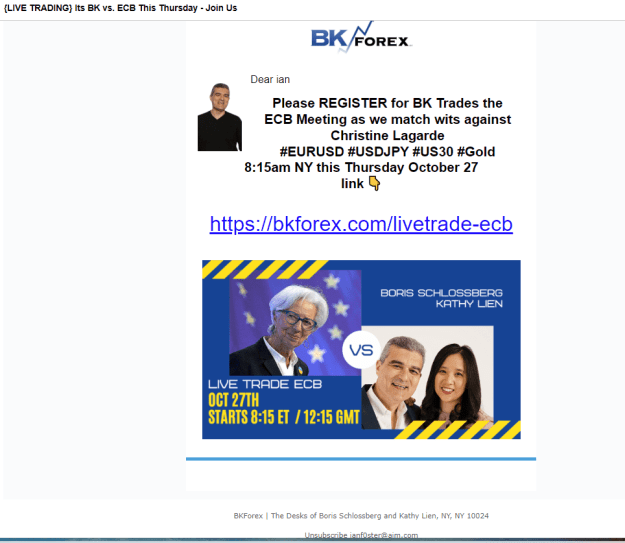
Boris Schlossberg is back to being idiotic again. Re-enforcing mistaken views of dumb retail traders:
Attached Image (click to enlarge)
As a retail news trader, your initial job is always trade with the Central banks. So you should never be pitting your wits against them, though on rare occasions where all/most of the big commercials disagree with a central bank there may be opportunities to scalp against such as C. Legarde (though I would be more likely to trade against a central banker who actually is an incompetent idiot - thinking of the likes of A. Bailey here).
Hi
ian
watched some of free session of ray , and some old video too. thinking to subscribe ray but i have two doubt
1. ray have lot of material from with long long hours, one don't know where to start
2. one of the user said if you subscribe than there are no path where to start and when finish, no chapter like instructions, you never know when to finish
3. i trade indian market but maximum cocept of ray based upon US


 Institutional Equivalent Education?