Good Morning Mr BenjaminIs, You have been doing great achievement, making money( in Demo ), BUT why not people taking any interest here in FF ???? may be Because of DEMO?? I’ve got a suggestion for you, why do not you start online training for free, then they show some interest. Take care & have a wonderful day.
Good Morning Mr BenjaminIs, You have been doing great achievement, making money( in Demo ), BUT why not people taking any interest here in FF ???? may be Because of DEMO?? I’ve got a suggestion for you, why do not you start online training for free, then they show some interest. Take care & have a wonderful day.
Ignored
Good Day
Here is the problem getting clients in Forex Factory. People are lazy and people do not even want to register to post.
I have known that for a long time so I have been using my thread here started on December 3, 2016 in order to build up the data and allow people to sign up for my Forex trading course through my new website.
The cost will be $250.00 US Dollars to register and for that fee the client gets three months of 24/7 access and they can even watch my Forex trades or email me or call me.
Once I determine their skills if they want to continue on the monthly cost will be $50.00 US dollars.
It costs me thousands of dollars for all my systems including research. This is not only a business it teaches people how to WIN and make substantial profits if they have the discipline and can control their FEAR and their GREED and their EGO !!!
I first want to talk about having an EDGE. Fundamentals by themselves is not an EDGE. However using Money Flow between Asset Classes from here on I will include in my basket of 100% of what a winning Forex Trader needs. I will not refer to it as a fundamental anymore since new people coming to this thread put my method as including Money Flow as a fundamental which it actually is however not in the same way as most people understand Fundamentals.
This week we will get to see Non Farm Payroll (N F P) and as any experienced Fundamental Forex Trader knows it usually is a fantasy number created by the BLS however next to a FED rate announcement it is the one number that can move markets hundreds of PIPS in seconds and minutes.
Whatever the number Trillions of Fiat Currencies and other Asset Classes will start to change values as we "SEE" the Money Flow. That is why I call it my EDGE and once you know it and understand it well then it becomes your EDGE as well.
Here are the 5 important things that any Forex Trader that belongs to the minority of constant profitable Forex Traders , which I have named , The 5% Club needs to have. Of course in my opinion, I would think that very few Professional Forex Traders use the EDGE. Of course when you know about it then anyone can use it.
Each of the following five important things which I have given a weighting of 20% to each makes up what a profitable Forex Trader needs to have in order of IMPORTANCE.
(1) The ability of the Forex Trader to control their FEAR and their GREED and their EGO. Perhaps the last one is the most important of the three since the MARKET is always right. Using Money Flow puts you with the Market instead of against it as your Forex Account keeps losing the value in it.
The reason that I teach Forex Traders whether experienced or new to Forex trading with a $50,000 US Dollars Demo Account is because that is how I learned my trade starting during 2003. By learning to trade with $50,000 US Dollars in Demo Funds, then I had no FEAR or GREED. However after 3 years of Forex Demo Trading I surely had EGO since month in and month out my Return On Investment (ROI) was constantly over 10% a month or 120% a year.
(2) Money Flow. I have now explained why.
(3) Risk Management. That is next to Money Flow the KEY element of my Forex Trading since when you blow your account whether you are trading with too little capital as the majority of Retail Traders are or because of a Black Swan event such as Brexit or Europe banking issue such as we have in Italy at the moment or the Swiss Central Bank as they did a few years ago say one thing and then next moment announce a major change in their policy and 500 PIP movements happen in seconds. The absolute MINIMUM Forex Account that I would and could trade with would be $10,000 US Dollars. I would be glad to answer questions as to why although most will understand. What if you do not have $10,000 US Dollars trade with ? Prove to yourself that you have the skills and the knowledge to trade with profits then you will have no problems finding funds to trade Forex with. After my 3 years of Forex Demo Trading, I went out and found 6 clients that first deposited initially $50,000 US Dollars and within 3 months along with the profits that I was generating in my first three months of Forex trading from March 2006 to June 2006, I was managing well over $100,000 US Dollars.
(4) Technical Indicators which includes all parts of it whether Support and Resistance or Supply and Demand or Pivot Points. I use when I do daily trades the 5 Minute Charts along with the 15 Minute Charts and 30 Minute Charts to go along with the 4 Hour Charts. When you toss a rock in the river the first ripple is the 5 Minute Chart and then on to the 30 Minute and the two others. I use other indicators aside from the standard ones which are SAR and Fractal and Awesome Oscillator. The most important one that I look at when I enter into a Forex Trade is Support and Resistance so if I am going long or short I enter either at the TOP or BOTTOM of the Chart that I am using. Of course my Risk Management protects me from Human Errors or EGO.
(5) Fundamentals. I am fairly sure most of those reading my words today or whenever they read it might be surprised how a Forex Trader such as myself who posts a tremendous amount of research can list fundamentals as number (5) in order of importance. It is the research that allows me to clearly understand the difference between PERCEPTION (Markets) and REALITY (Research) Then I know what will most likely happen in the future and I am better prepared to deal with it.
I hope that this post of my daily Morning Thoughts answers some of your questions both for the 12 Forex Traders using the $50,000 US Funds Demo account with FXCMUK or anyone else. There is no reason that an experienced trader reading this thread or anyone else to not open a $50,000 US Dollars FXCM UK account so they can use the knowledge that we share here to learn new things and try them without having any FEAR of LOSS !!!
As always , I look forward to feedback and thoughts and anything that you care to share with us on our Thread.
Good day fellow traders on Forex Factory. I have been trading Forex for over 10 years now and with the incredible movements on a monthly basis which has been caused by the intervention efforts of the world's central banks trading today is much different trading before 2008. Thus RISK MANAGEMENT must be a priority for any serious forex currency trader. You should never RISK more than 5% of your trading capital on any one trade plan. I also strongly suggest that you never trade more than 20% of your total trading capital at anytime. Example - If you are trading $50,000 in US Funds NEVER have more than 20% or $10,000 US Dollars on your various trade plans always using the 5% rule for risk on each trade plan being used.
The Money Flow Trading Method is based each trading day on Risk On or Risk Off which means are the markets heading down or heading up. I use the DOW to determine this each day. When the markets head down and we have Risk Off the money flows into US Dollars first and then the money is parked usually into US Bonds so the bonds go up and the yield goes down. Money also flows to USD/JPY. I will give more explanations when the forex markets reopen on Sunday. If you have any comments or questions please post them on this thread. Tomorrow we have two important events the most important being the referendum in Italy.
The results will move the markets whichever result we see. This is a Fundamental Fact and that combined with Technical Indicators as to Support and Resistance along with investor perception of the meaning of the results short term will lead the direction of the market. I will be thinking of going short on USD/JPY depending on the results of course and Risk being off.
Authored by Scott Melker via CoinTelegraph.com,
Almost all traders are aware of the widely publicized statistic that “95% of traders lose money.” When you drill deeper, research implies that this number is likely higher. The profession chews up and spits out aspiring traders at an astounding rate. So why are so many intelligent people drawn to a profession with incredibly high odds of failure?
6 striking stats showing traders have it rough
There are the obvious reasons — the appeal of working for yourself, sitting in your underwear on your couch all day making millions. There’s the (false) promise of “easy money” and the draw of independent wealth.
The truth is, day trading is extremely difficult, emotionally taxing and far more likely to destroy your life than enrich it.
Let’s start with a few key statistics, from online educational resource Tradeciety:
80% of all day traders quit within the first two years;
Among all day traders, nearly 40% day trade for only one month;
Within three years, only 13% continue to day trade. After five years, only 7% remain;
The average individual investor underperforms a market index by 1.5% per year;
Active traders underperform by 6.5% annually;
Traders with up to a 10 years negative track record continue to trade.
The last point suggests that day traders even continue to trade when they receive a negative signal regarding their ability.
Astounding. Almost everyone loses, they lose fast, they underperform simple, mindless investments, and they continue trading even after being proven unprofitable. Why?
The truth is, most would-be traders are woefully underprepared for the challenge ahead and learn many hard lessons with their real money. They underestimate the psychological challenges of trading and fail to eliminate emotion from their trades.
They fail to trade with a defined system. When they have a defined system, they often take trades outside of their own, established rules. These are all obvious reasons.
What is “random reinforcement”?
Perhaps a less notable reason that traders fail is the principle of “random reinforcement.” This concept also explains why they often continue trading, even after failing repeatedly. As defined by Investopedia, “Random Reinforcement” is: Using arbitrary events to qualify (or disqualify) a hypothesis or idea; attributing skill or lack of skill to an outcome that is unsystematic in nature; finding support for positive or negative behaviors from outcomes that are inconsistent in nature—like the financial markets.
The market has a tendency to reward bad habits, while concurrently punishing positive behaviors, especially with a small sample set. Let’s take a theoretical example to display this principal.
Bob wants to leave his job and become a crypto trader. He sets aside some starting capital, follows the markets and the “big names” on twitter. He sees them talking about an altcoin, opens the chart and sees that price is rising fast. He buys, goes to take a shower, returns and sells for a quick profit. He does this again before lunch and strings together a few successful trades. Bob starts to feel confident that he is a talented trader.
So what is the problem? Bob is trading without a system or a plan and is being fooled into believing that a successful outcome on a few random trades is indicative of likely success moving forward. The market has rewarded his bad behavior. We know how this story ends — Bob continues to make impulsive trades and eventually loses his capital.
There is a flip side to this coin. Let’s say that Bob learns his lesson and spends months developing a trading plan, complete with risk management, proper portfolio allocations and trading rules.
He identifies a trading opportunity that fits, takes the perfect entry and… stops out of his trade. He tries again. And again. He loses 7 times in a row. The market is punishing Bob for his good behavior. Bob starts to doubt his system and takes a high-risk trade that violates his system — and is successful. To his surprise, he tries this a second time and also makes money. Bob is now back to square one, trading without a system because the market has rewarded his bad behavior.
Through random reinforcement, the market has re-conditioned the way Bob approaches trading by distracting him away from his trading plan. He has allowed himself to be manipulated into an impulsive, high risk, revenge based trading approach.
Everyone was a genius in 2017
The concept of random reinforcement was never more evident than in the crypto bubble of 2017. During this parabolic bull market, it was easy to mistake luck for skill.
Amateur traders were making money hand over foot by simply throwing cash into random altcoins and selling after massive, immediate gains. Everyone was a “genius” in the 2017 crypto market. Then 2018 happened — the bubble popped, and these amateur traders were ill-prepared to deal with the drawdown. They failed to sell their assets and held blindly until they had lost everything.
Understanding that markets are dynamic and in constant flux is key to being profitable. A trader must learn to be able to determine when a certain string of losses or profits can be attributed to their skill and when it is random. This is done by trading with a defined plan over a long period of time.
Every trader should have a well developed and tested (through paper trading) plan, with written rules for entries, exits and stop losses, position sizing and risk. They should NEVER trade outside their plan.
Bitcoin trading: sticking to your plan
No more than 1% of a trader’s portfolio should be at risk on any single trade — this is the key to sustaining multiple, consecutive losses. They should test and tweak their plan over a long period of time — hundreds of trades. A good system gives a trader an edge over a long time frame because randomness becomes less of a factor with a larger sample.
A good trade should be defined as one where a trader planned their trade, traded their plan and managed their risk — those are all elements they can control.
It is NOT defined by the outcome.
A bad trade, on the other hand, is where a trader fails to follow their rules and executes trades against their better judgment. This is always going to be a bad trade even if it happens to be profitable.
By developing a well-tested plan, traders can overcome the pitfalls of random reinforcement, eliminate emotion and impulse, and learn to be profitable. That’s how you become a part of the 5% that make it as traders.
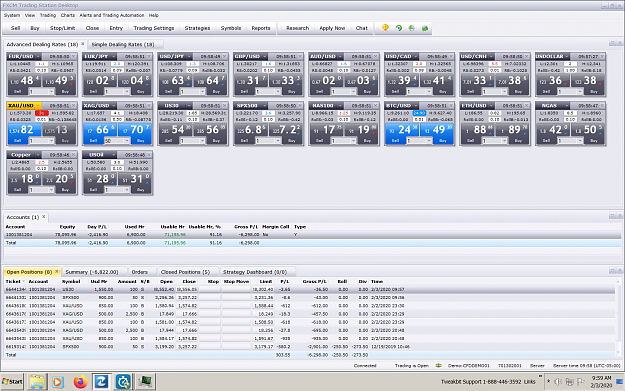
I opened this account on June 18, 2019. I have recently developed a Forex strategy that if learned and followed will make you very wealthy over the next few years if you qualify. It is you that need to qualify not me deciding that.
In this account starting with $50,000 US Dollars, I did 21 Forex trades between June 18, 2019 and June 28, 2019, a period of 11 trading days. All 21 Forex trades were profitable and there were no losses. All the trades were done in REAL TIME and SCREENSHOTS were always taken.
So for just under 1/3 of a month, I was able to net over $8500.00 US dollars or 17% Return On Investment (ROI) The exact amount is $8611.50 US dollars.
{quote} Hi, You are definitely right about leaving the positions open. I have encountered such thing numerous times and eventually closed the positions with the loss. I realized that sometimes it is best to analyze the situation like what you have described many many times, before letting the emotion rush make the decisions.
Thanks again for your post, I enjoy reading it a lot! It starts to become part of my reading hobby now, lol
Thank you for the kind words. That is my goal here along with KeepCalmfx. When you learn something then we are happy. I appreciate the feedback and the more that you post with any and all comments then the better.
The last few days were very much fun for me and whether I trade a $50,000 US Funds Demo Account or a REAL FUNDS $50,000 US Funds account you must treat both the same. When I have a DRAW DOWN compared to closing all my positions. I have the same HIGH doing it because for me they are both the same. Of course in my case having traded millions of US Dollars with real funds then I know that I trade the same way. I once thought that my contact at PFG BEST in Chicago , Casey C had a client for me who had $5,000,000 US Dollars for me to manage so he at my request opened a $5.000,000 US Funds Demo Account.
I traded it for exactly 56 days and got my balance over $7,500,000 US Dollars and did 1804 Forex Trades. Looking at the volume of $100,000 US Dollars per open position times 1804 Forex Trades is a lot of Millions traded. I have sent the PDF File of my 1804 Forex Trades to KeepCalmfx to verify my numbers and it can be confirmed. The amount of losses that I had in those 1804 Forex Trades (DEMO) of course was 4 LOSSES.
I doubt anyone can duplicate that MYSELF included. That was 10 years ago and I did not use my Money Flow Trading Method then.
COMMENTS FROM BENJAMINIS: Let us review what we teach and why it works if YOU WORK.
Without your WORK then you are just wasting your time and probably your money.
There is no such thing as Political Correctness here because we are here to teach and share our knowledge ALL FOR FREE until May 15, 2017 and then if you have subscribed to this thread before May 15, 2017, then you will get a FREE LIFETIME PASS to our company website.
SO.... going back to our winning FORMULA for FOREX SUCCESS.
20% of the SUCCESS is yourself the Forex Trader.
20% of the SUCCESS is your EDGE which we teach you and that is Money Flow Trading.
20% of the SUCCESS is control of your RISK (Your hard earned money) Our UNIQUE RISK MANAGEMENT allows you to trade without worry, fear and greed. Of course we want to make sure that you have the right qualities to be a winning Forex Trader so our course is for a period of three months, so we can teach you the right trading methods and we can see your results and make adjustments without your FEAR OF LOSS of Real Money.
20% of the SUCCESS is using and understanding the USE of Technical Indicators which include not only the common ones. It includes the understanding of Supply and Demand. Support and Resistance and the use of Pivot Points which you can see each day on our daily charts that cover ALL our Trade Plans which we also help you develop and explain WHY. These are our Winning Trade Plans that we review every three months or earlier if circumstances in the markets require that.
20% of the SUCCESS is the FUNDAMENTALS, which are much more than Data Releases each day around the world. It includes reports and articles extremely well researched as you can clearly see from this article that explains why the TREND in the Equity Markets especially in North America is DOWN. By understanding the difference between PERCEPTIONS (MARKETS) and REALITY, you then have a good handle on REALITY before the MASSES do and you are not surprised when events eventually unfold.
In order to be able to help you better it is VERY IMPORTANT that you share your thoughts and your QUESTIONS here on our thread.
As the Fed and Central banks continue propping up the financial markets, many precious metals analysts advise owning gold over silver. They say that gold is the key precious metal that will be used to reintroduce a “Sound Monetary System.” However, I believe the real winner in terms of “future value” in percentage terms will be silver, not gold.
Why? It all comes down to ENERGY. While I have repeated myself many times over about energy being the driver of the economy, there is a large percentage of precious metals analysts and investors that still don’t “GET IT.” And even worse than that, one website that publishes my work, REMOVES the energy content from the article, while only allowing the precious metals subject matter to remain… LOL.
I am going to say this once more… IF YOU DON’T UNDERSTAND ENERGY, you will not understand the real reason to own precious metals. For example, after my last video, Gold & Silver Investing: The Amazing Untold Facts, one commenter stated that after they watched the information, they “WOULDN’T SELL THEIR SILVER.
This is the key. If precious metals investors DO NOT understand the energy, they may LOSE FAITH in holding gold and silver in the sea of conflicting financial and economic information.
I continue to hear some precious metals analysts say negative things about owning silver during a recession or economic downturn. Well, for one thing, silver did very well during very high U.S. Unemployment from 2009-2011. When the U.S. Unemployment Rate was 4.5% in March 2007, silver was trading at $15. However, by early 2011 when U.S. Unemployment was at 9%, silver reached $50.
Secondly, the future value or price action of silver will not act the same way as it did in the past. Due to the massive propping up of the stock market, financial system, and economy by the Central banks, when the markets turn down… investors don’t have many choices to protect wealth this time around. Bonds won’t be the safe haven as they were in the past because Bonds are nothing more than Debt Instruments.
The Important Silver To Gold Production Ratio & What That Means Going Forward
When Spain was the leading empire during the 1500-1700s, the world was producing a lot more silver than gold. From 1493-1600, the world silver to gold production ratio was 32.5 to 1. From 1601 to 1700, the silver to gold production ratio increased to 44 to 1:
As the centuries went by, the world silver to gold production ratio declined. From 1901 to 2000, it fell to just 7.7 to 1. The figures in the chart above are in a million troy ounces (oz). Now, if you don’t believe ENERGY is a KEY FACTOR, take a look at the production level of silver and gold during 1901-2000. When oil came on the market, it allowed gold and silver production to increase exponentially.
World silver production during 1901-2000 increased 5.5 times compared to the prior century, and gold surged nearly ten times. In 2019, the world silver to gold production ratio will fall to 7.6 to 1. Thus, the world is producing one hell of a lot less silver compared to gold than it did during the 18th and 19th centuries.
The next chart shows the world silver to gold production ratio from 2010 to 2019:
Once global silver production peaked in 2015 and declined as the gold mine supply continued to increase, the ratio fell from 8.3/1 to 7.6/1 in 2019. This is excellent news for silver investors, whether they realize it or not.
Furthermore, a large percentage of the global silver mine supply that made its way into the market is gone forever. Or, let’s say, less likely to find its way back into the market. Why? Two reasons. Because only 20% of Industrial Silver consumption is recycled back into the market, and only 9-10% of silver jewelry, as I stated in previous articles, 90% of gold recycling comes from gold jewelry.
The next chart shows the total Global Non-Investment Silver Demand (excluding silverware). As we can see, of the 7,683 million oz, or 7.7 billion oz of Non-Investment Silver Demand from 2010-2019, only 1.8 billion ounces were recycled. Thus, approximately 5.8 billion oz of that Non-Investment demand over the past decade is likely lost for good. Of course, we could see more recycling of this past Industrial and Jewelry consumption, but only a small percentage.
When countries removed silver from their currency, it was recycled and fed back into the market to fill the insatiable industrial demand that took off during World War 2. The world basically ATE ITS SEED CORN of MONETARY SILVER so we could have more fancy gadgets and technology.
The last chart shows just how little above-ground silver investment stocks are remaining compared to massive 51.5 billion oz mined since 1493. According to the 2019 World Silver Survey and World Gold Council, there was approximately 2.5 billion oz of above-ground investment silver stocks versus 2.4 billion oz for gold:
This chart should help precious metals investors understand why silver will outperform gold in the future. There just isn’t that much more above-ground investment silver stocks in the world as there are gold stocks. Moreover, 41% of the “known” total world cumulative gold production from 1493-2019 is held in above-ground investment gold stocks compared to only 5% for silver.
Again, the world BURNED THROUGH SILVER like mad to supply our massive industrial needs, but also to provide the market with a great deal of inexpensive silver jewelry. Unfortunately, most silver jewelry won’t be recycled, even at a $100 silver price. If a ring contains 10 grams of silver, that’s only $30 worth of silver. Silver Investors have been given a HUGE GIFT that most don’t realize. Because the world consumed, 10’s of billions of ounces of silver for industrial and jewelry fabrication, most of this will never come back to the market. Which means, when push comes to shove, investors looking to protect wealth, won’t find that much silver available to acquire… only at much higher prices.
I will be putting out more videos explaining why precious metals investors should concentrate on the ENERGY INDUSTRY and why it is a critical factor to determine the future value of most assets. While gold is still an excellent precious metal to own, it will not fix our broken Fiat Monetary System. The Thermodynamics of Oil Depletion is destroying the Fiat Monetary System, and there isn’t anything that Governments, Corporations or Individuals can do about it.
However, you can protect your wealth with the 2,000+ year history of precious metals, especially silver.
HOW TO SUPPORT THE SRSROCCO REPORT SITE:
I would also like to thank those foundation supporters, who have chosen to become a member by making donations through PayPal to further the research and publishing work at the SRSrocco Report.
Brace for Impact: Global Pandemic Already Baked In
February 3, 2020
If we accept what is known about the virus, then logic, science and probabilities all suggest we brace for impact.
Here's a summary of what is known or credibly estimated about the 2019-nCoV virus as of January 31, 2019: 1. A statistical study from highly credentialed Chinese academics estimates the virus has an RO (R-naught) of slightly over 4, meaning every carrier infects four other people on average.
This is very high. Run-of-the-mill flu viruses average about 1.3 (i.e. each carrier infects 1.3 other people while contagious). Chris Martenson (PhD) goes over the study in some detail in this video.
Let's say the study over-estimates the contagiousness due to insufficient data, etc. Even an RO of 3 means the number of infected people rises geometrically (parabolically).
This matters because it negates any plan to track every potentially infected person who came in contact with a carrier. Coronaviruses tend to be contagious in relatively close contact (within two meters / six feet) but masks may not be enough protection, as it may spread by contact with surfaces and through the eyes.
All available evidence supports the conclusion that this virus is highly contagious, i.e. it isn't that difficult to catch.
2. Along with its contagiousness, the most consequential feature of this virus is that asymptomatic carriers can transmit it to other people, who will also be unaware they've been infected with the pathogen.
This means carriers have no reason to self-quarantine until they develop symptoms, which may be a week or more after they've begun spreading the virus to others.
It's easy to imagine a situation where an asymptomatic carrier from Wuhan took a flight to Beijing, infecting passengers and people in the airport, who then got on flights going to international destinations, where a few days later they become asymptomatic transmitters of the virus.
(The passenger from Wuhan might also have boarded a flight to the U.S. in Beijing, before flights from Beijing were restricted.)
By the time the initial individual carrier from Wuhan develops symptoms, the virus has already gone through two geometric expansions and everyone infected has no idea they even have the virus.
Common sense suggests that airplanes, airports, crowded markets, elevators--any confined space where a number of people might pass through a two-meter contagious circle around the carrier-- might result in a contagion rate far above 4.
It seems entirely possible for one carrier in crowded, constricted areas to infect 12 people, who might infect 12 others. If these 144 individuals infect 12 others, that's 1,728 infected people from one carrier.
That may sound extreme, but it's easy to imagine 100+ people passing within two meters of a carrier in crowded venues or touching surfaces just touched by the carrier. It could be that only one in ten exposed people catch the virus, but if the carrier is in close proximity to 120 people, that means 12 individuals will contract the virus.
3. Nobody seems to be tracking the origin point of travelers. If an asymptomatic carrier from Wuhan took a train or flight to Beijing last week (exposing other passengers to the pathogen) and then boarded a flight from Beijing to SFO (San Francisco), the presumption would be that the traveler is from Beijing. Tens of thousands of people have boarded flights in China over the past month and deplaned in international destinations. The likelihood that some consequential percentage of these travelers originated from Wuhan, or were infected by someone from Wuhan, is high.
It's basically impossible to thread these three points together and not conclude that a massive expansion of the virus is about to manifest in dozens of international destinations.
Put another way: this virus is a nearly ideal combination of contagiousness and asymptomatic transmission that enables a rapid spread of the virus via people who have no idea they're carriers.
4. Locking down major cities is a good strategy to contain the spread of the virus if the lockdown outlasts the contagious period of every carrier--say, two weeks--and the lockdown isn't porous enough to enable an RO of above 1. (Reducing the RO to 1.5 will still enable an expansion of asymptomatic carriers.) But given that 5 million people already left Wuhan, and some consequential percentage are likely to be carriers, then this doesn't stop all those travelers from initiating geometrically expanding epidemics in all Chinese cities that aren't locked down.
As I noted in a recent blog, a very large number of non-resident migrant workers from rural, impoverished western China live and work in every major Chinese city. Once their ability to make a living in the informal economy is impaired, their only choice is to either return to their home village/town or seek work in a city that hasn't been locked down.
This mass movement of informal-economy workers more or less insures the virus has spread far and wide from Wuhan long before the city was fully locked down. Locking down Beijing and Shanghai might limit the spread of the virus in these mega-cities, but it won't stop the virus from spreading to every city that has yet to be fully locked down.
These conclusions are drawn from what is already known about the virus. There would have to be a complete revocation of all that is known to change the parabolic trajectory of the epidemic.
5. The mortality rate of the virus is hard to pin down for a number of reasons. One is that mortality is a time-series, meaning counting those who have died isn't an accurate measure of all those who are infected who may die in the near future.
Furthermore, the official totals are suspect, as numerous anecdotal reports have come out indicating people who died were mis-classified as victims of "pneumonia." Other reports indicate the overwhelmed healthcare system in Wuhan has been sending corpses to be cremated without proper identification of the cause of death. It appears Chinese officialdom is reverting to the same tactics used in 2003 to suppress data about SARS and downplay the dangers of the pathogen. It seems highly unlikely that the death totals being announced are accurate, and highly likely that the totals are a fraction of actual deaths.
There isn't enough trustworthy data to estimate the mortality rate of the virus, but even the official totals, when coupled with the number of patients in intensive care, suggests a higher rate of mortality than typical flu viruses but less than SARS 9%.
What's worrisome is the official attempt to downplay the danger of the virus naturally reduces the incentive to be extra-cautious, self-quarantine, etc. In effect, under-reporting the true mortality rate is actually encouraging the spread of the disease by diminishing the resolve of those worried about dying to be extra-cautious.
If early evidence that a cocktail of anti-viral and HIV medications can reduce mortality is confirmed in large-scale trials, that good news has to tempered with the stipulation that these drugs don't reduce the risks of contagion; the expectation of a ready cure will also act to reduce the incentives to be extra-cautious. This expectation of a ready cure may be premature, but even if the cocktail meets high expectations, it doesn't mean the virus won't spread and sicken those who catch it.
If the cocktail only works on certain classes of patients or is ineffective in some cases, the presumption that a 100% cure is now available could actually accelerate the contagion as authorities and individuals clamor for an immediate "return to normal life."
Authorities are like the officers on the Titanic who were tasked with both reassuring the passengers everything was under control and urging them into the lifeboats: you can't tell everyone the risk is low and everything's under control but it's also high enough that you better get in a lifeboat. This is a classic double-bind. In the confusion, few understand the risk remains high and act accordingly.
6. Given all this, it seems inevitable that the handful of cases outside China will expand rapidly in the weeks ahead, and the impossibility of tracking all those who came in contact with carriers means the spread of the virus cannot be contained except by locking down all transportation and cities where the virus has spread.
7. Restrictions are half-measures. U.S. travel bans, for example, exempt U.S. citizens / green card holders and their immediate families. This amounts to thousands of people who will be allowed into the U.S. from China with a caution to monitor themselves for 14 days. 8. As I mentioned in the blog a week ago, a large number of Chinese people work overseas, and they will be returning to their jobs this coming week, as the official New Year's holiday ended 2 February. While some airlines have stopped flights to and from China, not all airlines have done so. So these workers have a number of ways to get back to their overseas jobs: catch a flight to somewhere outside China and then catch a flight to Europe, Africa, the U.S. etc. If you're not sick, or only have the sniffles, you don't want to be stuck in China. You want to get back to your job. If you do have the sniffles, you wear a mask and take over-the-counter medications to reduce fever. You tell yourself the risk of having the coronavirus is low and so you proceed on that basis.
9. The quarantines in China are more porous than advertised. Thousands of people are coming and going into quarantined cities every day. How long can China quarantine tens of millions of people before supplies are exhausted and the financial pain becomes unbearable? If the quarantine ends and there is still a pool of carriers in the city, the virus will quickly re-emerge. The quarantine is only effective if literally every last carrier of the virus either dies or recovers and is no longer contagious.
If 100 asymptomatic infected people move into the city after the quarantine is lifted, this pool of carriers will re-introduce the virus, which will spread anew. Quarantining a few cities and leaving hundreds of other cities, towns and villages as reservoirs of the virus insures the virus will return to the quarantined cities as soon as the restrictions are lifted.
To stop the spread of the virus, every community, village, town and city in the entire nation would have to be locked down. The horse already left the barn a month ago, and so closing the barn door now has little effect. Five million people already left Wuhan and tens of thousands have already traveled to dozens of other countries. The virus can no longer be contained with half-measures. Yet half-measures are all the authorities are willing to impose.
Nassim Taleb co-authored a paper (download available on his site) that explained why the only way to limit the spread of the virus is to severely limit connectivity of people and transport: the more connections exist, the greater the number of avenues for the virus to spread.
If China reduced connections with the rest of the world to zero, even for a month, the financial impact would trigger a global recession due to the fragility of the global economy and its dependence on China. Since authorities are unwilling to risk a global depression, they pursue half-measures which insure that multiple pathways for the pathogen to spread remain open.
10. The general assumption in the U.S. is that this will all blow over and the virus will burn itself out as a result of the Chinese quarantines and U.S. travel restrictions. This is akin to passengers on the Titanic looking around 10 minutes after the minor collision with the iceberg and seeing zero evidence the ship was in danger of sinking. Yet the ship's sinking was already inevitable despite the lack of visible evidence.
For the virus to burn itself out, all of these conditions must hold: only a handful of the tens of thousands of people who've landed in the U.S. from China over the past month are infected with the virus, and virtually every one of the infected people, despite having no symptoms, will rigorously self-quarantine themselves for 14 days to insure they won't infect anyone else.
Furthermore, these carriers can't have transmitted the virus to others on their airline flight, in the airport, in baggage claim, in Immigration Control, in the subway, etc. before they started their rigorous 14-day self-quarantine. In other words, not one person exposed to the virus caught it.
In addition, those expecting the virus to burn itself shortly must assume that no one slipping through the exceedingly porous restrictions will be an asymptomatic carrier, and that any asymptomatic carriers that do slip through will not have any close contact with other people.
Lastly, those expecting the virus to burn itself shortly must assume that the virus will not mutate into a more contagious or deadly form, even though viruses mutate at very high rates: the more people carry the virus, the greater the opportunities for a mutation to occur that can be spread to other hosts.
None of these assumptions are even remotely realistic. Neither is the expectation that an effective vaccine will be ready for mass inoculations in a month or two. Realistic timelines for an effective vaccine are four to six months for development of a vaccine, then additional months to test its safety and effectiveness and more months if all goes well to produce hundreds of millions of doses of the vaccine, and then more time to distribute the vaccines.
It's natural to grasp at straws in crisis, and natural to take every false dawn for sunrise. Announcements that the rate of infection is slowing will be taken as evidence the virus will soon be completely under control, when a decline from RO 4 to RO 3 or RO 2 doesn't mean the virus is about to disappear; all it means is the rate of expansion has declined. Premature announcements of a cure will encourage a complacent expectation of a quick return to "normal life" that will be severely challenged by the "Wave Two" global expansion of the virus.
The economic, political and social consequences of the extreme measures required to control the spread of the virus (total lockdown of an entire country's transportation systems)--or the failure to pursue such extreme measures, enabling the spread of the virus--are the second-order effects I've been exploring in recent blog posts: consequences have their own consequences.
NOTE: Contributions/subscriptions are acknowledged in the order received. Your name and email remain confidential and will not be given to any other individual, company or agency.
Thank you, Lawrence M. ($50), for your magnificently generous contribution to this site -- I am greatly honored by your steadfast support and readership. Thank you, Robert A. ($5/month), for your splendidly generous subscription to this site -- I am greatly honored by your support and readership. https://www.oftwominds.com/photos2016/BV300-250.gif
We have been harping on the question “are you prepared?” for years. We have asked if you were prepared financially, mentally, physically, and with your maker?
The potential boogeyman as we suggested could come from anywhere or any angle but the end result would affect the economy and thus finance (credit) and would then spill over socially.
I have to admit, a “pandemic” was low on my list of possible sparks, but after thinking it through, a pandemic is a financial disaster. Yes it is a human disaster and many will die, but the odds of dying from the virus are and will remain quite low. The real problem is what the human response will be. I say this because we live in a world of just in time inventory AND production. We also live in a financial world with more debt and financial leverage (and thus monthly debt service) than ever before. So much so that even a small hiccup (which this does not appear to be) where business slows and contracts will be enough to quickly default some credits.
The problem is not the initial defaults, rather, it is the “contagion” throughout the system because our world is so inter connected (globalism).
We saw this back in 2008 where one entity (Lehman) going down had the ability to torpedo the entire system if it were not for $10’s of trillions mobilized from the central banks. Remember, back then “liquidity” was shoved into the system so the banking system could withstand the shock of a small handful (but large) of upside down institutions.
I would use the analogy that 2008 was a snapshot event which lead to the motion picture of what they called “recovery” …expansion never came. Today is different, because back then the central banks and sovereign treasuries had the ability to print/borrow in an effort to reflate …which they have continually done since then. Now, in a world with a debt to GDP ratio of 332%, who has the ability to step up and reflate?
That last question is a real BIGGIE! Why? Because the financial system AND the debt outstanding is far larger (maybe close to double) what it was in 2008 …do central banks even have the ability to forestall another 2008? Probably not but that is not the question in this instance because China and the coronavirus is not a snapshot in time, it IS the movie!
By this I mean there are far more ramification than some bank with $ trillions in derivatives blowing up.
China is the largest trading partner/manufacturer in the world. 60 million quarantined people are not working from home, the factory floors are closed. Which means final products/components of all sorts are not being produced, shipped or delivered. Can you think of any ripple effects this might cause?
The next question is how long will this last? Are we already at peak infection spread or does it continue and expand for some time? I am not knowledgeable in this area so I will not speculate but it has already been a week++. My point is this, we are talking about real products not making it to market and the question is “time” because in a system levered as it is, “down time” is the arch enemy to a system requiring timely payments …because EVERYBODY OWES EVERYBODY ELSE!
From the human standpoint, China has already lost their pork stocks and look like they may also lose their chicken stock. As far as I can tell, grocery stores and markets in the affected areas have been picked clean and with quarantine, nothing in and nothing out is the situation. I don’t believe we are at the point where starvation is the grave problem but in a few more weeks, this will become the case.
Thinking from a US standpoint, the danger is a credit meltdown caused by contagion or even just a break in confidence. A credit seizure will be just as bad as a quarantine because nothing will “work”. I have told you we live in a world where everything runs on credit. Production, supply, shipping and distribution all depend on credit to be able to perform …not to mention buyers using credit because that’s all they have left to spend?
Ask yourself, how many individuals or businesses can weather little or no cash flow for a month. Or two?? Or more???
Off topic a little, but how smart will all the corporations look who have levered their balance sheets to buyback stock? Would keeping larger cash balances maybe be better in this situation?
So we ask, are you ready for the contagion? Not so much from the virus but from credit markets seizing up? Do you really believe that without credit, your grocery store will magically stock their shelves each night from little elves growing apples to zucchini? Do you really believe your fuel supplier will come fill your diesel tank if you cannot pay or they cannot pay their supplier? How about water or electric utilities, will they still run without credit? Lots and lots more questions and any single one answered “no” means you will do without.
Can you do without or have you prepared for the possibility …and for how long? We are not trying to scare you. We attempt to make you ask yourself questions because whether the corona virus is the spark or not, a very bad credit event is mathematically baked into the cake …because there is simply more credit outstanding than can ever be paid back!
Update: confirming that liquidity is indeed quite scarce to start the month of February, moments ago the Fed also conducted its overnight repo which saw a whopping $64.45BN in liquidity injected...
... and which together with the massively oversubscribed $30BN term repo discussed below, means the Fed has injected $94.45BN in liquidity for today's market needs.
* * *
After several relatively uneventful reverse-repos to close off the month of January, which saw a gradual decline in submission, February has started off with a bang.
Even ahead of the results of today's reverse repo, some traders were already closely watching to see how it would play out for one main reason: as we reported on Jan 14, this was the first "tapered" reverse repo, whose aggregate operation limit was shrunk modestly from $35BN to $35BN.
There were also some questions why the repo would be tapered by only $5BN when the Fed repeatedly said the liquidity injection via repo were just a temporary operation (one which ostensibly should have ended soon after the September repocalypse), and yet which to this day continues to be an integral part of the Fed's balance sheet rebuild.
CT st t-read stories. We got the answer moments ago, when the Fed announced that while the operation went off without a glitch, the demand for Fed liquidity was simply unprecedented, with $59.05BN in securities submitted ($41.75BN in TSYs, $17.3BN in MBS) for the downsized $30BN term repo maturing on Feb 18. As such, the nearly 2.0x submitted-to-accepted ratio made today's repo the most oversubscribed since the first term repo issued at the depth of the September repo crisis (and not by much), which saw $62BN in submissions for $30BN in liquidity.
Ominously, the massive demand for term repo today means that the liquidity crisis that continues to percolate just below the surface of the market and has clogged up the critical plumbing within the US financial system, is getting worse, not better, and today's massive oversubscription indicates that one or more entities continues to face a dire shortage of reserves, i.e., cash. As for what they are doing with that cash, one look at Tesla this morning may provide an answer.



 Money Flow Trading Method along with Risk Management


