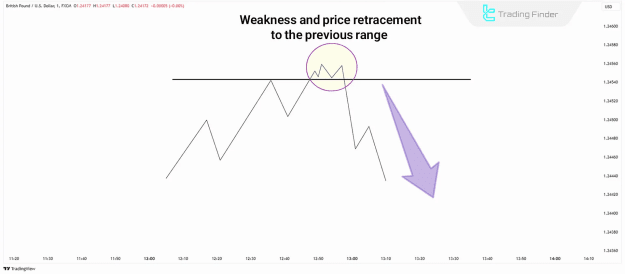


Characteristics of No Displacement
To correctly identify No Displacement in the market, traders must observe specific price behaviors and structural patterns. Key features include:
- Rapid retracement into the prior range: Following the breakout, price fails to maintain direction and quickly returns to the former zone.
- Lack of momentum in breakout candles: Candles are typically small and do not demonstrate aggressive directional movement.
- Failure to close outside the breakout level: Price action does not confirm the breakout with a strong close beyond the key level.
- Frequent occurrence of failed breakouts: These setups are strong indications of No Displacement and are often considered reversal signals.
Why Does No Displacement Occur?
No Displacement scenarios arise due to several market conditions, including:
- Insufficient liquidity at breakout levels, particularly in Forex markets.
- Presence of counter-orders (e.g., buying interest at bearish breakouts or selling pressure at bullish breakouts).
- Consolidation phases, where directional momentum is lacking and price remains range-bound.
How to Identify No Displacement
To evaluate whether a movement lacks displacement, traders must carefully analyze candlestick behavior at key levels:
- Strong Displacement is signaled by large-bodied candles closing near the high (bullish) or low (bearish) of the breakout.
- No Displacement is indicated by:
- Quick return to the previous range.
- Small, indecisive candles.
- Lack of commitment from market participants.
Multi-timeframe analysis enhances the accuracy of these assessments by confirming whether price action across different timeframes aligns with the observed structure.
Trading with No Displacement
In an Uptrend
- A break below a short-term low that lacks follow-through suggests weak bearish pressure.
- Price swiftly returns to the range, presenting a buying opportunity based on the failure to displace lower.
In a Downtrend
- A break above a recent high without momentum indicates weak bullish pressure.
- This setup implies a potential sell opportunity, capitalizing on a false breakout.
Using Failed Breakouts as Reversal Signals
Failed breakouts, which are a hallmark of No Displacement, provide reliable setups for counter-trend trades. When price fails to break and hold above or below a key level, the probability of reversal increases significantly.
Example of No Displacement in an Uptrend
Bullish Setup:
- Price breaks a recent swing low but fails to continue lower.
- Candlesticks following the break are small and non-committal.
- Price re-enters the prior trading range, indicating a lack of bearish conviction.
Example of No Displacement in a Downtrend
Bearish Setup:
- Price breaches a short-term high but fails to generate strong bullish momentum.
- Candles are weak, and price rapidly returns to the previous range.
- This reflects ineffective buying pressure and presents a selling opportunity.
Key Tools for Supporting No Displacement Analysis
- Currency Converter Calculator – Real-time exchange rates across 24 currencies.
- Forex Margin Calculator Tool – Calculate leverage up to 1:1000.
- Forex Market Hours Indicator – Identify active trading sessions.
- Economic Calendar Tool – Track financial events across 40 countries.
Conclusion
The No Displacement Model in ICT trading methodology underscores the inability of price to sustain directional movement after breaking a key level. Recognizing this pattern helps traders anticipate potential reversals and optimize entry points.
- Lack of displacement signals weakness in trend continuation.
- Failed breakouts under such conditions offer high-probability reversal trades.
- Incorporating this concept with proper risk management and multi-timeframe analysis enhances trading effectiveness and precision.