

Vacuum Block (ICT) indicator
Vacuum Block (ICT) indicator MT4
Vacuum Block (ICT) indicator MT5
What is a Vacuum Block?
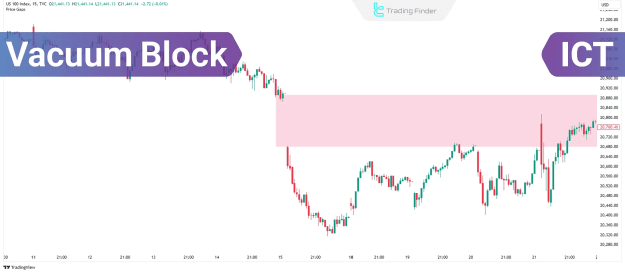
A Vacuum Block refers to a price gap created by major economic events such as the FOMC meetings, Non-Farm Payroll (NFP) releases, market openings, or the start of new trading sessions. These gaps represent zones where no trades have taken place, thus creating liquidity voids. Typically, price revisits these gaps to fill the liquidity void before continuing along its original trend.
Formation of a Bullish Vacuum Block
A Bullish Vacuum Block forms when the price gaps upward beyond the prevailing market level, generating a price gap.
- This phenomenon signals strong bullish momentum.
- However, it also indicates a liquidity void where price is expected to return.
- The price usually retraces to this gap area to fill the liquidity void before continuing its upward trajectory.
How to Trade a Bullish Vacuum Block?
- Begin by analyzing the cause and significance of the event responsible for the price gap.
- If the event is expected to have a sustained impact, wait for price to return to the vacuum block.
- Upon retracement, seek bullish confirmation signals such as a Market Structure Shift (MSS) on lower timeframes or confluence with Optimal Trade Entry (OTE) levels.
- After receiving confirmation, enter a long (buy) position.
- Set the stop-loss just below the lowest point of the vacuum block to manage risk effectively.
Formation of a Bearish Vacuum Block
A Bearish Vacuum Block occurs when price gaps downward below the current market price, creating a liquidity void. This gap often results from major economic or geopolitical events causing sharp declines.
- This gap indicates strong bearish momentum.
- Price is likely to revisit the gap to fill the liquidity void before proceeding lower.
How to Trade a Bearish Vacuum Block?
- Identify the eve
- nt that caused the gap and its potential lasting effect on the market.
- Wait for price to retrace to the vacuum block area.
- Look for bearish confirmation signals such as a Market Structure Shift (MSS) or a reaction to OTE levels.
- Once confirmed, initiate a short (sell) position.
- Place the stop-loss above the highest point of the vacuum block.
Which Assets Experience Liquidity Voids More Often?
Vacuum Blocks predominantly appear in assets highly sensitive to economic news and macroeconomic events, including:
- Major Forex pairs (e.g., EUR/USD, GBP/USD)
- Stock indices (e.g., S&P 500, NASDAQ)
- Commodities (e.g., Gold, Crude Oil)
- Cryptocurrencies, known for their high volatility
Does Price Always Fill a Vacuum Block?
- Price does not always fill the entire vacuum block.
- Sometimes, only a partial fill occurs before the trend resumes.
- Other times, the gap is fully filled before price continues in its original direction.
- It is important to note that filling a vacuum block is not guaranteed.
Conclusion
A Vacuum Block, or Liquidity Gap, represents a price void caused by high volatility or significant economic events. These gaps are valuable for identifying critical trading levels and optimizing risk management strategies, as prices tend to revisit these areas to fill the liquidity voids.