|
|
|
Optimized Risk vs Reward Equation
 |
|
|

Oct 10, 2009 1:42pm
|
 |
Member
|
|
|
|
Optimized Risk vs Reward Equation
Have no idea why, but without a peep for a long time (like a year), all of a sudden, I have 5 PM's.. Some of which I ignore and some of which I reply to.
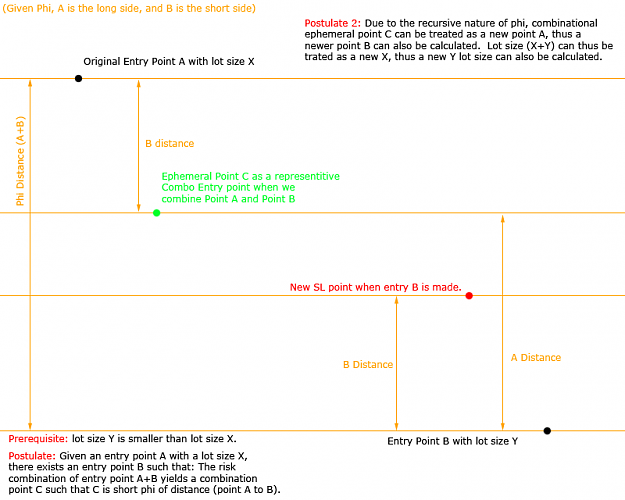
So while I'm logged in; I thought I might as well jot down for some that have asked; about 3 weeks ago, (after 2+ years) although I had always conjectured it to be true; I finally was able to give a mathematical formula to prove that for a given entry position size; there exists an optimized add-on position and pip distance such that profit is maximized and risk is minimized. Indeed my theory of a mini-max (saddlepoint) on a bi-axle risk/reward plot DOES exist.
Based and built on both phi and e, I was able to write into an equation that is optimized; with similar characteristics of a fractal formation; a "drill down" of the equation reveals the same equation (bits).
So I'm here to encourage all of you out there; 4~8 hours a day, 2+ years in a row, yields results.
Those of you not so inclined in math; I highly recommend you just stick to the pascal triangles.. It's systematically easy to use and fairly optimized; even though it's not systematically maximized.
So that's 1 down, 2 major math hurdles left..
__________________
google: "Trend and Trendfans"
|

Oct 14, 2009 5:23pm
|
 |
Financial Hacker
|
|
|
|
Quote:
Originally Posted by twoblink
So that's 1 down, 2 major math hurdles left..
|
So what's the other two?
|

Oct 16, 2009 7:26pm
|
 |
Member
|
|
|
|
Optimization of Entry/Exit pair.
Optimization of Entry/Entry pair.
Mathematically, an entry without either a paired Exit or a secondary entry cannot be called good or bad..
Given F(x) to be the entry, and G(F(x)) to be the exit; F(x) cannot be determined to be good or bad, since good or bad is determined generally by profit/loss, which does not exit until a secondary point of comparison is made. That second point can be an exit, in which case a profit or loss is then realized, and the quality of the entry point can now be assessed. OR, a secondary entry is added, in which case, the quality of the fist entry can now be assessed.
I'm formalizing the fundamental theorems of FX, as well as the fundamental theorems of Money Management.
Quite a bit of discoveries recently.
__________________
google: "Trend and Trendfans"
|

Oct 18, 2009 9:59am
|
|
|
Care to share any of your axioms?
|

Oct 19, 2009 4:49pm
|
|
|
Quote:
Originally Posted by TraderHotch
Care to share any of your axioms?
|
You may want to backtrack every post from twoblink to know those. Its been written in the past piece by piece. And his journey from vegas, mouteki.. turns out to be tom demark works, how he define high quality 123 twoblink reversal  , trendfan, after that, discovered a simple way to optimize trade momentum payrate by pyramiding using pascal triangle sequence, and lastly gravy train (its about currency basket trades maybe? bet againts the weakest.).
He is one of those people you want to use your time on reading all his posts. There's other I find interesting too, smjones, downrivertrader.
Believe me it is worth it.
ps. never got the chance to say this before. Thankyou Mr. Albert.
|

Oct 20, 2009 5:50am
|
|
|
Already doing so, just depending on his axioms it could just be a load of rubbish, sure it's not, just without context it could mean anything.
|

Oct 21, 2009 6:09am
|
 |
Member
|
|
|
|
I attack a problem quite differently than most I know..
I start by analyzing the math. If the logic vs math are completely different, then I trust the math. For example, logically, averaging down makes more sense; but mathematically, averaging up makes more sense. Therefore, 99% of the world average up, and 99% of the world don't make money long term.
Next, I look to what is seemingly unrelated things, and I relate them. There could be a problem that is similar, in different context, and a small shift in thinking might allow you to bring that item into solving a problem for you.
Example: Audi was looking for an all-wheel drive system. Where they looked was someplace nobody expected, deep sea drilling. The biggest problem with an AWD system is that because you are moving (variably) 4 or more wheels around, at different speeds with variable torque, how do you efficiently and mechanically distribute such power such that the wheel with the most grip is provided the most torque? Well, it's the same problem that deep drillers face; and so Audi's quattro system is actually a variant of the deep drilling drill bit. With multi-cross planary worm gears, the wheel with the least torque spins faster; therefore is the first to "lock up" when it spins too fast compared to the other gears. The one that spins the slowest is presumably the one with the biggest load, and by nature of the worm gear configuration, that one then becomes the only one that doesn't get locked up, and so all the torque is provided to it. Most AWD systems now are either with a viscous fluid that becomes a solid when heated up and thus driving a normally free spinning axel (like the volvos) or like a mechanically clutch packed shunt system like the Haldex based systems. How do I know all this? When I was shopping for a car with AWD, I called up every car manufacturer, and asked for the patent number on the AWD system. I then traced them all back to the patent company. For Audi, I even traced it back to the company that Audi licenses AWD from; I talked to the CEO and I talked to the original patent applicant engineer. Yes, when I do research, I don't half-ass it.
So aside from a good Audi advertisement, I can tell you that seemingly unrelated things is just that; seemingly. When you have the proper connectors, then they are all related. With math, I can promise you, it's ALL related.
I also like taking info from nature; as God seems to solve more problems and puts the solutions on display. For example, the cheetah is the fastest land animal in the world; nothing can outrun it if it wants to catch a prey.. BUT, most cheetah's try to pick on small game, and preferably unhealthy or lame ones. So I learn that in FX, I might have a HUGE bankroll to do battle with; but I should find opportunities in which I have a huge advantage.. like a cheetah vs a lame prey.
As far as an axiom; here's one that I throw out in easy language freely, and it's one of the most important.
With regards to MM, the carved in stone fact is:
You need to be bigger when right, smaller when wrong.
That is why risking the same amount every time is mathematically disadvantageous. That's also why averaging down is mathematically incorrect.
Most don't want to learn the math because most are bad at math. I get it. But if you want to be good at this game, you gotta put in the time and effort and the math.
On a separate note; I recently (maybe a month or so ago) discovered that my original predication that the goal of playing FX was to make money; is WRONG. So obviously this has HUGE implications. So now that I've realigned my FX compass to the correct path, all is better. So much to learn, so little time.
__________________
google: "Trend and Trendfans"
|

Oct 21, 2009 6:12am
|
|
|
This is most interesting. I have tried to do something similar, finding the right sequence of numbers (position size per hundred pips) in order to minimize risk and maximize profit.
The On-Line Encyclopedia of Integer Sequences
http://www.research.att.com/~njas/sequences/
is an interesting tool, but now I realize that i must use three set of numbers, one for position size, one for stop loss, and one for distances between two entries.
|

Oct 21, 2009 6:22am
|
|
|
Quote:
|
Next, I look to what is seemingly unrelated things, and I relate them. There could be a problem that is similar, in different context, and a small shift in thinking might allow you to bring that item into solving a problem for you.
|
This is only possible if a person has a wide array of interests and the will to read more about them. I have worked in a press clipping agency for a few years. Reading all that was printed and published daily, plus doing media analysis (plus radio, tv and internet) will give you tons of ideas about life, universe and everything else. It's a great prep school for FX. 
|

Oct 21, 2009 7:37pm
|
|
|
Hm... phi because equal rate of decay on both pips and position add rates? Maybe we can just use simple fibonacci sequence, large fib number mostly, for both mm and pipstop?
Btw, there's one thing that still boggled me. I tried a few simulation with excel randomizer using several pascal triangle hockeystick. Assuming on non-market condition that the probability of price to go from 00 to .50 is equal with 0 to -.50 Then with averaging up with stops moved according to sl sequence like the one you show raz, I found that without market momentum, the expectancy of this models are still between 0 to negative. But only if we traded with momentum, even originaly 1:1 payrate can be shifted into 1++:1. Am I missing something?
|

Oct 22, 2009 7:26am
|
|
|
First and foremost, I'm sorry to cut the post in several parts, but the allowed number of images per post is only 5, regardless of their size.
Quote:
|
Based and built on both phi and e, I was able to write into an equation that is optimized; with similar characteristics of a fractal formation; a "drill down" of the equation reveals the same equation (bits).
|
I have missed this sentence on first reading. It's a clue, a few pieces of a puzzle.
Quote:
|
I'm formalizing the fundamental theorems of FX, as well as the fundamental theorems of Money Management.
|
It is extremely difficult to follow someone's thought process, even more to reverse engineer it.
But that's the fun in twoblink's posts, solving the puzzle when you have just a few pieces, the rest is hidden in the room and you don't have the big picture to help you.
If this equation is correct, I assume looking at the charts becomes unnecessary. Would it be applicable to any sort of trading process?
Here's my thoughts on the subject (with wikipedia's help).
compounding frequency
For any given interest rate and compounding frequency, an "equivalent" rate for any different compounding frequency exists.
Formula for calculating compound interest:
* P = principal amount (initial investment)
* r = annual nominal interest rate (as a decimal)
* n = number of times the interest is compounded per year
* t = number of years
* A = amount after time t
Periodic compounding
The amount function for compound interest is an exponential function in terms of time.
t = Total time in years
n = Number of compounding periods per year (note that the total number of compounding periods is )
r = Nominal annual interest rate expressed as a decimal. e.g.: 6% = 0.06
As n increases, the rate approaches an upper limit of er. This rate is called continuous compounding
|

Oct 22, 2009 7:28am
|
|
|
Continuous compounding
Continuous compounding can be thought as making the compounding period infinitesimally small; therefore achieved by taking the limit of n to infinity. One should consult definitions of the exponential function for the mathematical proof of this limit.
a(t) = ert
The amount function is simply
A(t) = A0ert
The interest rate expressed as a continuously compounded rate is called the force of interest. The annual force of interest is simply 12 times the monthly force of interest.
The effective interest rate per year is
i = er − 1
Using this i the amount function can be written as:
A(t) = A0(1 + i)t
or
A = P(1 + i)t
For any continuously differentiable accumulation function a(t) the force of interest, or more generally the logarithmic or continuously compounded return is a function of time defined as follows:
which is the rate of change with time of the natural logarithm of the accumulation function.
Conversely:
 , (since a(0) = 1)
When the above formula is written in differential equation format, the force of interest is simply the coefficient of amount of change.
I'm still probably beating around the bush, but above mentioned seems worth investigating further.
|

Oct 22, 2009 7:30am
|
|
|
The time value of money is the value of money figuring in a given amount of interest earned over a given amount of time.For example, 100 dollars of today's money invested for one year and earning 5 percent interest will be worth 105 dollars after one year. Therefore, 100 dollars paid now or 105 dollars paid exactly one year from now both have the same value to the recipient assuming 5 percent interest; using time value of money terminology.
All of the standard calculations for time value of money derive from the most basic algebraic expression for the present value of a future sum, "discounted" to the present by an amount equal to the time value of money. For example, a sum of FV to be received in one year is discounted (at the rate of interest r) to give a sum of PV at present: PV = FV − r·PV = FV/(1+r).
The present value (PV) formula has four variables, each of which can be solved for:
PV is the value at time=0
FV is the value at time=n
i is the rate at which the amount will be compounded each period
n is the number of periods (not necessarily an integer)
The cumulative present value of future cash flows can be calculated by summing the contributions of FVt, the value of cash flow at time=t
Note that this series can be summed for a given value of n, or when n is infinite.
Future value of a present sum
The future value (FV) formula is similar and uses the same variables.
This is also worth looking into.
In behavioral economics, hyperbolic discounting refers to the empirical finding that people generally prefer smaller, sooner payoffs to larger, later payoffs when the smaller payoffs would be imminent. However, when the same payoffs are both more distant in time, people tend to prefer the larger outcome, even though the time lag from the smaller to the larger would be the same as before.
Hyperbolic discounting is mathematically described as:
where f(D) is the discount factor that multiplies the value of the reward, D is the delay in the reward, and k is a parameter governing the degree of discounting.
Notice that whether discounting future gains is logically correct or not, and at what rate such gains should be discounted, depends greatly on circumstances. Many examples exist in the financial world, for example, where it is l ogically reasonable to assume that there is an implicit risk that the reward will not be available at the future date, and furthermore that this risk increases with time. Consider: Paying $50 for your dinner today or delaying payment for sixty years but paying $100,000. In this case the restaurateur would be reasonable to discount the promised future value as there is significant risk that it might not be paid (possibly due to your death, his death, etc).
Uncertainty of this type can be quantified with Bayesian analysis. For example, suppose that the probability for the reward to be available after time t is, for known hazard rate λ
P(Rt | λ) = exp( − λt)
but the rate is unknown to the decision maker. If the prior probability distribution of λ is
p(λ) = exp( − λ / k) / k
then, the decision maker will expect that the probability of the reward after time t is
which is exactly the hyperbolic discount rate.
|

Oct 22, 2009 7:31am
|
|
|
Deferred gratification or delayed gratification is the ability to wait in order to obtain something that one wants. This attribute is known by many names, including impulse control, will power, and self control. In formal terms of accounting, an individual should calculate net present value of future rewards and defer near-term rewards of lesser value. Extensive research has shown that animals don't do this but instead apply hyperbolic discounting, so this problem is fundamental to human nature.
Conventional wisdom considered good impulse control be a personality trait important for life success. Daniel Goleman has suggested it is an important component of emotional intelligence. People who lack this trait are said to need instant gratification and may suffer from poor impulse control.
Psychoanalysts have argued that people with poor impulse control suffer from "weak ego boundaries." This term originates in Sigmund Freud's theory of personality where the id is the pleasure principle, the superego is the morality principle, and the ego is the reality principle.
The ego's job is to satisfy the needs of the id while respecting other people's needs. According to this theory, a person who is unable to delay gratification may possess an unbalanced id that the ego and superego are unable to control.
Could this be used for determining the rate of decay for risk?
A quantity is said to be subject to exponential decay if it decreases at a rate proportional to its value. Symbolically, this can be expressed as the following differential equation, where N is the quantity and λ is a positive number called the decay constant.
Mean lifetime
If the decaying quantity is the same as the number of discrete elements of a set, it is possible to compute the average length of time for which an element remains in the set. (how long one particular trade remains in the sequence of trades of the same pair) This is called the mean lifetime (or simply the lifetime) and it can be shown that it relates to the decay rate,
The mean lifetime (also called the exponential time constant) is thus seen to be a simple "scaling time":
Thus, it is the time needed for the assembly to be reduced by a factor of e.
A more intuitive characteristic of exponential decay for many people is the time required for the decaying quantity to fall to one half of its initial value. This time is called the half-life, and often denoted by the symbol t1 / 2. The half-life can be written in terms of the decay constant, or the mean lifetime, as:
When this expression is inserted for τ in the exponential equation above, and ln2 is absorbed into the base, this equation becomes:
Thus, the amount of material left is 2 − 1 = 1 / 2 raised to the (whole or fractional) number of half-lives that have passed. Thus, after 3 half-lives there will be 1 / 23 = 1 / 8 of the original material left.
|

Oct 22, 2009 7:33am
|
|
|
The Golden ratio, mentioned several times in various threads. Could it be used to determine the relationship of one particular (newest) trade comapred to all active trades of one currency pair?
In mathematics and the arts, two quantities are in the golden ratio if the ratio of the sum of the quantities to the larger quantity is equal to (=) the ratio of the larger quantity to the smaller one.
The golden section is a line segment divided according to the golden ratio: The total length a + b is to the longer segment a as a is to the shorter segment b.
The figure on the right illustrates the geometric relationship that defines this constant. Expressed algebraically:
This equation has as its unique positive solution the algebraic irrational number

|
 |
|
|
1 Trader Viewing This Thread (0 are members)
|
|
|
| Thread Tools |
Search this Thread |
|
|
|
|