Forex Factory
  • Login

  • Username: Password:
  • 5:10pm

  • Search
  • Home

  • Forums

  • Trades

  • Calendar

  • News

  • Market

  • Brokers

Options

Search
Search
Search

Subscribe to Thread

Bookmark Thread

First Page First Unread Last Page Last Post

Printable Version

Similar Threads

Harmonic Pattern Journal 8 replies

Another Trading Journal - Yuhu's Journal 16 replies

Electric Savant: R u still looking? I have an EA that will do. 0 replies

Electric near zero UPL...Maybe he can get flat this week! 0 replies

  • Trading Journals
  • /
  • Reply to Thread
  • 2,380

Pattern's Chemo-Electric Trading Journal

  • Last Post
  • First Unread
  •  
  • 1 41424344Page 45 46
  •  
  • Post# 881
  • Quote
  • Oct 26, 2012 11:24am | Edited at 1:54pm
  • ha-pattern
    Joined Sep 2008 | 1,966 Posts | Status: hardcore chartist
A series of trends in a chart shape -- often regular polygons -- emphasizes some over others, in order to create rays relevant later in price action. Ellipses are especially clear about this, showing a series of ever-increasingly important trends.
This finding led me to read the chart much more clearly, if still at a halting and slow speed for my brain to get used to ; )
So, I must exercise my brain each trading session to reliably discern which trends to project rays from, as well as innovate basic screens such as polygons to surround and highlight them.

What I've come up with recently is this:
.....
(fan / trend centerlines,ls2/slant,select(the above description)) - lp3 - combo

The push toward creativity producing the correct-enough chart
means that I have to add interpretive filters, subtract interruptive distractions, and monitor common errors
when I trade.
The last, I make an attempt below:

(NOTE I understand there are more-recent developments in the science of behavioral finance, ones that carefully describe various brain parts to make their point. I still don't trust their overview of the field, though, for the same reason.)


cognitive errors, from investopedia here--
anchoring:
"Successful investors don't just base their decisions on one or two benchmarks, they evaluate each company from a variety of perspectives in order to derive the truest picture of the investment landscape."
mental accounting ("the tendency for people to separate their money into separate accounts based on a variety of subjective criteria, like the source of the money and intent for each account"):
"money is fungible; regardless of its origins or intended use, all money is the same."
confirmation bias ("first impression can be hard to shake because people also tend to selectively filter and pay more attention to information that supports their opinions, while ignoring or rationalizing the rest. This type of selective thinking"):
Signal strength plays into here. "Confirmation bias represents a tendency for us to focus on information that confirms some pre-existing thought. Part of the problem with confirmation bias is that being aware of it isn't good enough to prevent you from doing it. One solution to overcoming this bias would be finding someone to act as a "dissenting voice of reason". That way you'll be confronted with a contrary viewpoint to examine."
hindsight bias(" a person believes (after the fact) that the onset of some past event was predictable and completely obvious, whereas in fact, the event could not have been reasonably predicted"):
incorrect oversimplifications.... signs of the ...bubble... had been obvious ....is a cause for ...overconfidence....unfounded belief that they possess superior stock-picking abilities."
gambler's fallacy ("an individual erroneously believes that the onset of a certain random event is less likely to happen following an event or a series of events. This line of thinking is incorrect because past events do not change the probability that certain events will occur in the future."):
Given the same individuals trade over and over again on each others' responses, for trading in the same direction when entering or exiting a trade and so producing a direction to trade into when the market later responds to said trades, the conjunctive chart areas doing this decide, between multiple time frames, very much from its division of history the likelihood of events. Tapping into this, however, is at best an extreme challenge.
The articles say this -- "in the case of independent events, the odds of any specific outcome happening on the next chance remains the same regardless of what preceded it."
herd behavior, or any simplistic group-based view("the tendency for individuals to mimic the actions (rational or irrational) of a larger group. Individually, however, most people would not necessarily make the same choice.
The first is the social pressure of conformity. You probably know from experience that this can be a powerful force. This is because most people are very sociable and have a natural desire to be accepted by a group, rather than be branded as an outcast. Therefore, following the group is an ideal way of becoming a member.
The second reason is the common rationale that it's unlikely that such a large group could be wrong. After all, even if you are convinced that a particular idea or course or action is irrational or incorrect, you might still follow the herd, believing they know something that you don't. This is especially prevalent in situations in which an individual has very little experience."):
"an investor is generally better off steering clear of the herd. Just because everyone is jumping on a certain investment "bandwagon" doesn't necessarily mean the strategy is correct. Therefore, the soundest advice is to always do your homework before following any trend.
Just remember that particular investments favored by the herd can easily become overvalued because the investment's high values are usually based on optimism and not on the underlying fundamentals."
overconfidence ("Confidence implies realistically trusting in one's abilities, while overconfidence usually implies an overly optimistic assessment of one's knowledge or control over a situation."):
also -- "overconfident investors generally conduct more trades than their less-confident counterparts.
Odean found that overconfident investors/traders tend to believe they are better than others at choosing the best stocks and best times to enter/exit a position. Unfortunately, Odean also found that traders that conducted the most trades tended, on average, to receive significantly lower yields than the market....
The best fund managers know that each investment day presents a new set of challenges and that investment techniques constantly need refining. Just about every overconfident investor is only a trade away from a very humbling wake-up call."
Overreaction,Availability Bias:
"retain a sense of perspective. While it's easy to get caught up in the latest news, short-term approaches don't usually yield the best investment results. If you do a thorough job of researching your investments, you'll better understand the true significance of recent news and will be able to act accordingly. Remember to focus on the long-term picture."
prospect theory("people value gains and losses differently, and, as such, will base decisions on perceived gains rather than perceived losses. Thus, if a person were given two equal choices, one expressed in terms of possible gains and the other in possible losses, people would choose the former - even when they achieve the same economic end result.
According to prospect theory, losses have more emotional impact than an equivalent amount of gains."):
"minimize the disposition effect by using a concept called hedonic framing to change your mental approach.
For example, in situations where you have a choice of thinking of something as one large gain or as a number of smaller gains (such as finding $100 versus finding a $50 bill from two places), thinking of the latter can maximize the amount of positive utility.
For situations where you have a choice of thinking of something as one large loss or as a number of smaller losses (losing $100 versus losing $50 twice), framing the situation as one large loss would create less negative utility because the marginal difference between the amount of pain from combining the losses would be less than the total amount of pain from many smaller losses. "

The article's summary --
"The concept of anchoring draws upon the tendency for us to attach or "anchor" our thoughts around a reference point despite the fact that it may not have any logical relevance to the decision at hand.
Mental accounting refers to the tendency for people to divide their money into separate accounts based on criteria like the source and intent for the money. Furthermore, the importance of the funds in each account also varies depending upon the money's source and intent.
Seeing is not necessarily believing as we also have confirmation and hindsight biases. Confirmation bias refers to how people tend to be more attentive towards new information that confirms their own preconceived options about a subject. The hindsight bias represents how people believe that after the fact, the occurrence of an event was completely obvious.
The gambler's fallacy refers to an incorrect interpretation of statistics where someone believes that the occurrence of a random independent event would somehow cause another random independent event less likely to happen.
Herd behavior represents the preference for individuals to mimic the behaviors or actions of a larger sized group.
Overconfidence represents the tendency for an investor to overestimate his or her ability in performing some action/task.
Overreaction occurs when one reacts to a piece of news in a way that is greater than actual impact of the news.
Prospect theory refers to an idea created by Drs. Kahneman and Tversky that essentially determined that people do not encode equal levels of joy and pain to the same effect. The average individuals tend to be more loss sensitive (in the sense that a he/she will feel more pain in receiving a loss compared to the amount of joy felt from receiving an equal amount of gain)."

-- my take on the above:
r.l. addresses overreaction, matching the pattern of news from its most-common and initial-premise news and fundamentals.
overconfidence, I still struggle with, often in a contrary way by margin-calling (in simulator) and then maybe rewriting my plan with the ensuing brain spike.
herd behavior is often the counter-balance to overconfidence.
gambler's fallacy -- I also seem to switch between the overconfidence / herd behavior attitude and the "best fund managers' " attitude, taking on the chart as a constant challenge; now, though, I understand a constructive, limited-means is all that one needs to interpret the chart correctly, however subtle the micro-trend projecting the correct ray and dramatic the multiple time frame's size is to most-easily figure its existence.
hindsight -- Good for rewriting a t.a. method. Push the learning to before the trade, and you got it.
confirmation -- Locking in on one line or another is still common for me, and adaptability and willingness to drop or reinterpret the rank of a line still too rare an occurrence. I think I lock in on one line because there's some point of reason I want to use in or derive from it, which is beneficial to a better method and poor toward better trading.
mental accounting -- not sure why this exists here, since I only trade all of money each trade.
anchoring -- see confirmation.

-- a summary of my take:

mental accounting, I'll look for.
charting is mostly found items in forex when doing price/time without news/fundamentals or sessions or volume or multiple symbols or, often, multiple time frames. I'm okay with the last one, nay, any of them, it's just that one is tough enough. I believe that mental accounting for differences and hindsight/confirmation bias for the highlights are why I choose this.
herd behavior / overconfidence / prospect theory each overweight one's decision to force a lead into a final answer and to leverage a lead into an improved method.

-- again:

Y under-borrowing/over-hoarding/sensitivity-avoidance for confidence
X differentiating the same or same-ing the different object(s) for group
equals a losing exchange


again:

testing a chart reason for how effective current thinking ability is --

X group diff action same results, same action diff results
Y confidence under-borrowing / overhaording / sensitivity - avoidance
XY exchange losing

-- okay, that's usable. Tack on the typify angle selection list, and I'm done for this round.
No, off-chart study is good too. How about, scenario+ with some gut version mid-action/objects.

typical shapes to begin angle selection --
(fan / trend centerlines,ls2/slant,select(the above description)) - lp3 - combo

testing a chart reason for how effective current thinking ability is --
X group diff action same results, same action diff results
Y confidence under-borrowing / overhaording / sensitivity - avoidance
XY exchange losing

off-chart study --
scenario+ with some gut version mid-action/objects.


another p1:


typical shapes to begin angle selection --
(fan / trend centerlines,ls2/slant,select(the above description)) - lp3 - combo

testing a chart reason for how effective current thinking ability is --
X group diff action same results, same action diff results
Y confidence under-borrowing / overhaording / sensitivity - avoidance
XY exchange losing

stimulus-response training --
scenario+ with some gut version mid-action/objects.

scenario+
two parallel lines -- addict
one line w/dots -- encounter
cycle -- level
line crossed -- exchange
dot with parallel curves from it -- immersion

some gut-version --- displace-draw, copy - entire-body / gut, project - talk / emote


-------------

http://www.forexfactory.com/showthre...44#post6136244
"Can't say I'm a huge fan of broke rs who are regulated by CySEC in Cyprus.

I don't have any direct experience with Exness myself, so I'm not putting them down, but in general I stick to IIROC, FSA, Swiss, or ASIC regulated shops."
  • Post# 882
  • Quote
  • Nov 2, 2012 10:06am | Edited at 2:03pm
  • ha-pattern
    Joined Sep 2008 | 1,966 Posts | Status: hardcore chartist
p1 dump:


typical shapes to begin angle selection --
(fan / trend centerlines,ls2/slant,select(the above description)) - lp3 - combo

testing a chart reason for how effective current thinking ability is --
X group diff action same results, same action diff results
Y confidence under-borrowing / overhaording / sensitivity - avoidance
XY exchange losing

stimulus-response training --
scenario+ with some gut version mid-action/objects.

scenario+
two parallel lines -- addict
one line w/dots -- encounter
cycle -- level
line crossed -- exchange
dot with parallel curves from it -- immersion

some gut-version --- displace-draw, copy - entire-body / gut, project - talk / emote


--------------


p1 new:


tsap123 -- stretch-trace for clean

(It's an analogy for LCM:
1 (jump, or logr) -- fight-or-flight and the impulse-overwhelm ; chart pattern with this type of projected line is combo,
2 (wave,) -- simplified (social) mec ; chart pattern with this type of projected line is ls2,
3 (skewed lines from point(s) off) -- akapplied kinesio points (LU: a concept or interaction that imbalances the body from inclusion); chart pattern with this type of projected line is l.p.3, )


working on rewrite of p1:


tsap123 -- stretch-trace for clean

inter-shape space measure: ratio / piece-change / count of logr,mid-,fractal,square,perfect-number;
unfilled shapes: dot,line,curve; usually, a dot (im)balances (and thus midlines) each regular polygon, a line (without breaks) logr's, and a curve changes the angle (and thus is more flexible, such as fractal)
filled shapes: regular polygons made from unfilled shapes; triangle
repeated/several,

abstractive
one -- dot,line,curve;
center -- triangle,rectangle,ellipse, random, and partially-built
change -- connected or separated lines that change in angle and relate with center
direction -- a shape's ratio - piece-change - count of type mid-,logr-,fractal,square,perfect
and then
several
one -- dot,line,curve; RATIO
center -- enclosed shapes that, in using unfilled shapes, are regular( triangle,rectangle,ellipse),partial ,mostly-random
mid-,logr-,fractal,square,perfect PIECE-CHANGE
COUNT it being more the copy and comparison of whole shapes , inter-shape dot/line/curve considered rather than inner thereof
and then
several
intra- and same piece repeated within one shape and these pieces compared with each other
intra- inter- and shape-piece comparison of same piece shared between shapes
inter- and whole-shape comparison

several lower-order rules to create one higher-order shape: set-area w/a repeater
repeat of one lower-order rule within random-positioned shapes: continuous tc w/variant poly's
specific contrast between several lower-order rules: midline-shape exception's project-intensive cycle-and-logrs
several-rule random several shapes with vertical line combine pivots's projected lines to run thru third or fourth centering line
lower-order rule repeated with higher-order shape: select-div for nearby lines in order of angle
specific contrast between strict-rule shapes: mixed strict-rule combo/lmv

the tsap is trend centerlines, scenario+ with attitude (also called a perfect; a shape that repeats in a certain area, with distinct level or y-axis lines built into (a theme to this method, lp3 having y axes in its repeated-random shape
the 123 is an analogy for LCM:
1 (jump, or logr) -- fight-or-flight and the impulse-overwhelm ; chart pattern with this type of projected line is combo,; the simplest, since only picks direction(s) within area; introduces logr:midline
2 (wave,) -- simplified (social) mec ; chart pattern with this type of projected line is ls2,; average, since goes up and down on a regular basis to fill area; matures into fractal etc. the logr:midline dichotomy
3 (skewed lines from point(s) off) -- akapplied kinesio points (LU: a concept or interaction that imbalances the body from inclusion); chart pattern with this type of projected line is l.p.3, ) the most advanced, since the skew off a regular set of lines creates a new area; multi-directional ratios


u rpt


again:


extra-candle shape superimposing
SHAPE -- lower DOT(-based)/LINE(-based)/TRIANGLE/RECTANGLE/CURVE(ellipse) higher
SPACE -- MID-/LOGR/FRACTAL/SQUARE/PERFECT
POSITION OF SPACE in relation to SHAPE --
RATIO, OR intra- and same piece repeated within one shape and these pieces compared with each other
PIECE-CHANGE, OR intra- inter- and shape-piece comparison of same piece shared between shapes
COUNT, OR inter- and whole-shape comparison


several lower-order rules to create one higher-order shape: set-area w/a repeater
repeat of one lower-order rule within random-positioned shapes: continuous tc w/variant poly's
specific contrast between several lower-order rules: midline-shape exception's project-intensive cycle-and-logrs
several-rule random several shapes with vertical line combine pivots's projected lines to run thru third or fourth centering line
lower-order rule repeated with higher-order shape: select-div for nearby lines in order of angle
specific contrast between strict-rule shapes: mixed strict-rule combo/lmv

the tsap is trend centerlines, scenario+ with attitude (also called a perfect; a shape that repeats in a certain area, with distinct level or y-axis lines built into (a theme to this method, lp3 having y axes in its repeated-random shape
the 123 is an analogy for LCM:
1 (jump, or logr) -- fight-or-flight and the impulse-overwhelm ; chart pattern with this type of projected line is combo,; the simplest, since only picks direction(s) within area; introduces logr:midline
2 (wave,) -- simplified (social) mec ; chart pattern with this type of projected line is ls2,; average, since goes up and down on a regular basis to fill area; matures into fractal etc. the logr:midline dichotomy
3 (skewed lines from point(s) off) -- akapplied kinesio points (LU: a concept or interaction that imbalances the body from inclusion); chart pattern with this type of projected line is l.p.3, ) the most advanced, since the skew off a regular set of lines creates a new area; multi-directional ratios


u rpt


p1 adj:


extra-candle shape superimposing
SHAPE -- lower DOT(-based)/LINE(-based;having one angle within the curve spectrum)/TRIANGLE/RECTANGLE/CURVE(ellipse;all angles) higher
SPACE -- MID-/LOGR/FRACTAL/SQUARE/PERFECT
POSITION OF SPACE in relation to SHAPE --
RATIO, OR intra- and same piece repeated within one shape and these pieces compared with each other
PIECE-CHANGE, OR intra- inter- and shape-piece (,or low number of pieces of each shape,) comparison of same piece shared between shapes
COUNT, OR inter- and whole-shape comparison, or high-percent of several pieces within each shape compared


The problem with this is the extreme creativity needed for each trade,
in deftly recombining the few variables listed here (lower- and higher-order shapes; space measure; postion around shape(s) where measure space).

So here are some examples:

several lower-order to create one higher-order shape: set-area w/a repeater
repeat of one lower-order within random-positioned shapes: continuous tc w/variant poly's
specific contrast between several lower-order: midline-shape exception's project-intensive cycle-and-logrs
several-rule random several shapes with vertical line combine pivots's projected lines to run thru third or fourth centering line
lower-order rule repeated with higher-order shape: select-div for nearby lines in order of angle
specific contrast between strict-rule shapes: mixed strict-rule combo/lmv


Also, one can often abbreviate the spaces as shapes, in a majority view:

the tsap is trend centerlines, scenario+ with attitude (also called a perfect; a shape that repeats in a certain area, with distinct level or y-axis lines built into (a theme to this method, lp3 having y axes in its repeated-random shape
the 123 is an analogy for LCM:
1 (jump, or logr) -- fight-or-flight and the impulse-overwhelm ; chart pattern with this type of projected line is combo,; the simplest, since only picks direction(s) within area; introduces logr:midline
2 (wave,) -- simplified (social) mec ; chart pattern with this type of projected line is ls2,; average, since goes up and down on a regular basis to fill area; matures into fractal etc. the logr:midline dichotomy
3 (skewed lines from point(s) off) -- akapplied kinesio points (LU: a concept or interaction that imbalances the body from inclusion); chart pattern with this type of projected line is l.p.3, ) the most advanced, since the skew off a regular set of lines creates a new area; multi-directional ratios


u rpt


okay, p1 done for now:


extra-candle shape superimposing
SHAPE -- lower DOT(-based)/LINE(-based;having one angle within the curve spectrum)/TRIANGLE/RECTANGLE/CURVE(ellipse;all angles) higher
SPACE -- MID-/LOGR/FRACTAL/SQUARE/PERFECT
POSITION OF SPACE in relation to SHAPE --
RATIO, OR intra- and same piece repeated within one shape and these pieces compared with each other
PIECE-CHANGE, OR intra- inter- and shape-piece (,or low number of pieces of each shape,) comparison of same piece shared between shapes
COUNT, OR inter- and whole-shape comparison, or high-percent of several pieces within each shape compared


The problem with this is the extreme creativity needed for each trade,
in deftly recombining the few variables listed above (lower- and higher-order shapes; space measure; postion around shape(s) where measure space).


So here are some examples:
  1. several lower-order to create one higher-order shape
  2. repeat of one lower-order within nonspecific higher-order shapes
  3. ratio-specific contrast between several lower-order: midline-shape exception(wave)'s project-intensive cycle-and-logrs
  4. several repeats of near-random (higher-order) shapes with lower-order, ratio-repeated shape to connect them into a higher-order, and thus somewhat abstract, shape, with a fourth such connector shape unrelated to the several repeated higher-order shapes that crosses over at a point a line from each of the repeats
  5. lower-order shape repeated within (or highly related to the within of the) higher-order shape, in order of angle for each lower-order shape
  6. specific (-ratio: midline) contrast between different types of higher-order shapes and thus between their majority-relation with specific ratios (logr w/triangle,midline w/rectangle,fractal w/ellipse -- majority example only)
  7. ratio-variant insides (w/dot having concept-bound consideration of a shape, as a dot, or outsides of dot in a ratio type of balance) of shapes

Also, one can often abbreviate the spaces as shapes, in a majority view, to expand use of patterns beyond the chart, or simplify examples:
123 is an analogy for LCM:
1 (jump, or logr) -- fight-or-flight and the impulse-overwhelm ; chart pattern with this type of projected line is combo,; the simplest, since only picks direction(s) within area; introduces logr:midline
2 (wave,) -- simplified (social) mec ; chart pattern with this type of projected line is ls2,; average, since goes up and down on a regular basis to fill area; matures into fractal etc. the logr:midline dichotomy
3 (skewed lines from point(s) off) -- akapplied kinesio points (LU: a concept or interaction that imbalances the body from inclusion); chart pattern with this type of projected line is l.p.3, ) the most advanced, since the skew off a regular set of lines creates a new area; multi-directional ratios


-----------
  • Post# 883
  • Quote
  • Nov 9, 2012 8:53am | Edited at 10:48am
  • ha-pattern
    Joined Sep 2008 | 1,966 Posts | Status: hardcore chartist
p1 dump:


extra-candle shape superimposing
SHAPE -- lower DOT(-based)/LINE(-based;having one angle within the curve spectrum, and length's weight for it)/TRIANGLE/RECTANGLE/CURVE(ellipse;all angles) higher
SPACE -- MID-/LOGR/FRACTAL/SQUARE/PERFECT
POSITION OF SPACE in relation to SHAPE --
RATIO, OR intra- and same piece repeated within one shape and these pieces compared with each other
PIECE-CHANGE, OR intra- inter- and shape-piece (,or low number of pieces of each shape,) comparison of same piece shared between shapes
COUNT, OR inter- and whole-shape comparison, or high-percent of several pieces within each shape compared


The problem with this is the extreme creativity needed for each trade,
in deftly recombining the few variables listed above (lower- and higher-order shapes; space measure; postion around shape(s) where measure space).


So here are some examples:
  1. several lower-order to create one higher-order shape
  2. repeat of one lower-order within nonspecific higher-order shapes
  3. ratio-specific contrast between several lower-order: midline-shape exception(wave)'s project-intensive cycle-and-logrs
  4. several repeats of near-random (higher-order) shapes with lower-order, ratio-repeated shape to connect them into a higher-order, and thus somewhat abstract, shape, with a fourth such connector shape unrelated to the several repeated higher-order shapes that crosses over at a point a line from each of the repeats
  5. lower-order shape repeated within (or highly related to the within of the) higher-order shape, in order of angle for each lower-order shape
  6. specific (-ratio: midline) contrast between different types of higher-order shapes and thus between their majority-relation with specific ratios (logr w/triangle,midline w/rectangle,fractal w/ellipse -- majority example only)
  7. ratio-variant insides (w/dot having concept-bound consideration of a shape, as a dot, or outsides of dot in a ratio type of balance) of shapes

Also, one can often abbreviate the spaces as shapes, in a majority view, to expand use of patterns beyond the chart, or simplify examples:
123 is an analogy for LCM:
1 (jump, or logr) -- fight-or-flight and the impulse-overwhelm ; chart pattern with this type of projected line is combo,; the simplest, since only picks direction(s) within area; introduces logr:midline
2 (wave,) -- simplified (social) mec ; chart pattern with this type of projected line is ls2,; average, since goes up and down on a regular basis to fill area; matures into fractal etc. the logr:midline dichotomy
3 (skewed lines from point(s) off) -- akapplied kinesio points (LU: a concept or interaction that imbalances the body from inclusion); chart pattern with this type of projected line is l.p.3, ) the most advanced, since the skew off a regular set of lines creates a new area; multi-directional ratios


If doing other than currencies, may also include roller language (r.l.) and news/correlation studies. Chose not to for currencies, tho.


p1 new:

gotta............. OBJECT money food lvg
.................... ACTION forms job b-p
wanna........... mm 3r e/e, 5 / (10-25)
symbol news effect trace copy projection
r.l. story pattern t.a. shape-space position


again:


mm limit 3r e/e, reason 5 / (10-25), distraction voice mec
symbol news effect trace copy projection
r.l. story pattern t.a. shape-space position


again:


mm limit 3r e/e, reason 5 / (10-25), distraction voice mec
symbol news effect trace copy projection
r.l. story pattern t.a. shape-space position

hobby: food and exercise timing (adjust how think during trading)


another:

mm limit 3r e/e, reason 5 / (10-25), distraction emotion, food and exercise timing
symbol news effect trace copy projection
r.l. story pattern t.a. shape-space position


another:

mm limit 3r e/e, reason 5 / (10-25), trace gut/voice/action
symbol news effect trace copy projection
r.l. story pattern t.a. shape-space position


another:

mm limit 3r e/e, reason 5 / (10-25), trace gut/voice/trigger-point
symbol news effect trace copy projection
r.l. story pattern t.a. shape-space position


mm limit 3r e/e, reason 5 / (10-25), trace gut/voice/points
symbol news effect trace copy projection
r.l. story pattern t.a. shape-space position


mm limit 3r e/e, reason 5 / (10-25)
symbol news effect trace gut/voice/points copy projection
r.l. story pattern t.a. shape-space position


mm limit 3r e/e, reason 5 / (10-25)
symbol news effect trace gut/voice/points
r.l. story pattern t.a. shape-space position


product 5% a trade / 10-25% a week
symbol news effect trace gut/voice/points
story r.l. pattern device chart's shape-space position for 3range (pre-,during,after) entry/exit


symbol news effect trace gut/voice/points
story roller language device chart's shape-space position
product 5% a 3range (pre-,during,after) entry/exit - delimited trade / *2 a month in account (w/d 1/2)


symbol news effect trace gut/voice/points
story roller language device chart's shape-space position
product 5% a 3range (pre-,during,after) entry/exit - delimited trade / *2 a month in account (w/d 1/2)


group-news effect
gvp trace
roller language
shape-space position
3-range e/e


group-news effect
gvp trace
roller language
shape-space position
3r e/e


5/t 10-25/w *2/m :
group-news effect
gvp trace
roller language
shape-space position
3r e/e


-------------------
  • Post# 884
  • Quote
  • Nov 11, 2012 8:14pm
  • ha-pattern
    Joined Sep 2008 | 1,966 Posts | Status: hardcore chartist
p1 dump:


(this is a pretty good summary of the methods I use/know/choose,
it's just that my big push to self-sufficiency or whatever
hinges on my psychological fitness while trading;
thus, I must combine my own ptm with space-shape position,
which can absorb the other methods (minus the screener and mm, of course)
easily.)


5/t 10-25/w *2/m :
group-news effect
gvp trace
roller language
shape-space position
3r e/e


--------
  • Post# 885
  • Quote
  • Nov 16, 2012 10:46am | Edited at 1:59pm
  • ha-pattern
    Joined Sep 2008 | 1,966 Posts | Status: hardcore chartist
p1 update:

(focus entirely on psych eval)


consequences, facts, perspectives
a slurry of separated, small pieces of my own ptm,
and a chart each to identify the other's and the self's interacting charts,
with inter-piece conflict and resolution of chart piece (via ssp language)
with respect to their individual surroundings and possible strength of projections,
the entirety also adding up for the next session


again:


each -- 2 who: what(separate),where(together)
session; carryover


again:


each -- 2 who: what(separate,noting prob. chart and gut type),where(together, own ptm portion highlighted (optional))
session; carryover


again:


REALITY IS NOTORIOUSLY DIFFICULT TO RECORD (let alone profit from)

each -- 2 who: what(separate,noting prob. chart and gut type),where(together, own ptm portion highlighted (optional))
session; carryover


REALITY IS NOTORIOUSLY DIFFICULT TO RECORD (let alone profit from): each -- 2 who:
what(separate,noting prob. chart
and gut type),
where(together, own ptm portion highlighted (optional))
session,
carryover


again:


chart action-reaction (example) --
  1. with and struggle (single spike and multi-point flow with a level-directing spike in it)
  2. vs. and struggle (countered spikes and a multi-point flow with a countering-spike point within it)
  3. under and separate (level projects flow)
  4. together and vs. (two levels)
  5. with and through (countering flows produce third with level-directing spike)


example of a sequence of chart action-reactions --
  1. with and struggle (single spike and multi-point flow with a level-directing spike in it)
  2. vs. and struggle (countered spikes and a multi-point flow with a countering-spike point within it)
  3. under and separate (level projects flow)
  4. together and vs. (two levels)
  5. with and through (countering flows produce third with level-directing spike)


okay, here's one :

example of a sequence of chart action-reactions (sub-ssp axes: r/s,left-vert-right angle)--
  1. with and struggle (single spike and multi-point flow with a level-directing spike in it)
  2. vs. and struggle (countered spikes and a multi-point flow with a countering-spike point within it)
  3. under and separate (level projects flow)
  4. together and vs. (two levels)
  5. projected-with (countering flows produce third with level-directing spike)


another:


to chart time-price position on temporary axes -- r/s,left-vert-right angle -- for ssp:
  1. with and struggle (single spike and multi-point flow with a level-directing spike in it)
  2. vs. and struggle (countered spikes and a multi-point flow with a countering-spike point within it)
  3. under and separate (level projects flow)
  4. together and vs. (two levels)
  5. projected-with (countering flows produce third with level-directing spike)


to chart time-price position on temporary axes -- r/s,left-vert-right angle -- for ssp of any trace:
  1. with and struggle (single spike and multi-point flow with a level-directing spike in it)
  2. vs. and struggle (countered spikes and a multi-point flow with a countering-spike point within it)
  3. under and separate (level projects flow)
  4. together and vs. (two levels)
  5. projected-with (countering flows produce third with level-directing spike)


another, after input of posting elsewhere:


to chart temporary axes -- r/s,left-vert-right angle -- and simple (one draw, one rule) to complex (multi-version,each with own rule) ssp-language pattern of any trace:
  1. with-under and struggle (single spike and multi-point flow with a level-directing spike in it)
  2. separate and struggle (countered spikes and a multi-point flow with a countering-spike point within it)
  3. under and separate (level projects flow)
  4. with-beside and struggle (two levels)
  5. separate and projected-with (countering flows produce third with level-directing spike)


to chart temporary axes -- r/s,left-vert-right angle -- and simple (one draw, one rule) to complex (multi-version,each with own rule) ssp-language pattern of any trace:
  1. with-under and struggle (single spike and multi-point flow with a level-directing spike in it)
  2. separate-over and struggle (countered spikes and a multi-point flow with a countering-spike point within it)
  3. under and separate (level projects flow)
  4. with-beside and struggle (two levels)
  5. separate and projected-with (countering flows produce third with level-directing spike)


an example of a sequence of temporary axes -- r/s,left-vert-right area angle -- and simple (one draw, one rule) to complex (multi-version,each with own related rule) ssp-language pattern with the two axes, for an entire combined trace each:
  1. with-under and struggle (single spike and multi-point flow with a level-directing spike in it)
  2. separate-over and struggle (countered spikes and a multi-point flow with a countering-spike point within it)
  3. under and separate and projected-with (level projects flow)
  4. with-beside and struggle (two levels)
  5. separate and projected-with from vs. (countering flows produce third with level-directing spike)


p1 adj -- the actual with and separate gets complicated:


an example of a sequence of temporary axes -- r/s,left-vert-right area angle -- and simple (one draw, one rule) to complex (multi-version,each with own related rule) ssp-language pattern with the two axes, for an entire combined trace each:
  1. with-under and struggle (single spike and multi-point flow with a level-directing spike in it)
  2. separate-over and struggle (countered spikes and a multi-point flow with a countering-spike point within it)
  3. under and with-and-separate, and projected-with (level projects flow)
  4. with-beside and struggle (two levels)
  5. separate and projected-with from vs. (countering flows produce third with level-directing spike)


okay, more:


an example of a sequence of temporary axes -- r/s,left-vert-right area angle -- and simple (one draw, one rule) to complex (multi-version,each with own related rule) ssp-language pattern with the two axes, for an entire combined trace each:
  1. with-under and struggle and projected-unknown with vs. safety (single spike and multi-point flow with a level-directing spike in it)
  2. separate-over and struggle and projected-vs. and under(countered spikes and a multi-point flow with a countering-spike point within it)
  3. under and with-and-separate, and projected-with (level projects flow)
  4. with-beside and struggle (two levels)
  5. separate and projected-with from vs. (countering flows produce third with level-directing spike)
  • Post# 886
  • Quote
  • Nov 30, 2012 10:16am | Edited at 1:39pm
  • ha-pattern
    Joined Sep 2008 | 1,966 Posts | Status: hardcore chartist
p1 dump:


a sequence of temporary axes -- r/s,left-vert-right area angle -- and simple (one draw, one rule) to complex (multi-version,each with own related rule) ssp-language pattern with the two axes, for an entire combined trace each


p1 new:

(what I did on the moi's,
was study them 5-10 years ago for a long time (yes, I was trading then, too),
put them aside for a while;
photocopied the ones from here that I found worked best in black and white and as a still and, if possible, that was easy to hand-draw,
and reached initial organization and structure to considering them;
put them aside for a longer while;
and, did another structure, one based on drawing moi's in highly fractal nature photos
-- I've already drawn chart patterns in them a bunch of times and made virtual money off them --
before including the structure in with a concurrently reorganized list of chart patterns (my own and others', for all I could find over the many years (intensive 2004-on, esp. 2008-on (forex))) )


shape -- chart patterns
details i/o of shape -- ratios
projection/interpretation to trade with -- moving optical illusions

p1 adj:

chart patterns

structure
. ls2 5 cl pivot
.>_ cycle ->angle->series
_>. fan,3,arc,echo
_ grid->channel/stakc/rs->twisted

details
M-F-LSP

results
Undulate (roll,expand,path)
Direction(1,2)
Onto (onto,between)
Heatwave (heatwave,voluntary,shimmer)

p1 adj:


chart patterns
-- each subcategory is approximately aligned with the other categories'

structure
_ grid->channel/stakc/rs->twisted
_>. fan,3,arc,echo
.>_ cycle ->angle->series
. ls2 5 cl pivot

details
PSL-F-M

results
Heatwave (heatwave,voluntary,shimmer)
Onto (onto,between)
Direction(1,2)
Undulate (roll,expand,path)

and you're just trading the results.
(This may result in a heavy emotional and social toll, in discretionary at least.)


again:


chart patterns
-- each subcategory is approximately aligned with the other categories'

structure
_ grid->channel/stakc/rs->twisted
_>. fan,3,arc,echo
.>_ cycle ->angle->series
. ls2 5 cl pivot

details
PSL-F-M

results
Heatwave (heatwave,voluntary,shimmer)
Onto (onto,between)
Direction(1,2)
Undulate (roll,expand,path)

and you're just trading the results.
(This may result in a heavy emotional and social toll, in discretionary at least.)


-----
some credibility in using moving optical illusions in trading --

what I did on the moi's,
was study them 5-10 years ago for a long time (yes, I was trading then, too),
put them aside for a while;
photocopied the ones from here that I found worked best in black and white and as a still and, if possible, that was easy to hand-draw,
and reached initial organization and structure to considering them;
put them aside for a longer while;
and recently, did another structure, one based on drawing moi's in highly fractal nature photos
-- I've already drawn chart patterns in them a bunch of times and made virtual money off them --
before including the structure in with a concurrently reorganized list of chart patterns (my own and others', for all I could find over the many years (intensive 2004-on, esp. 2008-on (forex)))

The 'details' is just ratios, either within, a bit within and also between, or between whole shapes.
I like P(erfect numbers, especially MT4's way of adjusting in the fibonacci fan 6,28,496),
S(quare, that is, for example of ls2, length from time 1 to time 2, for a time 3 that is squared of this length into the future)
L(ogr, or fibonacci numbers)
F(ractal)
M(idline, or the 50%)


--------------

from here:
I may start practicing on the GJ and not the GU,
since the G has the biggest financial center in its country and the J has the biggest number of individual traders per capita in its country,
and the GU has been lagging in its daily pip range as of late.
The spread isn't too much more, especially since broke rs have been competing on this as of late (the last few years),
and the EU, with its lowest spread, is probably still too MTF for my tastes (since it's what I practiced in demo, before simulator), what with all my LFH simulator practicing to bias my opinion on this.
Don't know, just guessing. Hey, 30 pips more potential on 2-3 more pips in the spread isn't too bad, me being more a long intra-day trader in the making.

The professional:individual angle on GJ would make things even more interesting than the GU angle, although I live in the US and so would be in tap with its news intuitively somehow. Just trade the U? That's not forex... Hmm..

Of course, cheap is cheap and so EU maybe. moi ratio shapes should apply there, too.


Also, broke r:
mbt trading vs. oa nda.
mbt, only awful in key times -- news, rollover,spikes,platform failure,etc. Maybe one platform used one of a couple of ways: here.
I like barebones, no "bells and whistles", so the new MBT Weblite platform sounds good, if overlain with their MT4 platform without trading on that latter platform, since it hasn't been upgraded in almost eight months and mbt's premier platform was last upgraded a month and a half ago. It has basic charting, which I hope is enough to match MT4's and the any-size candles clarity feature of an indicator I use in MT4.

-- I'm not posting in appropriate threads since I'm not yet trading real and this is only a few opinions of mine.


Okay, title of method, possibly changed later, is 'moi ratio shapes '.

Changed it once -- ratio-moi patterns

added caveat:


Of course, I didn't note anything about moi's on charts. That's next. I figure, I trade because I see a drawn device on the chart 'move' as a moi (on a still chart, the usual on a paused (switched between pause and maximum speed) simulator chart) and interpret that as a reason to trade it.


p1 again:


ratio-moi patterns


chart patterns
-- each subcategory is approximately aligned with the other categories'

structure
_ grid->channel/stakc/rs->twisted
_>. fan,3,arc,echo
.>_ cycle ->angle->series
. ls2 5 cl pivot

details
PSL-F-M

results
Heatwave (heatwave,voluntary,shimmer)
Onto (onto,between)
Direction(1,2)
Undulate (roll,expand,path)

and you're just trading the results.
(This may result in a heavy emotional and social toll, in discretionary at least.)


-----
some credibility in using moving optical illusions in trading --

what I did on the moi's,
was study them 5-10 years ago for a long time (yes, I was trading then, too),
put them aside for a while;
photocopied the ones from here that I found worked best in black and white and as a still and, if possible, that was easy to hand-draw,
and reached initial organization and structure to considering them;
put them aside for a longer while;
and recently, did another structure, one based on drawing moi's in highly fractal nature photos
-- I've already drawn chart patterns in them a bunch of times and made virtual money off them --
before including the structure in with a concurrently reorganized list of chart patterns (my own and others', for all I could find over the many years (intensive 2004-on, esp. 2008-on (forex))).

Of course, I didn't note anything about moi's on charts. That's next. I figure, I trade because I see a drawn device on the chart 'move' as a moi (on a still chart, the usual on a paused (switched between pause and maximum speed) simulator chart) and interpret that as a reason to trade it.
I'll eventually post examples and hand-drawn attempts at replicating and chart uses, of moi's.

The 'details' is just ratios, either within, a bit within and also between, or between whole shapes.
I like P(erfect numbers, especially MT4's way of adjusting in the fibonacci fan 6,28,496),
S(quare, that is, for example of ls2, length from time 1 to time 2, for a time 3 that is squared of this length into the future)
L(ogr, or fibonacci numbers)
F(ractal)
M(idline, or the 50%)


--------------


Here's a moi:
The 'open' transfers from printed to blank space on the page, overlays color onto black and white on the page, and similar.
This is an easy one for trading charts, as there's so much blank space and the chart itself has lots of balance issues to counter.
Thus, the chart example below --
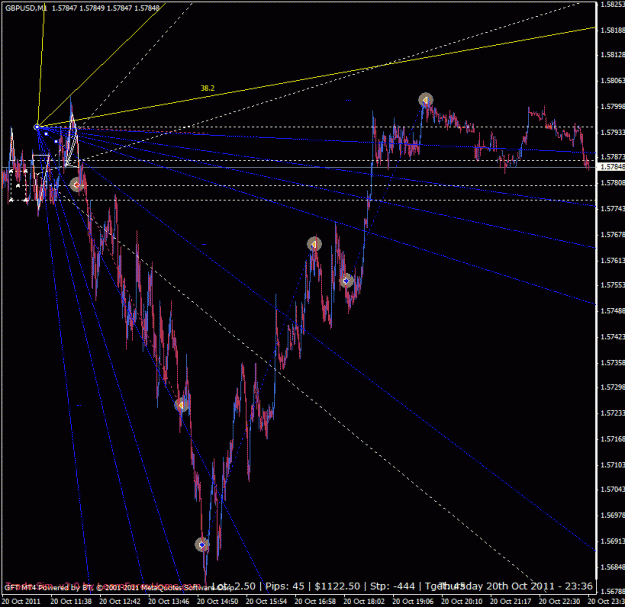
Attached Image

Most of the lines in this picture I just threw on there, to get a feel for the balance of the chart section.
The sense, after generating it with those rather random lines, is what I countered with the circle in the middle of nowhere and then drew fibs and perfects (the upper fan) for history I already knew was there. Well, I'm playing it safe right now with old data, kinda like paper trading rather than simulator trading.

results:

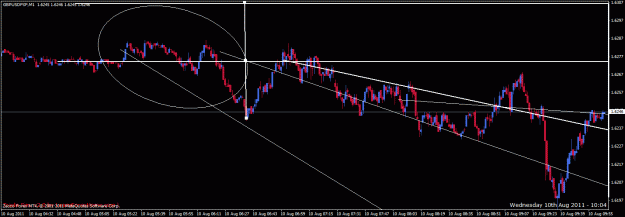
Attached Image (click to enlarge)
Click to Enlarge

Name: onto 2.gif
Size: 34 KB


This one is a relatively random spot on a simulator chart, and I'm posting what I think'll happen before I make the trade:

Attached Image (click to enlarge)
Click to Enlarge

Name: direction 1 1.gif
Size: 23 KB


Hmm interesting, I failed the trade. I had too much drawdown. Maybe mec + moi? That skew at the start, it's not just a D1... I take a relatively (5-10') long time to plan my fractal moi drawings of nature photos, the very few I've only done, and I only emotionally recoiled from the screen to trade it. Not good. Of course, to recoil so strongly means there was a very good moi in there, I just took it in rather than traded it at a personal distance. Maybe that's all it is, and mec would be taking it in personally and going along the price action as it does the moi's with shapes drawn in to show where it is. Testing.... Definitely moi, only how.
Maybe moi kicks in personal-area distance, and mec measures trade efficacy after this. Note: One can trade any emotion, if one takes into account in one's trade the emotion's place in mec and thus in-trade drawdown, direction of emphasis, and other mec-special interpretations of the chart's opportunity presented.
  • Post# 887
  • Quote
  • Dec 2, 2012 8:49pm
  • ha-pattern
    Joined Sep 2008 | 1,966 Posts | Status: hardcore chartist
Was able to include mec,moi,i/o ratio,AT and shapes in a simple (portion of my own ptm, it being optional to) model for trading;
need to practice it for a while, even with each in the list being reasonable specific for discret. Am finding fmd's and trading charts and regular people exchanges about interchangeable for this model.
  • Post# 888
  • Quote
  • Dec 4, 2012 10:13am | Edited at 10:24am
  • ha-pattern
    Joined Sep 2008 | 1,966 Posts | Status: hardcore chartist
ratio-moi patterns


chart patterns
-- each subcategory is approximately aligned with the other categories'

structure
_ grid->channel/stakc/rs->twisted
_>. fan,3,arc,echo
.>_ cycle ->angle->series
. ls2 5 cl pivot

details
PSL-F-M

results
Heatwave (heatwave,voluntary,shimmer)
Onto (onto,between)
Direction(1,2)
Undulate (roll,expand,path)

and you're just trading the results.
(This may result in a heavy emotional and social toll, in discretionary at least.)


-----
some credibility in using moving optical illusions in trading --

what I did on the moi's,
was study them 5-10 years ago for a long time (yes, I was trading then, too),
put them aside for a while;
photocopied the ones from here that I found worked best in black and white and as a still and, if possible, that was easy to hand-draw,
and reached initial organization and structure to considering them;
put them aside for a longer while;
and recently, did another structure, one based on drawing moi's in highly fractal nature photos
-- I've already drawn chart patterns in them a bunch of times and made virtual money off them --
before including the structure in with a concurrently reorganized list of chart patterns (my own and others', for all I could find over the many years (intensive 2004-on, esp. 2008-on (forex))).

Of course, I didn't note anything about moi's on charts. That's next. I figure, I trade because I see a drawn device on the chart 'move' as a moi (on a still chart, the usual on a paused (switched between pause and maximum speed) simulator chart) and interpret that as a reason to trade it.
I'll eventually post examples and hand-drawn attempts at replicating and chart uses, of moi's.

The 'details' is just ratios, either within, a bit within and also between, or between whole shapes.
I like P(erfect numbers, especially MT4's way of adjusting in the fibonacci fan 6,28,496),
S(quare, that is, for example of ls2, length from time 1 to time 2, for a time 3 that is squared of this length into the future)
L(ogr, or fibonacci numbers)
F(ractal)
M(idline, or the 50%)


------------------


interesting post -- String circle-actions in shared environs to project next circle-action on leverage grid (in my own ptm's language).

I've an update to post #1, only it's got five (of course) pieces, several of which are highly involved if logical enough to work. It's supposed to adjust each step in a trading process, with one of them an overview if any one step overlaps another. I'd rather scan it in, and I doubt many would want to do much of it, only several of the portions are immediately understandable enough to help others in their own trading ventures.

I organized my chart patterns (x over y) into:

(dot) ls2,5,cl,pivot..................... ...............chaos,onto,voluntary
(*) (fan,3) <=>(arc,echo)...................... ...(D1,D2)<=>(roll,path,expand)
(#) (cycle->angle->series)
................^
................||................. ...................(heatwave)<=>(sh immer,blink)
................\/
......(grid->channel/stack/rs->twisted)


I organized my money management (one over both), at least as pertains to the chart, into:


||stop(pre-)||---|entry|---mid-|trade:trade-is-opp-own-right-study---|exitrofit|---||stop(post-)|


Then of course there's my own simplified mec (x over xy) and my own ptm (personal thinking model) (y over x).

Finally, I considered formulating each of these four and also the entire body (which can be summarized with Anatomy Trains, in consideration to how a gut trace works through the body).
This (for the AT combo one, y over xy) is what I got:


axis.....product................... ................................... .......|........................... . + .................... =
___________________________________ ___________________________________ __________________________________
x..........pattern................. ................................... ........|............ . ...............................*... .........#
y.........ff response........................... .............................|..... ...... . .............................. ( ........... -
x>xy.....emotion................... ................................... ......|........ (),O,- ...(cycle,vector circle)...... *(w/emph x,y axes)
y>xy.....AT combo(deep | ,side > , curved ( types of AT's)...|....... <>|<> ..... (_<- , ->|) ................<-|-|-| ->
(one>)both...i/o ratio.............................. .......................|.........M. ...............PSL................. ..........F


This method should self-generate habit strings such as noted in the post, instead of depending on others' and a computer program to do so.
On the down side, it needs lots of experience in use and is, with so many variables, highly open to interpretation.
  • Post# 889
  • Quote
  • Dec 7, 2012 11:01am | Edited at 2:15pm
  • ha-pattern
    Joined Sep 2008 | 1,966 Posts | Status: hardcore chartist
okay, reducing p1 as having scaffolding --


I mixed up study with mm with some other ideas, to get thru a trade:
  1. chart patterns to study chart with, several of which devolve to/from others:

    (dot) ls2->5/cl->pivot............................. .......chaos->onto->voluntary->shimmer/shine
    (*) (fan,3) <=>(arc,echo)...................... ...(D1,D2)<=>((roll,path,expand)->expand color waves,rainbow,)
    (#) (cycle->angle->series)
    ................^
    ................||................. ...................(heatwave,scinti llate)<=>blink
    ................\/
    ......(grid->channel/stack/rs->twisted)
  2. TP/SL order: ||stop(pre-)||---|entry|---mid-|stop:trade-is-opp-own-right-study---|exitrofit|---||stop(post-)|
  3. reason right, trade diff't; r wrong,trade same; r right, t same; r wrong, t diff't
  4. i/o ratio -inclusive (to get emotions in chart, instead of with chart patterns), social - lines activated, regular-emotions-simplified cycle of market emotions
  5. x over y -- cognitive biases: Return to mean; Rarity; Polarization. One can track them thru chart patterns.

.


1 : privacy


another p1:

  1. devolved and/or opposing chart patterns:

    (dot) ls2->5/cl->pivot............................. .......chaos->onto->voluntary->shimmer/shine
    (*) (fan,3) <=>(arc,echo)...................... ...(D1,D2)<=>((roll,path,expand)->expand color waves,rainbow,)
    (#) (cycle->angle->series)
    ................^
    ................||................. ...................(heatwave,scinti llate)<=>blink
    ................\/
    ......(grid->channel/stack/rs->twisted)
  2. TP/SL order: ||stop(pre-)||---|entry|---mid-|stop:trade-is-opp-own-right-study---|exitrofit|---||stop(post-)|
  3. accuracy check: reason right, trade diff't; r wrong,trade same; r right, t same; r wrong, t diff't
  4. emotions and ratios: i/o ratio -inclusive (to get emotions in chart, instead of with chart patterns), social - lines activated, regular-emotions-simplified cycle of market emotions
  5. cognitive biases: Return to mean; Rarity; Polarization. One can track them thru the moi(moving optical illusion) type of chart patterns.


.


"as if it were stacking
in an ever-littler amount" -- perspective on a pyramid-type triangle, or head and shoulders, where a vertical area angle exhausts one direction on the chart.
  • Post# 890
  • Quote
  • Dec 10, 2012 12:38pm
  • ha-pattern
    Joined Sep 2008 | 1,966 Posts | Status: hardcore chartist
p1 dump:


  1. devolved and/or opposing chart patterns:

    (dot) ls2->5/cl->pivot............................. .......chaos->onto->voluntary->shimmer/shine
    (*) (fan,3) <=>(arc,echo)...................... ...(D1,D2)<=>((roll,path,expand)->expand color waves,rainbow,)
    (#) (cycle->angle->series)
    ................^
    ................||................. ...................(heatwave,scinti llate)<=>blink
    ................/
    ......(grid->channel/stack/rs->twisted)
  2. TP/SL order: ||stop(pre-)||---|entry|---mid-|stop:trade-is-opp-own-right-study---|exitrofit|---||stop(post-)|
  3. accuracy check: reason right, trade diff't; r wrong,trade same; r right, t same; r wrong, t diff't
  4. emotions and ratios: i/o ratio -inclusive (to get emotions in chart, instead of with chart patterns), social - lines activated, regular-emotions-simplified cycle of market emotions
  5. cognitive biases: Return to mean; Rarity; Polarization. One can track them thru the moi(moving optical illusion) type of chart patterns.


----------------


p1 new:


PICTURE (o) REPETITION (i/o) SENSE (i)

visual............ -- distance:closure,distance,tone
auditory......... -- order:level,sequential position,key,hold,volume
kinaesthetic.... -- motion:intra-type: mec (hi-aud),mfl(hi-kin),moi(hi-vis):
................................... ...........AREA
................................... ...........SAME
.........................personal area.........|................. chaos voluntary onto balance
.........................addiction. ..............|................. path expand roll r- D- rs
.........................1.-10. cycle.......BOTH....... fan(,backward) arc 3 frame-opp ls2 simplified one-level / social multi-level mec
................................... .........DIFFERENT
.........................series.... ...............|................. snowfall bit series area angle cl 5 pivot
.........................bound..... ..............|................. viral heatwave scintillate stack blink twisted


------------
  • Post# 891
  • Quote
  • Dec 12, 2012 11:07am | Edited Dec 13, 2012 10:27am
  • ha-pattern
    Joined Sep 2008 | 1,966 Posts | Status: hardcore chartist
p1 old:

PICTURE (o) REPETITION (i/o) SENSE (i)

visual............ -- distance:closure,distance,tone
auditory......... -- order:level,sequential position,key,hold,volume
kinaesthetic.... -- motion:intra-type: mec (hi-aud),mfl(hi-kin),moi(hi-vis):
................................... ...........AREA
................................... ...........SAME
.........................personal area.........|................. chaos voluntary onto balance
.........................series.... ...............|................. snowfall bit series area angle cl 5 pivot
.........................1.-10. cycle.......BOTH....... fan(,backward) arc 3 frame-opp ls2 simplified one-level/position / social(multi-level: one to another position) mec
................................... .........DIFFERENT
.........................addiction. ..............|................. path expand roll r- D- rs
.........................bound..... ..............|................. viral heatwave scintillate stack blink twisted


p1 adj:


ratio (where; what, is PSL - F - M)

.....chaos - balance,chaos,voluntary,onto
i..........cl - snowfall area angle bit series | perfect cl/5

i/e.....fan - frame-opp 3 | fan(,backward) 2mec arc select | ls2 1mec

e......viral - viral vs. scintillate; stack vs. heatwave; twisted vs. blink
.........line - rs D- roll path | r- | expand


--------------------------

p1 adj (fourth line):


ratio (where; what, is PSL - F - M)

.....chaos - balance,chaos,voluntary,onto
i..........cl - snowfall area angle bit series | perfect cl/5

i/e.....fan - frame-opp 3 | fan(,backward) 2mec arc select | ls2 1mec

e......viral - viral vs. scintillate; stack vs. twisted; blink vs. heatwave
.........line - rs D- roll path | r- | expand


-----


The thing about moi's, is that they're based on how they move, rather than, beyond the smaller scale, what they look like.
So I made some compromises along the way of categorizing them according to internal or external positioning for ratio (PSL-F-M) and alongside regular (including my own created) chart patterns.
I'm hoping to continue to use these categories, because of their extreme tensegrity with these other two features. But if I find lots of examples of each type of moi and the appearance of any one moi is significantly different from the original examples I found, then I may have a problem with the categorization. And then there's level of categorization, that is, individual type vs. one of the five general types.

Again, you will see lots of moving optical illusions if you google. I print them out in black and white, to avoid any residual effects from the monitor, colors, or a specific size of the moi. Then, I try and collect several versions of the same moi, to find the underlying reason the effect happens; and, I try and research the scientific reason for the effect, if available. Often, it's two or three scientific reasons happening at the same time, or one not even listed yet which is nevertheless obvious and reproducible. Finally, if others say there's an effect happening and I don't see it on a black and white, printed-out copy for either at least two sizes or very obviously, then I exclude it. I call these initial printed-out, black and white copies 'candidates' or some such name for being a moi.The good thing about this is I can find some really powerful ones, even ones that produce color on their own!


Moving optical illusions --
It's overdue I tell what I mean by each type of moi -- chaos,voluntary,onto; snowfall; path,expand,roll,r-,D-; heatwave,scintillate,blink . Mec's (1,2), for the fan types, I'll just link to an earlier post.
I use this list for any image, not just charts, so qualitative terms are described more quantitatively.

Okay,
each type of moi -- chaos,voluntary,onto; snowfall; path,expand,roll,r-,D-; heatwave,scintillate,blink . Mec's (1,2).


I forget why I didn't put in 'rotate' type of moi, may it's just not that common in nature is why. It'd be one of the 'line' types, to the right of 'path' since it's the most similar to 'expand' yet firmly belonging to 'path' and 'roll'.
  • Post# 892
  • Quote
  • Dec 13, 2012 12:00pm
  • ha-pattern
    Joined Sep 2008 | 1,966 Posts | Status: hardcore chartist
(continued from last post)


Other people who've explored the optical illusion - charts perspective: 1, 2 ...
  • Post# 893
  • Quote
  • Dec 14, 2012 4:21pm | Edited at 8:05pm
  • ha-pattern
    Joined Sep 2008 | 1,966 Posts | Status: hardcore chartist
found this: MT4 generates false ticks via algorithm... Hmmm...


Fiddled around with interpreting photo images,
and was able to include emotion, or at least my simplified and socialized version of the cycle of market emotions, with it,
through this:

mec -- direction
thru object(s) creates patterns
moi -- reference
of object(s) creates dir'n
chart patterns -- ratio
between o. cr. dir'n


p1 adj:


ratio (where ('e' external, 'i' internal); what, is PSL - F - M)

.....chaos - balance,chaos,voluntary,onto
i..........cl - snowfall area angle bit series | perfect cl/5

i/e.....fan - frame-opp 3 | fan(,backward) 2mec arc select | ls2 1mec

e......viral - viral vs. scintillate; stack vs. twisted; blink vs. heatwave
.........line - rs D- roll path | r- | expand


mec -- direction
thru object(s) creates patterns
moi -- reference
of object(s) creates dir'n
chart patterns -- ratio
between o. cr. dir'n

Mec is underlined and italicized, chart patterns are underlined, and moi's left plain.


again:


ratio (where ('e' external, 'i' internal); what, is PSL - F - M)

.....chaos - balance,chaos,voluntary,onto
i..........cl - snowfall area angle bit series | perfect cl/5

i/e.....fan - frame-opp 3 | fan(,backward) 2mec arc select | ls2 1mec

e......viral - viral vs. scintillate; stack vs. twisted; blink vs. heatwave
.........line - rs D- roll path | r- | expand

,where
mec -- direction
thru object(s) creates patterns
moi -- reference
of object(s) creates dir'n
chart patterns -- ratio
between o. cr. dir'n
; and,
mec is underlined and italicized, chart patterns are underlined, and moi's left plain.


again:


Measure of mec (1 and 2+), moi's and the regular chart patterns differs, though the measures are equivalent in terms of categorizing them.
Mec's are direction averaged through the given other shapes and their respective types,
moi's are reference of one object in terms of the major object relation to create direction(s),
and regular chart patterns are ratio (PSL-F-M) between objects creating direction(s).
Also, mec is underlined and italicized, chart patterns are underlined, and moi's left plain.
The various ways of separating the types of patterns serve to (de)emphasize and illuminate their differences.
There's a lot of reasons that each of the five major types of patterns exist, I was just trying to keep it simple by merely titling each major type with the most memorable type in its respective list.

chaos - balance,chaos,voluntary,onto
.....cl - snowfall area angle bit series | perfect cl/5

...fan - frame-opp 3 | fan(,backward) 2mec arc select | ls2 1mec

..viral - viral vs. scintillate; stack vs. twisted; blink vs. heatwave
...line - rs D- roll path | r- | expand


Yeah alright, first chart okay. Simple is good...

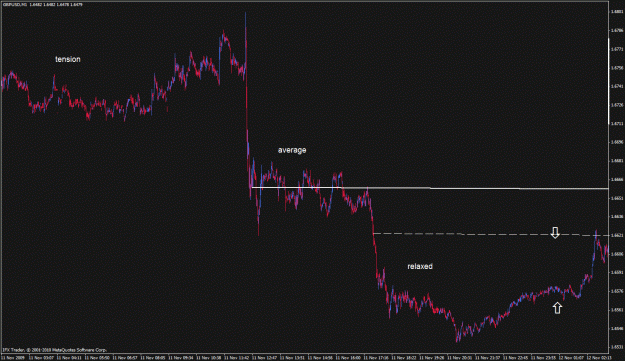
Attached Image (click to enlarge)
Click to Enlarge

Name: emotion, rs.gif
Size: 25 KB
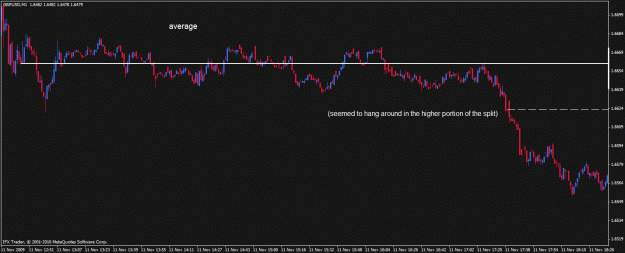
Attached Image (click to enlarge)
Click to Enlarge

Name: emotion, rs 2 detail.gif
Size: 18 KB


Often, the emotion applies to me!
Well, that's the whole purpose of this approach....
'relaxed', 'average' and 'tension' are terms for the distance between 'depression' and 'ecstacy', in a sense with social's levels only more rudimentary to the body. It resembles 2mec in terms of divisions, and 1mec in terms of long-term effect; so, any next pattern read would be derivative of this triple expression, for a little while at least, until some pivot or other distinguishable pattern shows a non- or extra-level direction.


Another:
I let emotion bleed into this, and surprised myself with the intermingling of levels and arcs --
Attached Image (click to enlarge)
Click to Enlarge

Name: emotion, rs 2 adfasf.gif
Size: 31 KB

I seem to often jump for the 'it's gonna go there NOW' (the triangle's lowest tip). Yeah, right. Gettin' feeble. That emotion relates directly to the first three emotions' set. Not studying it, or maybe I was living it and the 'surprise' feel followed.
I did surmise a 'balance' type of pattern to be where I exited the first trade, only I somewhat ignored this so I could freshly study the chart for a decent perspective. While I achieved the latter, I poorly blended it in with the more obvious 'balance'.


-------------
  • Post# 894
  • Quote
  • Dec 20, 2012 11:44am | Edited Dec 21, 2012 11:44am
  • ha-pattern
    Joined Sep 2008 | 1,966 Posts | Status: hardcore chartist
Trying chops (.) :
Attached Image (click to enlarge)
Click to Enlarge

Name: sdfgasdgfrf.gif
Size: 65 KB


Well, THAT'S dumb-looking. Had a limited time to figure how to use the draw program I was using at the time.
Anyhow, on to yet another try at a method....


.............all/one................................ ...versus.......................... ..........copy/anchor............................. ..series........................... ..substitute
(MEC.......grid;once............... .................opp emotions,grid vs. mec,.. ......em/grid->mec;em vs. same...........whole mec.......................diff't mec)
STILL......slant................... ..................combo,twisted,rs balance...........arc(s),3,(backwar d) fan................bit,perfect,L:M area angle..viral,stack
B&W.......D1,expand,voluntary,heatw ave...D2,rotate,frame-opp,onto...........roll,chaos...... .............................path.. ............................blink
COLOR...diff't-wavelength tone of area w/one bound...rainbow......................... ....centered fan...............................o il drops..........................scin tillate
  • Post# 895
  • Quote
  • Dec 21, 2012 11:48am | Edited at 12:50pm
  • ha-pattern
    Joined Sep 2008 | 1,966 Posts | Status: hardcore chartist
ran out of minutes to edit...


p1 dump:


Measure of mec (1 and 2+), moi's and the regular chart patterns differs, though the measures are equivalent in terms of categorizing them.
Mec's are direction averaged through the given other shapes and their respective types,
moi's are reference of one object in terms of the major object relation to create direction(s),
and regular chart patterns are ratio (PSL-F-M) between objects creating direction(s).
Also, mec is underlined and italicized, chart patterns are underlined, and moi's left plain.
The various ways of separating the types of patterns serve to (de)emphasize and illuminate their differences.
There's a lot of reasons that each of the five major types of patterns exist, I was just trying to keep it simple by merely titling each major type with the most memorable type in its respective list.

chaos - balance,chaos,voluntary,onto
.....cl - snowfall area angle bit series | perfect cl/5

...fan - frame-opp 3 | fan(,backward) 2mec arc select | ls2 1mec

..viral - viral vs. scintillate; stack vs. twisted; blink vs. heatwave
...line - rs D- roll path | r- | expand


p1 simply added caps to top line and adjusted the dots in-between:


.............ALL/ONE................................ .VERSUS............................ ......COPY/ANCHOR..........................SER IES...........................SUBST ITUTE
(MEC.......grid;once............... .................opp emotions,grid vs. mec,.. ......em/grid->mec;em vs. same........whole mec........................diff't mec)
STILL......slant................... ..................combo,twisted,rs balance...........arc(s),3,(backwar d) fan.............bit,perfect,L:M area angle...viral,stack
B&W.......D1,expand,voluntary, heatwave...D2,rotate,frame-opp,onto...........roll,chaos...... ..........................path.. .............................blink
COLOR..diff't-wavelength tone of area w/one bound....rainbow........................ .....centered fan.............................o il drops..........................scin tillate


This method does better combining moi's and regular chart patterns, and I threw in mec (for which one may substitute about anything) for the titles' breakdown of use.


Well, I guess I'd better try and use it.... ; )

Really, right now, I'm trying to get used to using moi's in a regular way. This should help in that endeavor.

Mec for trade, I guess. Fail usu, anyhow.


-------------
  • Post# 896
  • Quote
  • Dec 31, 2012 1:19pm | Edited at 1:37pm
  • ha-pattern
    Joined Sep 2008 | 1,966 Posts | Status: hardcore chartist
I've got a new demo simulator method I'm trying.
It blended the moi's and the chart patterns in with each other again, and then also includes body positions and emotions.
Obviously, I'm trying for a comprehensive discretionary trading method; it's still chart-only.
I separated the groups into dot, dot-line, line, and double-line.
Finally, I've had a book (search site for 'ecstatic postures') for a long time whose chapters do well to separate body positions that are meaningful enough to also connect with a full range of emotions if needed. The core chart-patterns method works well enough, what being based on support-resistance lines and the relative verticality of short micro-trends within each area, which was demonstrated in the truncated chart picture in the last post. I've tested the groups for the body positions and moi's and emotions added in, and they fit well in regular life -- Something I have to have for discretionary trading, with so much variance involved there.
The thing is, I'm really just getting into the body positions. In the few times I've tried them, they help me access old chart experience through chart-body memories connection, that I may not have otherwise recalled. The method groups have been solid to now, and I ran through a whole bunch of method groups before this on how to arrange the book's chapters, and really have no credentials (no anthropology degree, etc. ; ) ) to change those groupings the author provided, so I'm going to stick with them. I can, in time and good conscience, divide each body position into its regular physiological significances, and so move inter-position more effortlessly.
The whole point is to make money from trading, so an easy reference of the four symbols (each also a method group) starts off a chart study and then broadening my understanding of the chart area with one of the four areas per symbol (within each of which I also break down into the four same symbols) helps keep a clean, repeatable path for the trading plan to follow through on.
  • Post# 897
  • Quote
  • Jan 14, 2013 11:31am | Edited at 6:40pm
  • ha-pattern
    Joined Sep 2008 | 1,966 Posts | Status: hardcore chartist
Still working on chart method, and getting Ecstatic Postures further into it. Also included a book on psychological problems, one that spans seven or so different types of psychology. I've managed to use EP's in everyday life, to represent intra-/inter-environmental motions. I suppose my next step is to connect gut traces and EP's.

1: A valuable post.
  • Post# 898
  • Quote
  • Jan 18, 2013 5:33pm
  • ha-pattern
    Joined Sep 2008 | 1,966 Posts | Status: hardcore chartist
I still rewrite my method, and got something for the last few posts' ingredients.


To add Anatomy Trains for the body, the three variances (I think it was escape,opposite and another) for the mind, and the usual ratios (half,fib,fractal,square,perfect) for the chart,
this method, organized to time regularity, takes care of a hefty amount of discretionary-trading psychology (which can include emotions (w/mec),under 'deprivation' and another):

In each of the three levels: The body has neutrality exist/action, as listed. The mind has bias passive/aggressive, as listed.
CONTINUITY
Chart -- path,L:M area angle; combo,perfect,fit.
Body -- unfamiliarity/trip,metamorph. Mind -- (defective,fail;standard) - (depend;subjugation).
PULSE
Chart -- D1;arc,fan;b-fan,arcs;c-fan,shine. |_: D2;frame-opp,ls2,rainbow,stack,twist;rs balance;roll;heatwave.
Body -- perspective/divine,phase/initiate. Mind -- (deprive;entitle) - (vulnerable;mistrust and abuse)
END
Chart -- tone,chaos,oil drops;expand;viral. 1,2 sided balance;3,rotate,blink,scintillate.
Body -- celebrate/heal. Mind -- abandon;exclude.

I drew stick figures for each chapter in the body book, only referring to the book would be easier.


This method ties in the three -- my chart patterns and ratios, the psych book's stuff (with ratios), and the body book's stuff (with AT for ratios).
It may be comprehensive, only I haven't used it much, so this is just for the record.


dump (good for moi color expl'n):

.............ALL/ONE................................ .VERSUS............................ ......COPY/ANCHOR..........................SER IES...........................SUBST ITUTE
(MEC.......grid;once............... .................opp emotions,grid vs. mec,.. ......em/grid->mec;em vs. same........whole mec........................diff't mec)
STILL......slant................... ..................combo,twisted,rs balance...........arc(s),3,(backwar d) fan.............bit,perfect,L:M area angle...viral,stack
B&W.......D1,expand,voluntary, heatwave...D2,rotate,frame-opp,onto...........roll,chaos...... ..........................path.. .............................blink
COLOR..diff't-wavelength tone of area w/one bound....rainbow........................ .....centered fan.............................o il drops..........................scin tillate
  • Post# 899
  • Quote
  • Feb 21, 2013 10:53am
  • ha-pattern
    Joined Sep 2008 | 1,966 Posts | Status: hardcore chartist
Fumbling along still, making models -- One may work.

Trying a combined syndrome (last post or two, noted), mec (ditto) and Instinct Diet (its five-part theory only, to apply to gut intuition stuff), patching the first and third onto the second.
Made, with inner structure to move more easily between patterns, a five - pattern - trading-types list (23 patterns in all). Only, had to keep returning to mec, so trading with mec and studying chart with pattern list.
Needs alot of chart time, though. Good thing, the I.D. has patterns, too, to position. So I may just drop the 23 patterns model and go on with mec only, given its wider applicability.
  • Post# 900
  • Quote
  • Mar 4, 2013 10:16am | Edited at 2:06pm
  • ha-pattern
    Joined Sep 2008 | 1,966 Posts | Status: hardcore chartist
developed a quick (1-5') personal-condition drawing (one-EP fmd) and concepts connection (several on back of card, connected (at least) to each other through the drawing in front of the card), as a kind of card game
to help further connect ideas and guide my own actions,

after finishing a new (ranging mec already have: group w/syndromes,the already-made (social- ) level, and production utility (Instinct Diet)) mec
with a chart patterns and body-chart percentiles micro-model.


-------------


Read something interesting that may substitute for the extra computer power needed for aligning red-flag news, one-point (multi-symbol) correlation, and the chart pattern typical of most or all of the symbols (and thus selecting the largest-probable-range for that pattern):
"levels of agreement,averaged levels,cross referencing time perspectives and there convergences to one point" -- 1
Thread Tools Search this Thread
Show Printable Version Show Printable Version
Email This Thread Email This Thread
Search this Thread:

Advanced Search

  • Trading Journals
  • /
  • Pattern's Chemo-Electric Trading Journal
  • Reply to Thread
    • 1 41424344Page 45 46
0 traders viewing now
  • More

©2013 Forex Factory, Inc. / Terms of Use / Privacy Policy

Forex Factory® is a registered trademark.

Connect

  • Facebook
  • Twitter
  • RSS

Company

  • About FF
  • FF Blog
  • Careers at FF
  • Advertising
  • Contact FF

Products

  • Forums
  • Trades
  • Calendar
  • News
  • Market
  • Brokers
  • Trade Explorer

Website

  • Homepage
  • Search
  • User Guide
  • Member List
  • Online Now
  • Report a Bug